

Charles-Henry Monchau

Chief Investment Officer

Introduction

Smart glasses are one of the few technologies the market has already embraced as the most likely successor to the smartphone. Meta, Apple, Samsung, Google and OpenAI are all investing, with product prices ranging from $200 to $500. Yet that consensus overlooks a contradiction with real investment implications. Smart glasses break the usual pattern. The always-on camera is both the key feature and the biggest weakness. In past technology cycles, companies competed by adding more capabilities. This time, the strongest competitive advantage may come from removing one. Apple is reportedly considering launching its N50 smart glasses without a camera, or with one that cannot capture photos or videos, reflecting the growing importance of privacy as a product differentiator.

Online platforms already show how unevenly these risks are treated. A video containing copyrighted music can be removed automatically within seconds, yet footage recorded discreetly with smart glasses may remain online long enough to reach millions of viewers. In one case, a secretly filmed encounter attracted more than 23 million views before any action was taken. This exposes a major enforcement gap: platforms respond quickly to copyright violations but far more slowly to privacy breaches. The market may still underestimate this risk but growing regulatory and public scrutiny is likely to make it increasingly costly for smart-glasses manufacturers and digital platforms.


Four companies, four different definitions of the product itself

The absence of an agreed product definition itself is revealing. The product’s final form is still unsettled, and the four leading strategies disagree on whether the winning device needs a camera, a display, both, or neither.

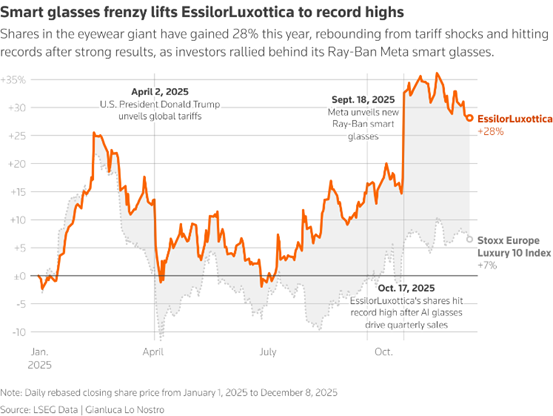
Meta is pursuing the most aggressive monetisation strategy. Its $300 dual-camera glasses serve as a testing ground for recurring revenue. Meta initially planned to limit Conversation Focus, a feature that amplifies the voice of the person in front of the wearer to make conversations easier to hear in noisy environments, to three free hours per month. Users would then pay $19.99 a month for up to 15 hours of use. The company suspended the plan after users questioned why an entirely on-device feature, which creates no additional cloud-computing cost, should require a subscription. Simultaneously, Meta is expanding into lower-priced products through its partnership with Ray-Ban’s parent company and increasingly positioning the glasses as part of its broader AI and cloud strategy. Mark Zuckerberg has gone further, arguing that people who do not use AI glasses could eventually face a “cognitive disadvantage.”
Source: Reuters

Samsung is following the model already established by Meta. Its glasses, developed with Google, Gentle Monster and Warby Parker, are expected to launch in autumn 2026. They will use Google’s Gemini assistant to answer questions about what the wearer sees, provide directions, translate text, send messages and capture photos or videos.

Apple is taking the most privacy-conscious approach. The company reportedly plans to unveil its N50 smart glasses in June 2027, with a commercial launch expected later that year. The glasses would rely heavily on Siri for voice commands but would initially have no display inside the lenses. Apple is also considering removing the camera entirely or limiting it to visual analysis by AI without allowing users to record photos or videos. This design could protect Apple’s reputation for privacy, but it would remove one of the features that helped Meta’s Ray-Ban glasses gain traction: the ability to capture first-person photos and videos. Apple’s previous issues with AirTags highlights the risks. After the trackers were misused to follow people without their consent, the company introduced additional warnings and anti-stalking protections. That experience helps explain why Apple may be particularly cautious about placing an easily concealed camera on users’ faces.

OpenAI is taking the most AI-focused approach. Working with Jony Ive, it is building two products: a voice speaker with a camera but no screen, priced at USD 200 to 300 and expected in early 2027, and a smartphone built around AI agents rather than traditional apps. The phone will run on a MediaTek Dimensity 9600 chip made by TSMC, with mass production expected in the first half of 2027. Supply-chain analyst Ming-Chi Kuo says the phone is designed to prioritise agents over apps, which would let OpenAI skip past the current smartphone interface entirely instead of competing within it.


The value chain: where exposure is less binary than the brand war

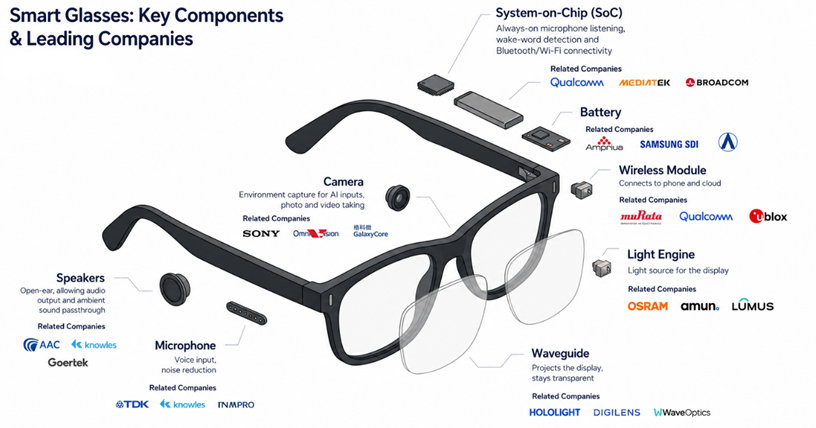
Whether the next major AI device is a pair of glasses, a pendant, a speaker or a smartphone, each product will require energy-efficient processors capable of running AI models and interpreting data from cameras, microphones and other sensors.

Qualcomm has launched the Snapdragon Wear Elite, a processor built specifically for discreet, body-worn AI devices. CEO Cristiano Amon said that "some of the largest companies in the world" are developing AI pendants, pins and jewellery, showing that demand for this technology exists independent of any single device maker.

OpenAI's phone uses a customised MediaTek Dimensity 9600 chip, made by TSMC, with two dedicated AI processors, one for the camera and one for language processing. This points to rising demand for custom chips and the foundries that manufacture them.
Source: Treeview

Batteries remain one of the main physical and regulatory bottlenecks. Cameras, AI processing and displays consume considerable power, yet the glasses must remain light enough to wear throughout the day. Manufacturers therefore need to improve battery life without making the frames heavier, thicker or less comfortable. The regulatory threat has recently eased. The EU Batteries Regulation was expected to require user-replaceable batteries in most portable devices from February 2027, but on 14 July 2026 the European Commission adopted an exemption for wearables. Batteries in smart glasses would still need to be replaceable by independent repairers, but not necessarily by users. The measure remains subject to scrutiny by Parliament and the Council.

Meta’s Ray-Ban Display planned launch in the UK, France, Italy, and Canada was initially delayed because of strong US demand and limited supply, European battery and AI rules were later cited as additional obstacles. The new exemption should ease battery-related pressure, although privacy, data protection and AI compliance remain unresolved. The in-lens display remains the largest unresolved product decision. It places directions, messages or captions directly in the wearer’s field of vision. Apple’s first model is reportedly being developed without one, while Meta’s Ray-Ban Display includes a private screen in one lens. A display improves functionality but also increases power consumption, weight, heat, cost and manufacturing complexity. Meta’s display-equipped model has also faced international launch delays. Displays therefore offer more utility but concentrate more of the technical and execution risk.

Taken together, this points to a barbell-shaped opportunity. Custom silicon, battery and energy systems, frames, and distribution all carry lower risk than betting on which device maker wins. Several of these areas are also directly shaped by regulation, which makes them a more reliable way to gain exposure to this trend than picking a single winner among the device makers.


The constraint: trust and consent

The factor most investment models underweight is social and regulatory acceptance. This is what will determine the timing of launches and the real size of the addressable market, and it favours specific designs discussed in the first section.

The central issue is consent. A smartphone held up to record is usually visible, while smart glasses resemble ordinary eyewear and capture exactly what the wearer sees. France’s data protection authority found that 67% of surveyed adults considered them a privacy risk and warned that recording lights may be too discreet.

Misuse is already creating reputational problems. Smart glasses have been used to film strangers without their knowledge and post the footage online. One covert recording attracted more than 23 million views before action was taken. Instagram has since pledged to remove exploitative or harassing content, while Meta deactivated two accounts with more than one million followers each. The response, however, came only after the videos had spread widely.

Meta’s glasses use a flashing white LED to indicate recording and disable the camera if the light is covered. Yet guides and services offering ways to conceal the indicator have emerged, while many bystanders do not recognise what it means. Meta is therefore promoting frictionless recording while restricting some of the content it produces.

Formal restrictions are also expanding. New York has banned recording-enabled glasses from state courts, while Royal Caribbean restricts their use in casinos, restrooms, medical facilities, and children’s areas. France’s CNIL has called for greater vigilance, and Meta faces a US class action over third-party access to footage captured through certain AI features.

The most serious risk is operational security. In July, US Central Command warned that footage posted by service members could help Iran assess the effectiveness of its strikes. A video recorded with Meta glasses during an attack on the Muwaffaq Salti Air Base in Jordan showed evacuation procedures and potentially revealed information about the strike’s impact.

The debate therefore extends beyond consumer privacy. Smart glasses can create legal, reputational and security liabilities for employers, schools, hospitals, courts, venues and military organisations. Institutional restrictions could limit adoption even if consumer interest remains strong.

Consent is the main variable to watch. Stronger backlash and tighter regulations would favour camera-free or camera-limited designs, including Apple’s reported approach of enabling visual AI analysis without photo or video recording. They would also pressure companies whose business models depend on first-person content creation.


Conclusion

The market may be right about smart glasses’ long-term potential, but too optimistic about how quickly adoption will scale. Better processors, batteries and displays will improve the product, but technical progress alone will not create a mass market. Consumers, regulators and institutions must also accept devices that can continuously record and interpret their surroundings. The next eighteen months should make the industry’s direction clearer. Samsung and Google are preparing their first commercial products, Apple is expected to present its privacy-focused approach in June 2027, and Meta must show that growth can continue without triggering broader restrictions. The winner may not be the company offering the most features, but the one whose product the public feel comfortable wearing and being around.


Disclaimer

This marketing document has been issued by Bank Syz Ltd. It is not intended for distribution to, publication, provision or use by individuals or legal entities that are citizens of or reside in a state, country or jurisdiction in which applicable laws and regulations prohibit its distribution, publication, provision or use. It is not directed to any person or entity to whom it would be illegal to send such marketing material. This document is intended for informational purposes only and should not be construed as an offer, solicitation or recommendation for the subscription, purchase, sale or safekeeping of any security or financial instrument or for the engagement in any other transaction, as the provision of any investment advice or service, or as a contractual document. Nothing in this document constitutes an investment, legal, tax or accounting advice or a representation that any investment or strategy is suitable or appropriate for an investor's particular and individual circumstances, nor does it constitute a personalized investment advice for any investor. This document reflects the information, opinions and comments of Bank Syz Ltd. as of the date of its publication, which are subject to change without notice. The opinions and comments of the authors in this document reflect their current views and may not coincide with those of other Syz Group entities or third parties, which may have reached different conclusions. The market valuations, terms and calculations contained herein are estimates only. The information provided comes from sources deemed reliable, but Bank Syz Ltd. does not guarantee its completeness, accuracy, reliability and actuality. Past performance gives no indication of nor guarantees current or future results. Bank Syz Ltd. accepts no liability for any loss arising from the use of this document.

Read More

Straight from the Desk

Syz the moment

Live feeds, charts, breaking stories, all day long.

Thinking out loud

Sign up for our weekly email highlighting the most popular posts.

Follow us

Thinking out loud

Investing with intelligence

Our latest research, commentary and market outlooks