

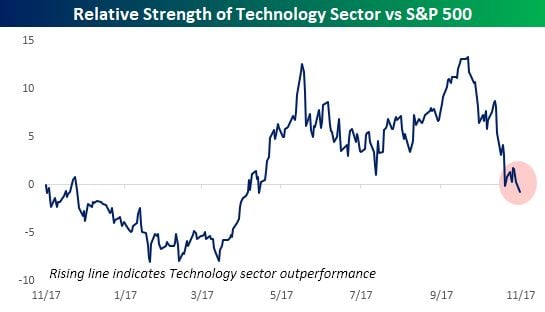
Here's a headline you would have thought was impossible six weeks ago. Technology has underperformed the S&P 500 over the last year.
Disclaimer
This marketing document has been issued by Bank Syz Ltd. It is not intended for distribution to, publication, provision or use by individuals or legal entities that are citizens of or reside in a state, country or jurisdiction in which applicable laws and regulations prohibit its distribution, publication, provision or use. It is not directed to any person or entity to whom it would be illegal to send such marketing material. This document is intended for informational purposes only and should not be construed as an offer, solicitation or recommendation for the subscription, purchase, sale or safekeeping of any security or financial instrument or for the engagement in any other transaction, as the provision of any investment advice or service, or as a contractual document. Nothing in this document constitutes an investment, legal, tax or accounting advice or a representation that any investment or strategy is suitable or appropriate for an investor's particular and individual circumstances, nor does it constitute a personalized investment advice for any investor. This document reflects the information, opinions and comments of Bank Syz Ltd. as of the date of its publication, which are subject to change without notice. The opinions and comments of the authors in this document reflect their current views and may not coincide with those of other Syz Group entities or third parties, which may have reached different conclusions. The market valuations, terms and calculations contained herein are estimates only. The information provided comes from sources deemed reliable, but Bank Syz Ltd. does not guarantee its completeness, accuracy, reliability and actuality. Past performance gives no indication of nor guarantees current or future results. Bank Syz Ltd. accepts no liability for any loss arising from the use of this document.
Related Articles
Semiconductors have underperformed the S&P 500 by more than 30 percentage points since June, the sharpest relative drawdown since 2002. Goldman's AI semiconductor basket now trades at just 11x 2028 earnings versus nearly 16x for the S&P 500, despite consensus forecasting 31% earnings growth in 2028. At the broader market's multiple, current prices would imply earnings declining approximately 6%. Either earnings estimates are about to collapse, or the market has become excessively pessimistic about AI. Source: TME
Alibaba: +38.1% SpaceX: +19.2% Uber: -7.6% Anthropic: ? Source: Rand Group
“Max Overweight” on global equities. The call rests on a simple thesis. The AI spending cycle still has room to run, and the earnings benefits could spread beyond the hyperscalers in 2027. Here’s what Morgan Stanley is telling clients: • Hold less cash and trim exposure to bonds and commodities. • Move European and Japanese equities to overweight. • Expect global earnings to grow 13% in 2027 and 8% in 2028. Valuations are part of the case. The MSCI ACWI trades at roughly 15× forward earnings, its cheapest level since 2023, according to the note. The call follows what Morgan Stanley described as a brutal hedge fund deleveraging since October. Retail investors stayed relatively calm while leveraged funds drove sharp daily swings. Two things could derail the call. Sticky inflation could force the Fed to hike more than the two additional increases Morgan Stanley expects. And the AI spending cycle could end sooner than projected. The last time I could find Morgan Stanley using similar language was June 2012, when it went “maximum overweight” on emerging-market equities. Fourteen years later, the call is global. The question for 2027 is how much of the AI spending boom shows up in earnings beyond the hyperscalers. Source: Serenity @aleabitoreddit