

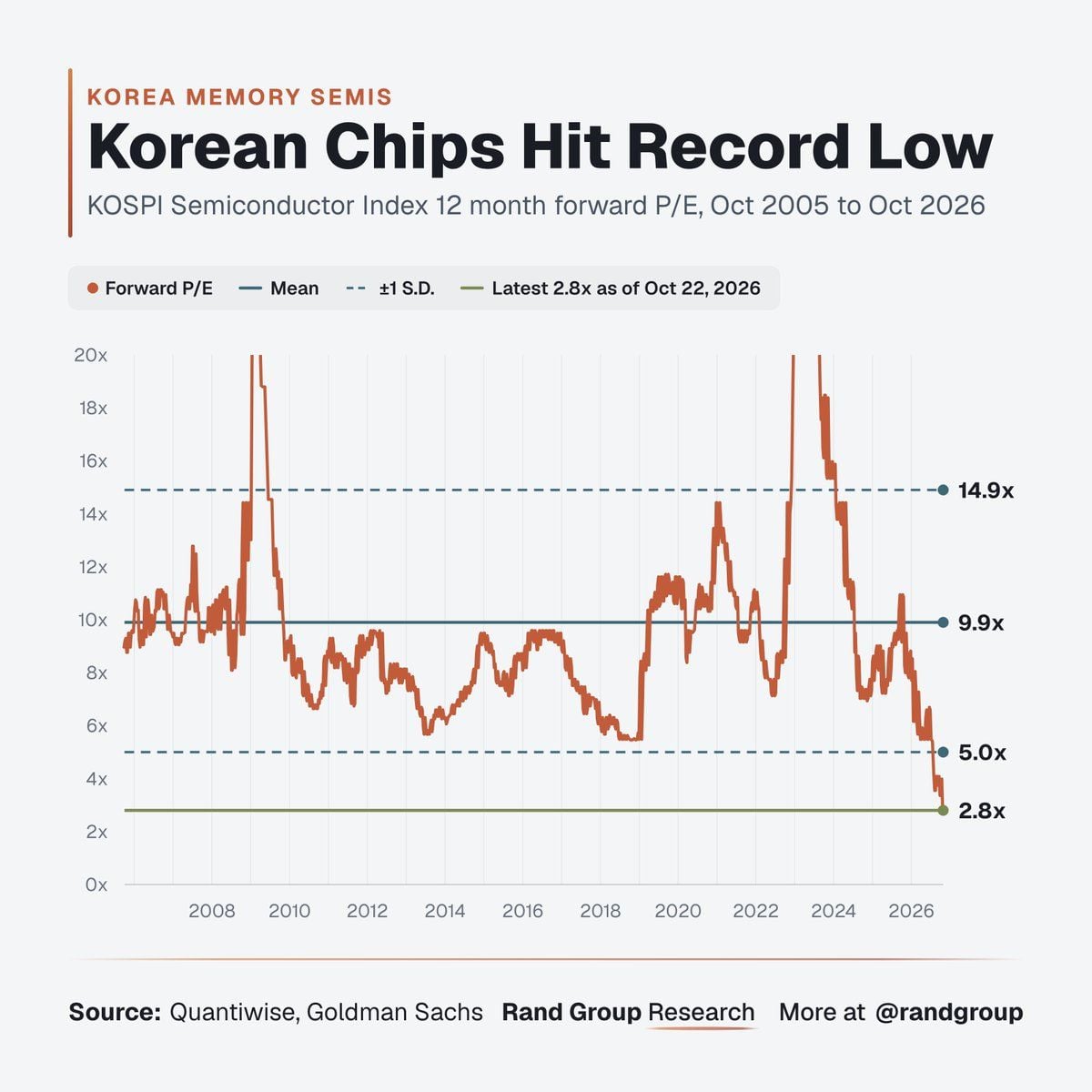
Korean chips at 2.8x forward earnings which is the lowest in 20 years.
Disclaimer
This marketing document has been issued by Bank Syz Ltd. It is not intended for distribution to, publication, provision or use by individuals or legal entities that are citizens of or reside in a state, country or jurisdiction in which applicable laws and regulations prohibit its distribution, publication, provision or use. It is not directed to any person or entity to whom it would be illegal to send such marketing material. This document is intended for informational purposes only and should not be construed as an offer, solicitation or recommendation for the subscription, purchase, sale or safekeeping of any security or financial instrument or for the engagement in any other transaction, as the provision of any investment advice or service, or as a contractual document. Nothing in this document constitutes an investment, legal, tax or accounting advice or a representation that any investment or strategy is suitable or appropriate for an investor's particular and individual circumstances, nor does it constitute a personalized investment advice for any investor. This document reflects the information, opinions and comments of Bank Syz Ltd. as of the date of its publication, which are subject to change without notice. The opinions and comments of the authors in this document reflect their current views and may not coincide with those of other Syz Group entities or third parties, which may have reached different conclusions. The market valuations, terms and calculations contained herein are estimates only. The information provided comes from sources deemed reliable, but Bank Syz Ltd. does not guarantee its completeness, accuracy, reliability and actuality. Past performance gives no indication of nor guarantees current or future results. Bank Syz Ltd. accepts no liability for any loss arising from the use of this document.
Related Articles
The stock jumped nearly 8% after-hours The number we are watching: its $1 billion quarterly interest bill. The Q3 numbers show how fast demand for AI compute is growing: ▪️ Revenue hit $3.66B, up 168% YoY ▪️ Adjusted EBITDA reached $2.26B, up 169% ▪️ Revenue backlog surpassed $132B ▪️ Annualized revenue run-rate outlook rose to $20B–$21B Now look at what it costs to build the capacity to serve that demand. CoreWeave expects $35B–$39B in 2026 capex. It also expects $1.05B–$1.15B in interest expense in Q4 alone. That’s more than $4B annualized at the Q4 pace. And even with revenue more than doubling, CoreWeave posted a $529M adjusted net loss in Q3. There is still significant long-term potential. Customers are committing billions, and the backlog gives CoreWeave a substantial pipeline of future revenue. How much cash that revenue generates will depend on what it costs to build and finance the infrastructure behind it. How much of that $132B backlog will translate into free cash flow after capex and interest? That’s the number we want to see. Source: CNBC, Merlin Capital
That’s a nearly $23 billion swing. The figure I’m watching is the $10 billion SoftBank has borrowed against its OpenAI stake. First, a look at the quarter. ▪️ SoftBank recorded a $3.7 billion loss tied to changes in equipment plans for US AI data centers. ▪️ Its Vision Fund posted an ¥81.6 billion quarterly loss. ▪️ Financing costs more than doubled to $2.9 billion. ▪️ SoftBank shares are down more than 50% from their June peak. SoftBank signals it may slow its AI spending after a $7 billion loss (bearish for semis?). “It is only natural that there is some discussion now about waiting and seeing how things play out for a little while,” CFO Yoshimitsu Goto said. SoftBank also denied Elon Musk’s claim that it was defaulting on turbine orders. The broader financial question is how much room SoftBank has if the value of its collateral falls. SoftBank invested $64.6 billion in OpenAI for a roughly 13% stake, valued at nearly $100 billion at the end of September. Alongside the $10 billion borrowed against that stake, SoftBank has around $25 billion in loans backed by Arm shares. If OpenAI’s valuation falls materially, SoftBank could have to post more collateral or repay some debt, depending on the loan terms. If Arm and other tech holdings fall at the same time, raising cash could get more expensive and asset sales could add pressure to tech stocks. How much flexibility would SoftBank have if its biggest tech holdings fell together? Source. The Macro Paper