

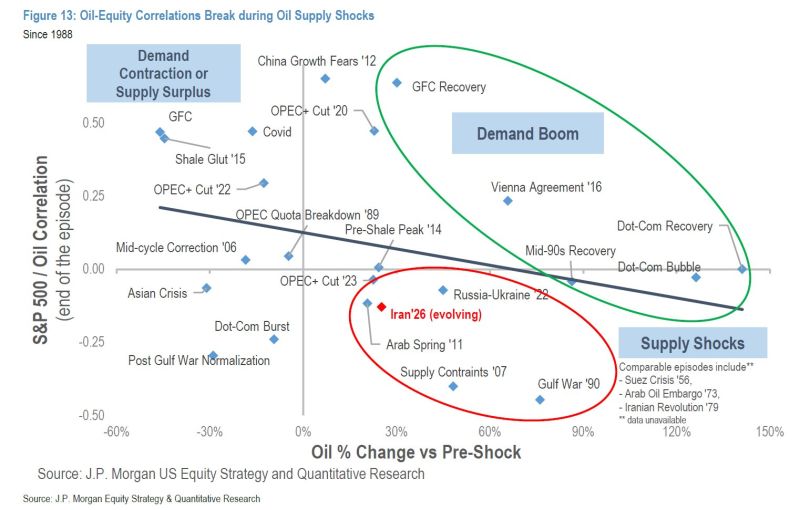
Oil-equity correlations break during oil supply shocks
Disclaimer
This marketing document has been issued by Bank Syz Ltd. It is not intended for distribution to, publication, provision or use by individuals or legal entities that are citizens of or reside in a state, country or jurisdiction in which applicable laws and regulations prohibit its distribution, publication, provision or use. It is not directed to any person or entity to whom it would be illegal to send such marketing material. This document is intended for informational purposes only and should not be construed as an offer, solicitation or recommendation for the subscription, purchase, sale or safekeeping of any security or financial instrument or for the engagement in any other transaction, as the provision of any investment advice or service, or as a contractual document. Nothing in this document constitutes an investment, legal, tax or accounting advice or a representation that any investment or strategy is suitable or appropriate for an investor's particular and individual circumstances, nor does it constitute a personalized investment advice for any investor. This document reflects the information, opinions and comments of Bank Syz Ltd. as of the date of its publication, which are subject to change without notice. The opinions and comments of the authors in this document reflect their current views and may not coincide with those of other Syz Group entities or third parties, which may have reached different conclusions. The market valuations, terms and calculations contained herein are estimates only. The information provided comes from sources deemed reliable, but Bank Syz Ltd. does not guarantee its completeness, accuracy, reliability and actuality. Past performance gives no indication of nor guarantees current or future results. Bank Syz Ltd. accepts no liability for any loss arising from the use of this document.
Related Articles
McCullen: "We are expecting the next blackout window to begin this week ~3/18, estimating ~45% of the S&P 500 to be in blackout by that point, assuming entry 6 weeks prior to earnings ... We expect blackout to run through the end of April." Source: TME
Asia: Paying very high prices (~$150+/barrel) US/West: Paying much lower prices (~$95–$105/barrel) T This as an unprecedented “broken” market driven by geopolitics, not normal supply/demand. ⚠️ Main Reasons Strait of Hormuz disruption: A major shipping route (≈20% of global oil supply) is allegedly blocked or restricted. Geopolitical tensions (Iran): Seen as the key player controlling whether supply resumes. Emergency reserves released: Large releases from global and US reserves are being used to stabilize prices. US reserves are described as historically low. 📊 Key Effects 1. Two-tier pricing system Countries with domestic oil (like the US) are better protected. Import-dependent Asian economies pay much more. 2. Economic strain in Asia High oil prices → rising costs → factories slowing or shutting down. Early signs of “demand destruction” (reduced consumption due to high prices). 3. Shrinking safety buffers Strategic oil reserves may only last weeks at current usage rates. Limited ability to replenish during conflict. 4. Rising US fuel prices Gas prices expected to increase significantly if oil rises further. 5. Inflation risk Higher energy costs could: Push inflation back up Force central banks to delay or reverse rate cuts 6. Iran’s leverage Iran is portrayed as holding decisive control over supply routes. Ongoing conflict reduces chances of quick resolution. Source: zerohedge
There is meaningful dispersion across constituents beneath the surface, reflecting a market that is quickly separating durable growers from more challenged business models. Source: Rick Rieder