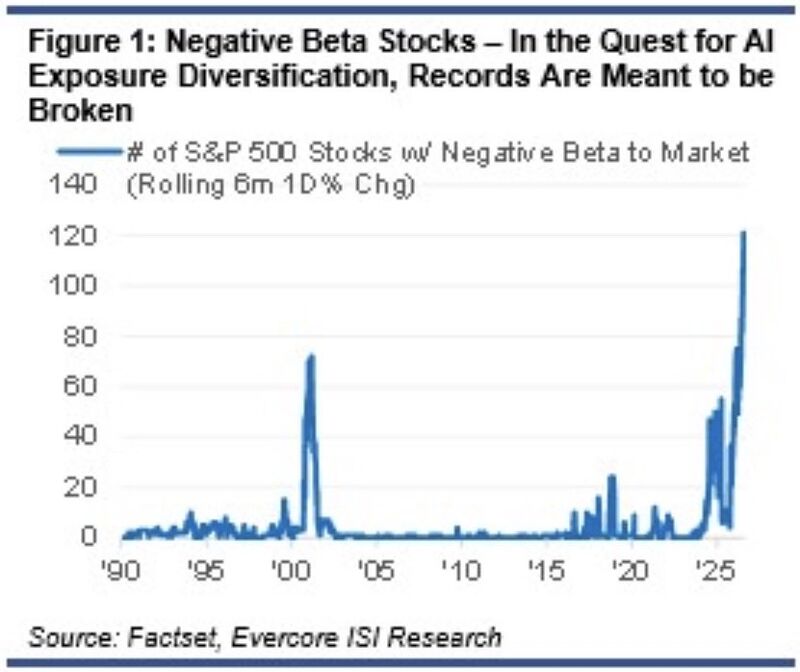
The number of S&P500 stocks that now have negative beta to the market is at the highest level since 2000 / 2001
Disclaimer
This marketing document has been issued by Bank Syz Ltd. It is not intended for distribution to, publication, provision or use by individuals or legal entities that are citizens of or reside in a state, country or jurisdiction in which applicable laws and regulations prohibit its distribution, publication, provision or use. It is not directed to any person or entity to whom it would be illegal to send such marketing material. This document is intended for informational purposes only and should not be construed as an offer, solicitation or recommendation for the subscription, purchase, sale or safekeeping of any security or financial instrument or for the engagement in any other transaction, as the provision of any investment advice or service, or as a contractual document. Nothing in this document constitutes an investment, legal, tax or accounting advice or a representation that any investment or strategy is suitable or appropriate for an investor's particular and individual circumstances, nor does it constitute a personalized investment advice for any investor. This document reflects the information, opinions and comments of Bank Syz Ltd. as of the date of its publication, which are subject to change without notice. The opinions and comments of the authors in this document reflect their current views and may not coincide with those of other Syz Group entities or third parties, which may have reached different conclusions. The market valuations, terms and calculations contained herein are estimates only. The information provided comes from sources deemed reliable, but Bank Syz Ltd. does not guarantee its completeness, accuracy, reliability and actuality. Past performance gives no indication of nor guarantees current or future results. Bank Syz Ltd. accepts no liability for any loss arising from the use of this document.

Related Articles
Over $650 BILLION has been wiped out from Asian stocks as semiconductor and tech stocks sell off across Asian markets. 🇰🇷 South Korea's KOSPI -5.5%, wiping out ₩279.7T ($186B). 🇯🇵 Japan's NIKKEI -3.1%, wiping out ¥36.7T ($232B). 🇨🇳 China's SSE -2%, wiping out ¥1.29T ($180B). 🇹🇼 Taiwan's stock market -1.5%, wiping out NT$1.80T ($55B). Source: Bull Theory
The US diesel crack spread — the margin between crude oil and diesel — just hit a record $102/barrel, setting new highs in five of the last six sessions. Why it matters: ⛽ US diesel inventories are at their lowest seasonal level since 1996. 🏭 Global refinery output is down ~5 million barrels/day YoY amid disruptions linked to Iran and Ukraine. 🇷🇺 Russia has restricted diesel exports through January. 🚜 And Northern Hemisphere harvest season is starting — exactly when diesel demand from agriculture rises. Most investors watch crude oil. But diesel is arguably more important for the real economy. Trucks, tractors, ships and heavy machinery depend on it. One study estimates diesel prices explain 46% of trucking costs. Higher diesel → higher freight costs → higher food and goods prices. And with producer prices already rising faster than consumer prices, some of those costs could still be waiting to reach consumers. Oil may drive the headlines. Diesel could be the one driving inflation higher. Source: Hedgie
Many investors might still underestimate the sheer scale of debt issuance coming from Big Tech. At the current pace, hyperscalers could become as significant in the investment-grade bond market as the largest global banks within just a few years. The AI infrastructure boom isn’t just reshaping technology. It’s reshaping credit markets too. Source: BofA, Tracy Alloway