

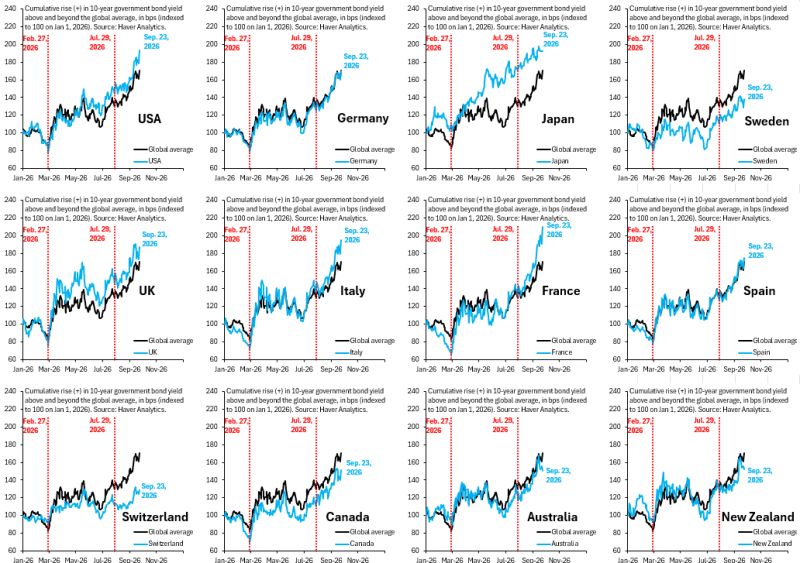
Yesterday was the worst day in global bond markets in quite some time.
Disclaimer
This marketing document has been issued by Bank Syz Ltd. It is not intended for distribution to, publication, provision or use by individuals or legal entities that are citizens of or reside in a state, country or jurisdiction in which applicable laws and regulations prohibit its distribution, publication, provision or use. It is not directed to any person or entity to whom it would be illegal to send such marketing material. This document is intended for informational purposes only and should not be construed as an offer, solicitation or recommendation for the subscription, purchase, sale or safekeeping of any security or financial instrument or for the engagement in any other transaction, as the provision of any investment advice or service, or as a contractual document. Nothing in this document constitutes an investment, legal, tax or accounting advice or a representation that any investment or strategy is suitable or appropriate for an investor's particular and individual circumstances, nor does it constitute a personalized investment advice for any investor. This document reflects the information, opinions and comments of Bank Syz Ltd. as of the date of its publication, which are subject to change without notice. The opinions and comments of the authors in this document reflect their current views and may not coincide with those of other Syz Group entities or third parties, which may have reached different conclusions. The market valuations, terms and calculations contained herein are estimates only. The information provided comes from sources deemed reliable, but Bank Syz Ltd. does not guarantee its completeness, accuracy, reliability and actuality. Past performance gives no indication of nor guarantees current or future results. Bank Syz Ltd. accepts no liability for any loss arising from the use of this document.
Related Articles
This puts the UK at the greatest risk of potential contagion & losses if France were to default on their debt or require an IMF & European Central bank loan. When Greece experienced this in 2011 European Banking Crisis, youth unemployment skyrocketed to 60% by 2013. Source: Financelot
Those bonds were issued in June at 9.625%. That’s an increase of nearly 5 percentage points in four months in the yield investors demand to hold its unsecured debt. The figures behind the move: ▪️ More than $35 billion raised this year. ▪️ Around $52 billion in debt and lease obligations. ▪️ $640 million in net interest expense last quarter—roughly a quarter of revenue. ▪️ A $104 billion backlog, with revenue dependent on infrastructure delivery and customer payments. Venture capitalist Chamath Palihapitiya shared the yield chart, warning of a potential private credit bubble linked to AI. According to figures he cited, private lenders charge AI borrowers spreads of 6.2 percentage points, compared with 6.1 points for other borrowers. CoreWeave’s backlog has grown. So has the yield on its debt. Source: Hedgie
September delivered another enormous trade surplus: $133.5 billion, with exports surging 36.3% year-on-year. Expecting Beijing to abandon export-led growth anytime soon looks wishful. China’s economy is increasingly K-shaped: • The upper arm: exporters and advanced manufacturers benefit from global demand for chips, AI infrastructure and green technology. • The lower arm: households face property-related wealth losses, a soft job market and pressure to repay debt. Consumption remains weak as families protect their finances. Factories can thrive even while consumers feel poorer. That leaves Beijing heavily dependent on overseas demand to compensate for weakness at home—and makes a rapid pivot away from exports unlikely. Until Chinese households regain the confidence to spend, the world will keep absorbing the output of China’s factories. Source: Robin Brooks