


.png)
What happened last week?
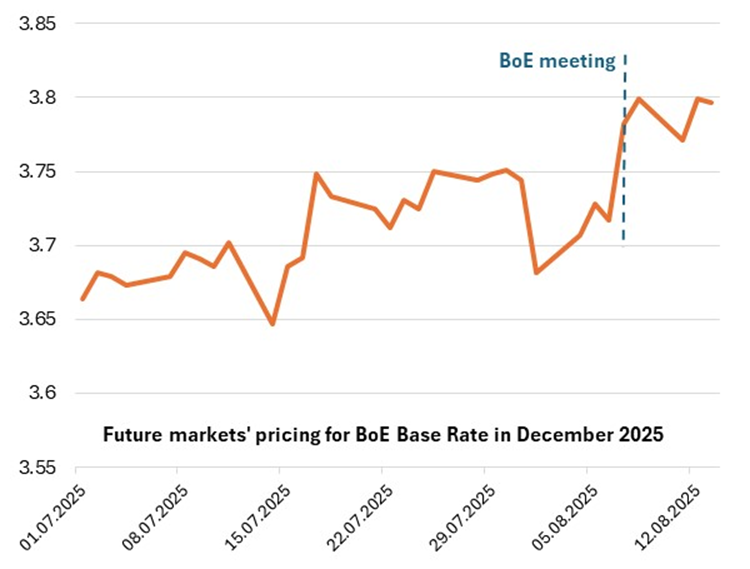
The Bank of England introduced complexity in the outlook for UK monetary policy with a rate cut that was expected in size but unexpectedly hawkish in tone. The Monetary Policy Committee (MPC) lowered the Bank Rate by 25 basis points to 4%, aligning with market forecasts. However, the messaging around the decision signaled caution rather than easing. In a highly unusual development, the initial vote was split evenly—four members supported holding rates steady, and four voted for a cut. One member acted as the deciding vote, leading to a rare second round of voting that produced a narrow 5-4 majority in favor of the cut. This marked the first time such a procedure has occurred, highlighting the internal divisions within the Committee. Additionally, the Bank of England shifted its focus from labor market conditions to inflation trends, suggesting growing concern over persistent inflationary pressures.
Last week was also eventful for monetary policy in the United States even without a Fed meeting. Trump nominated Miran, a Fed reform advocate and current Chair of the Council of Economic Advisers, to temporarily fill Governor Kugler’s vacant seat through January, potentially paving the way for a broader reshaping of the Fed. Trump advisers are said to currently favour Fed Governor Waller—who recently dissented in favour of a rate cut—as a possible replacement for Chair Powell, signaling a potential shift toward a more dovish FOMC leadership.
While immediate Fed pricing was little changed, those developments and some comments from Fed Governor Bostic indicated a slight dovish tilt, acknowledging that recent weak jobs data could influence policy thinking. Market reactions—such as a drop in the dollar index and weak Treasury auction demand—suggest rising sensitivity to signs of an easing bias, especially if further data supports labour market weakness.
Credit markets were supported by a better sentiment towards risk assets that also saw equity markets climb back toward their July peak. As US tariffs started to be implemented and some economic data were below expectations, investors may have been relieved of no further escalation or sharp deterioration after the drop in sentiment experienced following the US payroll report.
US credit spreads tightened back toward their July lows, with Investment Grade spreads down to 78bp (-4bp) and High Yield spreads down -16bp.
This tightening in spreads helped credit ETF to deliver a positive performance despite the rise in yields.
US Investment Grade ETFs had a 4th consecutive positive weekly performance (+0.19%) and briefly reached the +5% level of Ytd performance before a late pullback.
US High Yield ETFs bounced back after their previous week’s decline (+0.32%) but are yet to reclaim their July peak’s level.
EUR credit spreads also experienced some tightening (EUR IG -2bp to 80bp), even if the movement was less pronounced than on the other side of the Atlantic. EUR Investment Grade ETFs had a mild positive performance (+0-10%) and EUR High Yield ETFs experienced a firmer rebound (+0.43%).
Credit spreads remain historically tight. Light summer issuance may keep them contained, but the September supply wave could test market resilience if rally fatigue sets in.
US interest rates bounced up somewhat last week from their post US payrolls’ drop as economic data released since then pointed toward a still resilient US economy. The growth dynamic appears to be subdued but the risk of recession appears to be contained for the time being. This helped the US yield curve to stabilize and re-anchor after the brisk adjustment triggered by the Nonfarm Payrolls report.
Sentiment toward US Treasuries was also not helped by soft demand across the week’s 3-year, 10-year, and 30-year auctions.
As US tariffs became effective, inflation expectations gradually climbed back toward their end-of-July level, before pulling back slightly after the US CPI release. The US 10y inflation breakeven was up +6bp, back toward 2.4%
US yields were up across all maturities (US Treasury 2y +8bp, 5y and 10y +7bp, 30y +3bp).
As a result, US Treasury ETFs posted negative performance across all maturity buckets: the iShares Treasury 3-7 years was down -0.2%, the 7-10 years lost -0.3% while the longer 10-20 years and 20+ years were down respectively -0.5% and -0.6%.
As the rise in yields was mostly due to inflation expectations bouncing up, TIPS stood out and posted a positive performance last week (iShares USD TIPS ETF +0.2%).
A better sentiment in Europe, helped by reassuring economic data, also drove German sovereign yields slightly up (2y +3bp, 5y +2bp, 10y +1bp). European sovereign spreads tightened slightly and helped to contain or even drive marginally lower southern economies’ yields.
As a result of those combined developments, the iShares Core EUR Govt bond ETF posted a positive performance (+0.10%).
Following the surprisingly hawkish Bank of England meeting, UK yields rose, with a more pronounced movement at the front end of the yield curve given the repricing of future rate cuts’ expectations. The UK government 2y yield was up +11bp, the 5y rose +10bp and the 10y climbed +7bp.
In this context, UK government bonds’ ETFs had a negative week, with the iShares UK Domestic Government Bond 3-7 ETF down -0.5%.
Emerging market
US tariffs became effective at punitive levels for several Emerging Countries, and India even faced a doubling of its tariff to 50% in response to its imports of Russian oil.
Despite those developments, Emerging Market bonds still experienced positive performance, helped by a clear compression in spreads.
EM USD sovereign bond indices posted a solid performance of +0.7% while EM USD corporate bond indices were up +0.4%.
The VanEck J.P. Morgan EM Local Currency Bond ETF bounced by +0.96% last week, The iShares USD Asia High Yield Bond ETF fell 0.6%.
Credit spreads remain compressed, warranting greater selectivity and a more cautious approach.
 Source: Banque Syz, Factset