

.png)
What happened last week?
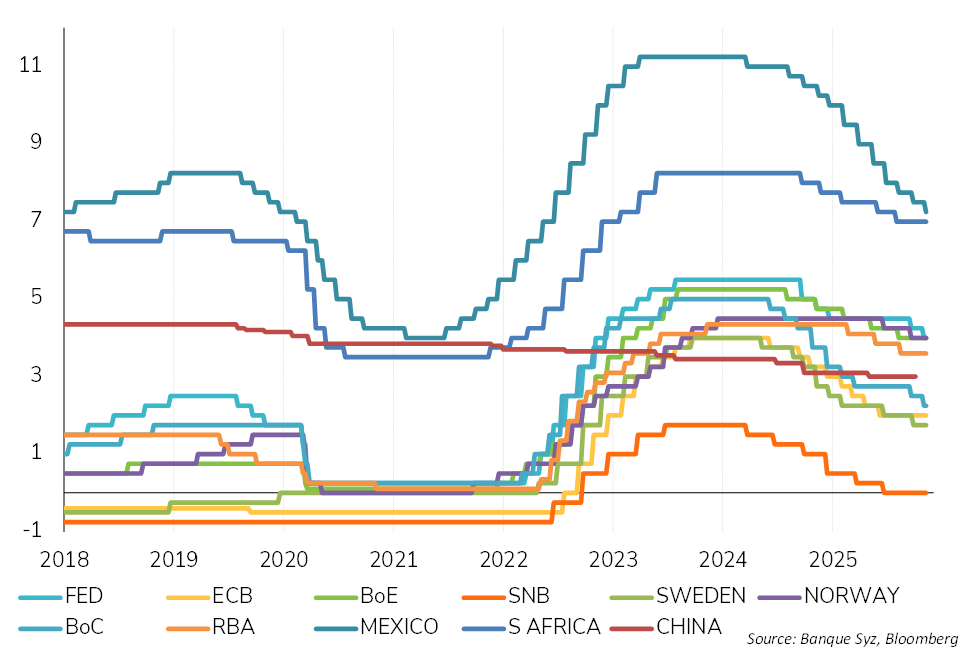
Remarks from Fed officials leaned hawkish last week, underscoring divisions over the path ahead. Chicago Fed President Goolsbee warned against further easing in the absence of fresh inflation data during the government shutdown. Cleveland’s Hammack called the current stance “barely restrictive,” while St. Louis’ Musalem described policy as between “modestly restrictive and neutral.” The probability of a December 25bp rate cut hovered in between 60% and 70% last week, signaling that it is seen as the most likely outcome but that it cannot be taken for granted yet. The economic data deluge expected once the shutdown ends is likely to significantly influence the December decision.
Bundesbank President Joachim Nagel reiterated that euro-area data remain consistent with prior projections, suggesting no need to adjust policy before the December review. ECB President Lagarde reaffirmed that inflation is near target and that policy is “in a good place,” while Nagel pointed to Germany’s improving growth prospects, supported by infrastructure and defense spending.
The BoE held rates at 4%, but the decision was notably dovish. Four of nine policymakers favored a 25bp cut, and Governor Bailey suggested September’s 3.8% inflation marked the peak. Forward guidance now signals a “gradual downward path” for rates, dropping previous cautionary language, a subtle but clear shift toward easing.
The Reserve Bank of Australia kept its key rate unchanged last week (at 3.60%). The Central Bank of Brazil also held its target rate unchanged at 15.0%, while the Central Bank of Mexico cut its overnight rate by 25bp to 7.25% as expected by markets
Credit markets softened last week, weighed down by global weakness across credit and equities, and the ongoing drag from the longest U.S. government shutdown, which may end if the U.S. Senate’s bill to reopen the government will be passed by the House of Representatives and signed by the President Trump.
Among EUR investment-grade, Bank senior bonds and real estate sector have outperformed Healthcare, Automobile, Chemicals and Telecom, while in high yield, chemicals suffered the largest weekly total return loss. Across the Atlantic, U.S. spreads also drifted wider, reflecting risk aversion and rising sovereign yields.
Investor sentiment was also tested by a wave of AI-related bond issuance, stirring anxiety about a potential supply glut. Yet, today’s backdrop differs markedly from the dot-com era: while hyperscaler capex is expanding rapidly, so too are profitability and cash flow. The 2001 tech bubble is a poor comparison. Then, most internet and technology firms and startups were unprofitable with little or no revenue.
Fundamentally, the 3Q profit margin of EUR investment-grade companies continued to show resilience despite trade frictions. However, financial leverage among BBB-rated issuers increased over the past four quarters.
Positively, EUR investment grade funds posted inflows for the 28th time in 29 weeks, driven by strong inflows in medium maturities, while long-duration funds saw mild outflows.
However, performance was broadly negative across all credit segments, given higher Treasury and German Bund yields, and wider credit spreads. U.S. investment grade (Vanguard USD Corporate Bond ETF) and US high yield fell 0.1%. EUR investment grade declined -0.4%, and EUR high yield fell -0.2%.
Looking ahead, a formal resolution to the U.S. government shutdown would offer welcome relief and could lift risk sentiment. November typically brings one final surge in primary issuance before the holiday lull. With steady inflows and robust coupon reinvestment, markets appear well-positioned to absorb the seasonal uptick in supply heading into year-end.
Government bond markets saw limited net movement over the week, with investors balancing hawkish central bank commentary against signs of easing financial conditions. In the U.S., Treasuries traded in a volatile but ultimately range-bound manner. The 2-year yield edged down 1bp to 3.56%, while the 10-year rose 2bps to 4.10%, leaving the curve slightly steeper. Shorter maturities found support from Fed Vice Chair Jefferson’s call for caution as policy nears neutrality, while longer yields drifted higher on persistent inflation concerns and speculation about an eventual end to quantitative tightening. Breakeven inflation slipped 2bps to 2.29%, and real yields climbed 4bps, suggesting a modest repricing toward tighter real conditions.
In Europe, bond yields ticked higher after ECB officials, including Bundesbank President Nagel, signaled no urgency to ease further. German 10-year yields rose 3bps to 2.67%, with similar moves across France (+4bps to 3.46%) and Italy (+5bps to 3.43%). The UK gilt curve underperformed, with 10-year yields up 6bps to 4.47%, amid the influence of the Bank of England’s unexpectedly dovish tone, uncertainties on the timing of rate cuts and the upcoming budget announcement.
Bond ETFs mirrored the modest weakness: U.S. Treasury indices lost 0.1–0.8% across maturities, while euro-area government bond funds were broadly flat, underscoring subdued price action.
Emerging market
Emerging market (EM) Sovereign $ bonds declined last week, pressured by rising US Treasury yields. Within Latin American investment countries, Chile, Uruguay, Mexico and Peru underperformed. In the HY space, Argentina stood out with strong gains. However, valuations across both investment grade and high yield sovereigns remained exceptionally tight.
Primary issuance continued at a brisk pace. EM sovereigns have raised $239 billion year-to-date, surpassing the previous record of $225 billion set in 2020. Remarkably, despite the heavy supply, EM debt funds recorded another week of inflows, marking 28 inflow weeks out of the past 29 weeks.
S&P revised Israel’s outlook to Stable from Negative, reflecting reduced geopolitical risks following the U.S.-brokered ceasefire between Israel and Hamas. The agreement is expected to ease military tensions and lower the likelihood of broader regional escalation, while direct confrontations are likely to remain contained.
In local markets, EM currencies outperformed as the J.P. Morgan EM Local Currency Bond ETF rose +0.4%, supported by a weaker U.S. dollar. The softer dollar effectively lowered financing costs, improved trade balances, contained imported inflation, and supported domestic demand.
By contrast, the EM Sovereign USD Bond ETF slipped 0.2%, and Asian high yield declined 0.3%, while EM USD corporates remained broadly flat.
Overall, EM corporate spreads have shown notable resilience in 2025, reflecting strong corporate fundamentals and gradually improving sentiment toward EM sovereigns. Still, with valuations tight and investors extending into lower credit quality, credit selection remains key.