

.png)
What happened last week?
After lowering key rates in the last seven consecutive meetings, the ECB decided last Thursday to make a pause in its rate cutting cycle. The decision was taken unanimously by the Governing Council. President Lagarde reiterated that the ECB remains data-dependent, taking decisions on a meeting-by-meeting basis without any pre-commitment. The ECB confirmed it would remain in a “wait-and-see” mode, consistent with the current approach taken by the Federal Reserve. The probability of a cut has partially decreased, a “no-cut” scenario has become more likely while some investors had appeared to position for a more dovish signal. Following the ECB meeting, the probability of a -25bp cut in September dropped from close to 50% down to below 20%.
The Federal Reserve will hold its FOMC meeting on July 30th. While the recent political pressures and comments from Waller have created volatility and some uncertainty on the outcome of this meeting, the Fed appears unlikely to change its monetary policy this month. Fed members were in their pre-FOMC blackout period last week.
The Bank of Canada and the Bank of Japan also hold monetary policy meetings this week, and both are also expected to keep rates steady.
Among EM central banks, two cut their key rate last week: the Central Bank of Russia lowered its rate from 20% to 18%, a second consecutive cut after the -100bp change decided in June. The Central Bank of Turkey lowered its rate from 46% to 43%.
Credit markets were buoyant last week following the U.S.–Japan trade deal, with Japanese bank spreads tightening despite a rise in JGB yields.
Markets are increasingly viewing trade deals — even those with relatively high tariffs—as preferable to no deals at all. A similar positive reaction was observed from the U.S.–EU agreement over the weekend.
Spread dispersion in EUR sectors such as retail, autos, and technology could narrow further, helped by improving sentiment. Notably, last week marked the strongest inflows into European fixed income funds in over five years.
In the EUR primary market, BBB-rated bonds have been the sweet spot for new issuance oversubscription year-to-date. Among sovereigns, Spanish credits saw the highest oversubscription, benefiting from their relatively low dependence on U.S. exports, while Italian names lagged.
Despite the broader rally, U.S. cyclicals—notably energy and retail—continue to underperform. Until U.S. growth reaccelerates, this divergence is likely to persist.
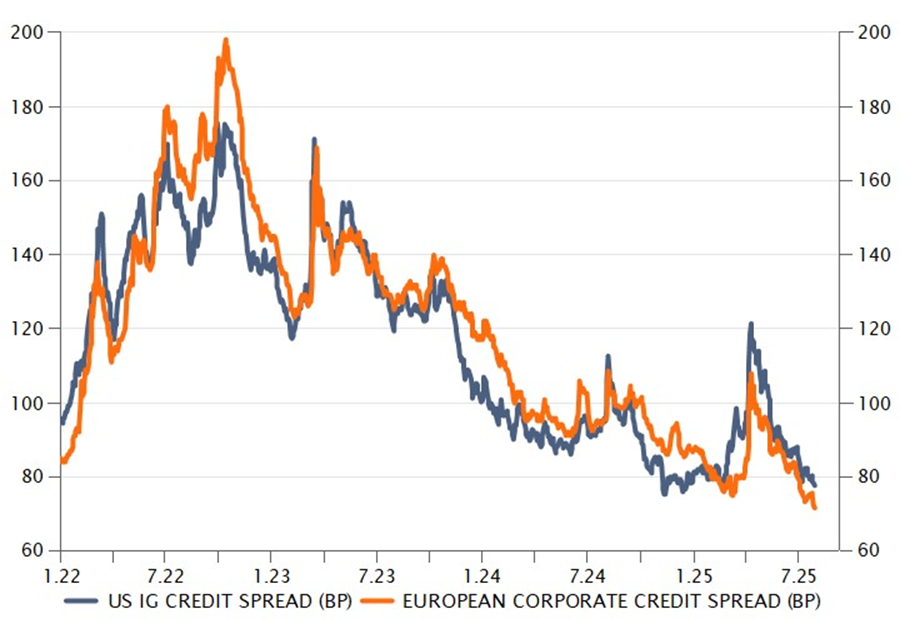
Credit spreads tightened across both U.S. and European corporates, with a more pronounced compression observed in EUR credits.
U.S. investment grade (IG) spreads tightened by 2 bps to 78 bps, while high yield (HY) narrowed by 9 bps to 284 bps. Correspondingly, U.S. IG bond ETFs rose 0.4% (+3.8% year-to-date), and HY ETFs gained 0.3% (+5.1% YTD).
In Europe, IG spreads contracted by 4 bp to 79 bps, and HY spreads tightened significantly by 17 bps to 278 bps, closely mirroring U.S. levels. Euro IG ETF was flat (+2.0% YTD), while Euro HY ETF rose 0.2% (+3.4% YTD).
Riskier segments outperformed in the risk-on environment: euro hybrid corporate bonds gained 0.4% (+3.7% YTD), and Additional Tier-1 bank capital (AT1s) jumped 0.6% (+5.1% YTD).
Despite moderating growth, credit spreads have remained resilient, and valuations are now near historically expensive levels. While the potential for further tightening appears limited, spreads are likely to remain rangebound, as markets continue to look through near-term headwinds, provided recession risks stay contained.
Interest rates had a volatile week amid encouraging signs on trade negotiations, reassuring economic data, the ECB meeting and a general “Risk on” tone in financial markets.
The USD yield curve flattened, with short-term maturities edging up (US Treasury 2y +5bp to 3.92%) while longer-term maturities saw yield declining (UST 10y -3bp to 4.39%, UST 30y -6bp to 4.93%). The decline in long-term maturities was essentially driven by lower real yields, while inflation breakevens held mostly unchanged.
As a result, USD Treasury ETFs with medium-to-long term maturities posted positive performance (iShares Treasury 7-10y +0.4%, 10-20y +1.1%, 20y+ +1.4%) while those with shorter maturities were essentially flat, as for the inflation-protected iShares USD TIPS ETF.
EUR short-term rates were pushed higher by the combination of hawkish-leanings commentary of Ms Lagarde and of better-than-expected economic data for the Eurozone. The German 2y yield was up +8bp to 1.95%. The movement was less pronounced on longer-term maturities (German 10y +2bp to 2.72%) and EUR sovereign spreads experienced a slight tightening resulting in unchanged 10y yields for French OATs (3.39%), Italian BTP (3.55%) and Spanish Bonos (3.31%). The iShares EUR 3-7 year Government Bond ETF was down -0.2% last week, was its 10-15y equivalent was flat over the week.
CHF rates drifted lower last week as the strength of the currency weighed on inflation and rate expectations. The Swiss Confederation 2y was down -5bp to -0.10% while the 10y ticked down -3bp to 0.44%. GBP rates also drifted lower last week (UK Gilt 10y -4bp to 4.64%).
Japanese yields experienced upward pressures from fears of increased fiscal deficits and public debt going forward after the elections’ results. 10y JGB yields reached a new 17-year high to 1.60%.
Emerging market
Emerging market (EM) sovereign dollar bonds gained last week, supported by a decline in US Treasury yield. Colombia was among the outperformers. Argentina lagged, despite a credit rating upgrade by Moody’s. With three months remaining until Argentina’s mid-term elections, investor sentiment remains cautious. However, Argentine corporates with dollar-linked revenues saw further credit spread tightening, reflecting selective investor confidence.
Fitch revised PEMEX’s outlook to Positive, citing continued and tangible government support. The Mexican government, through the Ministry of Finance plans to raise USD 9.5 billion via pre-capitalized notes issued by an SPV (Eagle Funding), without direct sovereign guarantee. These proceeds will purchase U.S. Treasuries, which will then be transferred to Pemex. Pemex can use these securities as collateral to secure low-cost financing from global banks including JPMorgan, Citi, and Bank of America, a clear credit positive.
EM debt fund recorded their 14th consecutive week of inflows.
The total return of VanEck J.P. Morgan EM Local Currency Bond ETF (sovereign bonds) rose 0.4% last week. The EM USD sovereign bond index jumped 0.9%. EM corporate bonds and the iShares USD Asia High Yield Bond ETF gained 0.4% and 0.8% respectively.
The current spread levels became difficult to justify the trade tariff risks and slowing global growth. A more defensive positioning would be warranted.