

.png)
What happened last week?
Fed officials maintained a cautious tone this week, despite growing external pressure for faster rate cuts. Chicago Fed President Goolsbee and Kansas City's Schmid both leaned hawkish, warning against premature easing amid sticky inflation and a still-resilient labor market. However, some divergence emerged: Vice Chair Bowman noted growing signs of labor market fragility, and Governor Miran defended his dissent at last week's meeting, urging proactive rate reductions. Notably, US Treasury Secretary Bessent criticized the Fed’s pace, arguing for 100–150bps of cuts by year-end. Still, with resilient economic data, markets slightly revised their rate cut expectations for the remaining of 2025: while one 25bp cut is now fully priced in, a second one is now assigned a 60% probability (compared to 80% a week ago).
The SNB held its key rate at 0%, reflecting Switzerland’s stable inflation and resilient economic performance. Officials highlighted risks from ongoing U.S. tariff disputes and weakness in the export sector but emphasized a high bar for returning to negative rates. President Schlegel reiterated that negative rates remain a last resort. Given muted inflation and minimal franc volatility, no policy change is expected before mid-2026.
The Riksbank of Sweden took market consensus by surprise and cut its key rate by 25bp to 1.75% last week while no change was expected at this meeting. However, it also signaled that this decision was likely the end of its rating cycle initiated in 2024 (rate at 4% at the time).
The Bank of Mexico cut its key rate last week as expected to 7.50% (from 7.75%), extending the rate cut cycle initiated in 2024 when its short-term rate stood at 11.25%.
US credit spreads edged modestly wider, and higher Treasury yields drove negative total returns across both investment grade and high yield segments.
In Europe, credit spreads also widened, weighed down by a heavy slate of new issuance, renewed tariff concerns, and volatility in rates markets. EUR investment grade was the only segment to finish flat on the week, while other credit segments gave back part of earlier gains.
Despite the ECB’s corporate bond holdings in CSPP (Corporate Purchase) declining by about 25% from their peak, strong inflows — particularly at the front end — have more than offset the impact. Relentless demand for short-term funds has underpinned inflows into EUR investment grade.
On the policy front, the US announced plans for 100% tariffs on branded pharmaceutical imports, with possible exemptions for companies maintaining US manufacturing. Additional tariffs on heavy trucks and furniture will take effect from 1 October.
The US announced plans to impose 100% tariffs on branded pharmaceutical imports with the caveat of possible exemptions on companies with US manufacturing operations. Meanwhile, the US also announced 25% tariffs on heavy trucks and 30% on furniture starting on 1 October.
EUR investment grade outperformed last week. The Vanguard USD Corporate Bond ETF fell -0.3% while the iShares Core Euro IG Corporate Bond ETF was unchanged. Both USD High Yield and EUR High Yield declined -0.2%.
Supportive European monetary easing, fiscal stimulus, and strong technicals continue to make EUR issuance attractive. European and UK corporates have tilted new supply toward EUR markets to capture robust investor demand.
US Treasury yields moved higher across the curve last week, driven by firmer economic data that prompted a reassessment of monetary policy expectations. The 2-year yield rose +7bp to 3.64%, as markets digested a stronger-than-expected initial jobless claims print (218k vs. 233k expected), an upward revision to Q2 GDP, and robust real personal spending data for August (+0.4% vs. +0.2% expected). The 5-year yield climbed +9bp to 3.77%, while the 10-year increased +5bp to 4.18%. The 30-year yield was little changed, up just +0.5bp to 4.75%, leading to a modest steepening of the curve. The move was primarily driven by rising real yields, with the 10-year real rate up +6bp to 1.79%, while breakeven inflation declined slightly (-0.9bp to 2.38%).
US Treasury ETFs declined as a consequence. The iShares 7–10Y Treasury ETF fell -0.42%, while the 3–7Y and 1–3Y declined -0.30% and -0.08%, respectively. Longer-dated segments also came under pressure, with the iShares 20Y+ ETF down -0.13%.
In Europe, rate moves were more muted. The German 10-year Bund yield slipped -0.2bp to 2.75%, while France’s 10-year OAT was flat at 2.86%. Peripheral spreads widened modestly, with Italy’s 10-year yield up +4.8bp and Portugal +2.6bp. In the UK, Gilts tracked the US, with the 10-year yield rising +3.1bp to 4.75%.
European government bond ETFs posted modest gains. The iShares EUR 3–7Y ETF rose +0.08%, while the iShares 10–15Y gained a stronger +0.53%. The broad-based iShares Core EUR Government Bond ETF added +0.31%, and inflation-linked bonds also performed well, with the iShares EUR Inflation-Linked ETF up +0.41%.
Emerging market
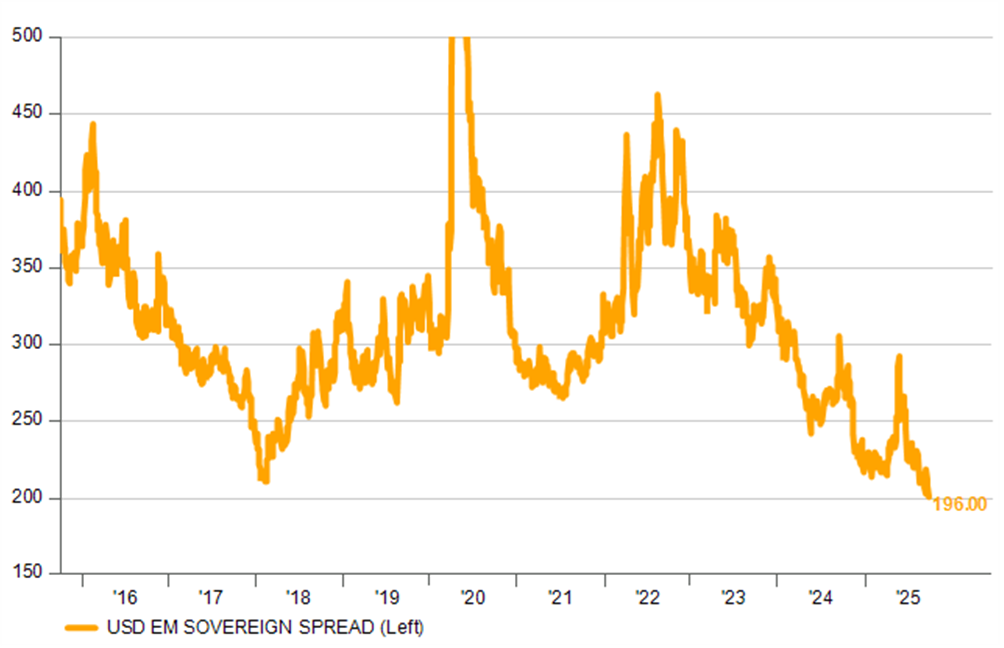
Emerging market (EM) sovereign USD bonds advanced last week, with Argentina accounting for nearly half of the EM index’s weekly gain. Colombia also outperformed, while Egypt and South Africa lagged.
Argentina bonds rallied after U.S. President Trump endorsed President Milei and Washington pledged a USD 20 billion swap line to the central bank. Treasury Secretary Bessent signaled that the U.S. stands ready to purchase Argentina’s USD debt in both primary and secondary markets if needed. This unprecedented backing stabilized the Argentina peso and bolstered sentiment. Still, by Friday, Argentine bonds retraced part of their rally. Sustained investor confidence will hinge on Milei’s ability to secure political momentum in the 26 October mid-term elections.
In Asia, the People’s Bank of China’s meeting minutes revealed a dovish tone, reinforcing expectations of further monetary easing in 4Q. Yet, ahead of the National Day “Golden week”, property sentiment remained fragile, with new home search activity declined. Markets will be looking to the late-October Politburo Standing Committee meeting - comprising the seven most senior Party leaders. for policy direction.
EM Flows remain a bright spot: EM debt funds record a 23rd consecutive week of inflows.
Performance diverged across asset classes, with hard currency iShare EM Sovereign bonds ETF up 0.2%. Local-currency sovereign bonds slipped, with the JP Morgan EM Local Currency Bond ETF down -0.5%. EM corporates and Asian high yield both declined modestly (-0.1%).
Looking ahead, EM credits are expected to benefit from U.S. rate cuts, which provide greater room for EM central banks to ease policy and support growth.