

.png)
What happened last week?
There were no rate decisions last week, but the Fed and the ECB released the minutes of their latest monetary policy meetings, and the BoE published its quarterly Financial Stability Report.
In the US, the September FOMC minutes revealed a divided committee balancing persistent inflation risks with signs of a weakening labor market. Inflation hawks pointed to tariff-driven price pressures, while doves emphasized slowing job growth and productivity gains. Although some officials would have preferred to keep rates on hold, most judged that further policy easing would likely be appropriate before year-end. Markets agree: Future markets assign a 98% probability of a rate cut in October and 92% for another in December. Despite the dovish bias, participants stressed caution, noting that recent data show only a gradual cooling in labor conditions.
On this of the Atlantic, ECB minutes revealed that policymakers had debated another rate cut in September but opted to maintain the deposit rate at 2%, citing two-sided risks to inflation and high uncertainty from global trade and geopolitical tensions. While some members argued for additional easing to protect the inflation target, most favored patience, highlighting resilient growth and solid labor markets. Staff projections foresee inflation dipping to 1.7% in 2026 before returning close to target. Officials also warned of stretched asset valuations and a stronger euro weighing on inflation expectations.
In the UK, the BoE warned, in its latest Financial Stability Report, of elevated global asset prices, particularly in AI-linked equities, raising the risk of a sharp market correction. The BoE highlighted potential bottlenecks in AI-related supply chains and pledged further analysis of sector-specific financial risks.
In Japan, the unexpected election results and prospects of Abenomics-like policies led future markets to reassess and lower rate hike prospects form the BoJ. Future markets now assign more probability to a status quo than to a rate hike by the end of the year.
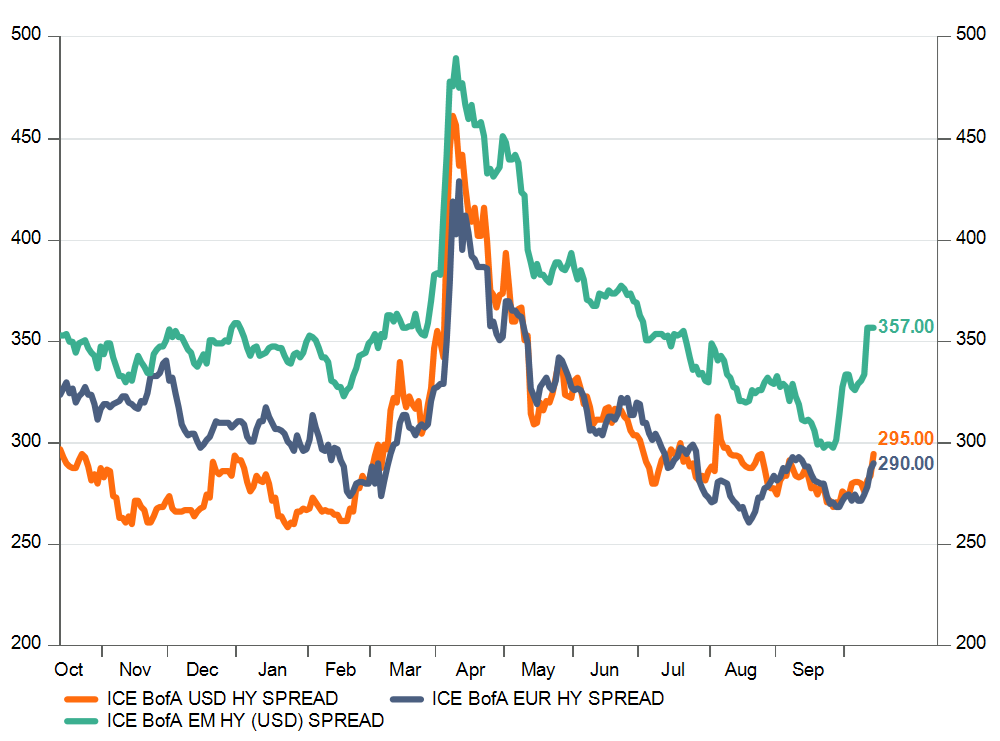
Credit spreads widened notably risky segments after renewed US-China trade tensions sparked a broad global sell-off. Prior, sentiment was already weighed down by France’s political volatility, mounting stress in the global chemical sector, and contagion fears following the collapse of First Brands, a U.S. auto-components importer. The bankruptcy was driven partly from fraudulent accounting and partly by the firm’s aggressive use of factoring—selling receivables to banks for upfront cash, sometimes without full disclosure.
Market pressure on EUR high yield chemicals intensified after Brazil’s Braskem appointed a debt advisor to explore “capital structure optimization,” a move widely interpreted as a potential prelude to debt restructuring.
In contrast, investment-grade segments benefited from the decline in core yields. The Vanguard USD Corporate Bond ETF rose +0.2%, and the iShares Core Euro IG Corporate Bond ETF gained +0.3%, supported by lower U.S. Treasury and German Bund yields, despite wider credit spreads.
Risky segments underperformed: USD high yield lost 1.1% and EUR high yield –1.0%, with spreads widening sharply from very tight levels.
Elevated volatility could persist in the coming weeks as investors grapple with the looming U.S. government shutdown, renewed tariff threats, and persistent fiscal uncertainty in France.
Government bond markets rallied last week as investors rotated into duration amid a wave of geopolitical and financial uncertainty. Amid concerns around the US government shutdown, risk sentiment deteriorated following renewed US-China trade tensions, political upheaval in France and Japan, and renewed weakness in crypto and credit markets. US Treasuries posted their best weekly performance since mid-summer.
Across the US curve, yields fell sharply: 2Y -7 bps to 3.50%, 10Y -9 bps to 4.03%, and 30Y -9 bps to 4.62%. Breakevens declined -2 bps, and real 10-year yields slipped -7 bps to 1.71%, signaling a broad flight-to-quality. Reflecting this, US Treasury ETFs advanced across maturities: iShares 1-3Y (+0.17%), 3-7Y (+0.36%), 7-10Y (+0.53%), 10-20Y (+1.04%), and 20Y+ (+1.39%), underscoring the strength of the duration rally.
European sovereigns followed the trend, with 10Y Bunds -5 bps to 2.64% and Italian BTPs -5 bps to 3.46%. EUR government bond ETFs posted solid weekly gains: the iShares EUR 3-7Y (+0.40%), 10-15Y (+1.09%), Core EUR Govt (+0.57%), and EUR Inflation-Linked (+0.83%). UK Gilts edged firmer (10Y -2 bps to 4.68%), while Japan was the exception, with 10Y JGBs +3 bps to 1.69% following the collapse of the ruling coalition.
Emerging market
Sovereign $ bonds were down last week amid global market selloff and strengthened USD. Argentina bonds were volatile. In the middle of the week, Argentina bond yields spiral. Quickly, US Treasury Secretary Bessent came to calm the market and reiterated the U.S. readiness to buy Argentina bonds. President Trump will meet President Milei in the White House on 14 Oct. Argentina bonds rebounded. Colombia was among outperformers last week.
S&P upgraded Egypt to B (Stable), from B-, citing improving fiscal discipline and growth prospects. The government posted a primary surplus of 3.5% of GDP in fiscal year 2025 (ending June). Primary surplus represents government revenue minus expenses but excludes interest payments. A flexible exchange rate has supported growth, tourism, and remittances. S&P expects GDP growth to rise from 2.4% in 2024 to 4.4% in 2025, reaching 5% by 2028, while elevated debt-to-GDP should decline from 89% to 82% in 2025.
Morocco sovereign bonds appear attractive in the current context. The country was upgraded by S&P to BBB- and became a very few African investment-grade economies. Protests have erupted in recent days over insufficient resources in the healthcare sector, and the investments deemed excessive for organising the 2030 World Cup. Yet, Morocco creditworthiness has been resilient over the economic cycles, supported by stable currency and foreign direct investment and stable currency.
Both hard-currency and local-currency bonds fell, with the iShares EM Sovereign Bond ETF dropping 0.8% and J.P. Morgan EM Local Currency Bond ETF was down 0.8%. EM corporates declined by 0.7% and only Asian high yield also was flat.
Given the heighted volatility, a highly selective approach to emerging markets is warranted.