

.png)
What happened last week?
Investors face a packed week with policy decisions from four of the G7 central banks: the Federal Reserve and Bank of Canada on Wednesday, followed by the Bank of Japan and European Central Bank on Thursday. Markets are braced for a series of key signals on the global policy outlook as central banks navigate slowing growth, uneven inflation trends, and financial stability risks.
A second consecutive 25bp rate cut is widely expected at Wednesday’s FOMC meeting, with markets pricing nearly 50bps of easing over the next two meetings. Chair Powell is likely to avoid strong forward guidance amid a divided committee, focusing instead on balance sheet policy and financial stability. The Fed is expected to announce an end to quantitative tightening in response to tighter funding conditions. St. Louis Fed President Alberto Musalem noted limited room for further easing before policy becomes overly accommodative, while Governor Stephen Miran emphasized a focus on employment over asset prices.
The ECB is set to hold rates steady at 2% for a third straight meeting. President Lagarde is expected to reiterate that policy is “in a good place,” while Chief Economist Philip Lane emphasized a data-dependent approach and warned that a “more powerful intervention” may be needed if transmission weakens.
The BoJ is expected to maintain its current stance, while the BoC is likely to match the Fed with a 25bp cut as growth slows.
Credit market continued to rebound last week, supported by solid U.S. banks earnings and a softer September inflation, despite the government shutdown extending to 24 days. U.S. investment-grade spreads have tightened back to early-October levels. Investors remained positioned in higher-rate, shorter-duration instruments.
In Europe, credit spreads also moved tighter despite a sell-off in EUR sovereign yields and higher oil and gas prices following renewed U.S. and EU sanctions on Russia. On Friday, Moody’s affirmed France’s Aa3 rating but revised the outlook to Negative, citing political fragmentation and increased challenges in reducing the fiscal deficit.
Flow dynamics were encouraging. EUR investment grade continued to attract strong inflows amid subdued rate volatility, making 2024 one of the best years for credit fund inflows. While EUR high yield flows were negative, the pace of outflows sharply decelerated from prior week.
Dispersion is the defining theme, reflecting trade tensions, diverging political dynamics, and uneven economic growth — for instance, Spain’s GDP has expanded nearly 10% more than Germany’s since 3Q 2022. This divergence creates opportunities. Some of the biggest dispersions can be found in the consumer goods, autos, energy, and capital goods.
Market performance was positive across the board: U,S, investment grade rose 0.4% (Vanguard USD Corporate Bond ETF), aided by tighter spreads and lower U.S. Treasury yields. EUR investment grade inched up +0.1%, as tighter spreads offset higher German Bund yields. Both USD high yield and EUR high yield gained 0.4%, extending last week’s recovery.
With spreads tightening but dispersion widening, credit selection remains the key performance differentiator into year-end.
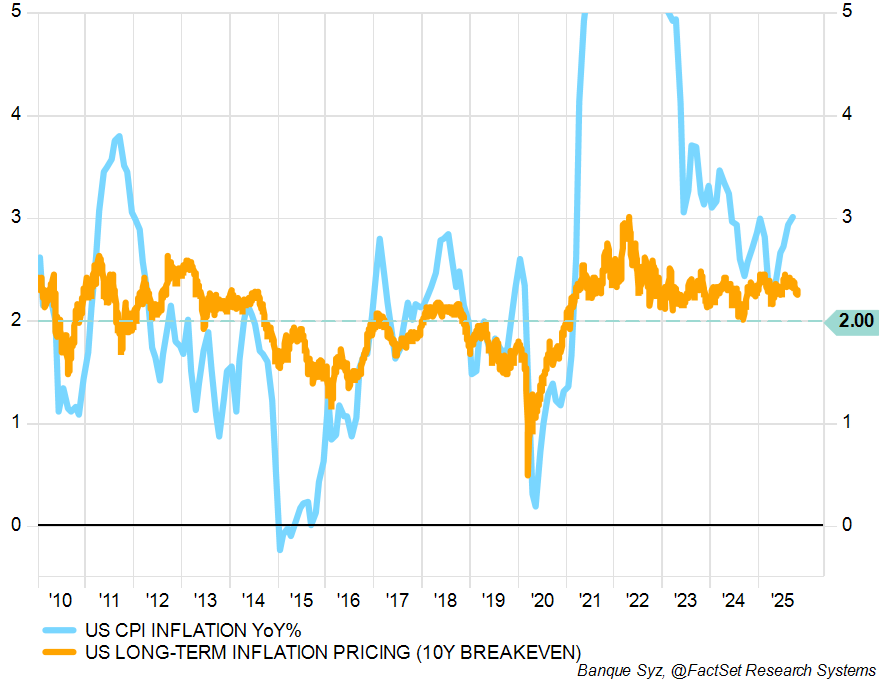
Government bond markets delivered a mixed performance over the week. U.S. Treasuries initially rallied on Friday’s softer CPI print but ended broadly unchanged as investors digested the lingering impact of tariff-related inflation. The 2-year yield rose 2.5bps to 3.48%, while the 10-year yield eased slightly to 4.00% after touching a 12-month low of 3.95% midweek. Longer maturities outperformed modestly, with the 30-year yield down 2bps to 4.59%. Breakeven inflation widened to 2.30%, while real 10-year yields fell 4bps to 1.70%, suggesting inflation expectations remain resilient.
U.S. Treasury ETFs posted small positive returns, reflecting mild curve flattening: the iShares Treasury 1-3y gained +0.03%, 3-7y +0.02%, 7-10y +0.10%, 10-20y +0.25%, and 20y+ +0.30%.
In Europe, yields rose as data signaled strengthening activity. The Euro area composite PMI climbed to a 17-month high of 52.2, with Germany’s PMI hitting a two-year peak of 53.8. The 10-year Bund yield rose 4.5bps to 2.63%, while OATs and BTPs gained 7.2bps and 3.7bps, respectively. Correspondingly, Euro government bond ETFs declined: iShares EUR 3-7y fell -0.19%, 10-15y -0.24%, and Core EUR Govt Bond -0.17%. Inflation-linked bonds underperformed slightly (-0.05%) amid higher nominal yields.
UK rates fell last week after September inflation data came out below expectations. The UK 10y Gilt yield dropped to 4.43%, down -10bp over the week.
Emerging market
Credit market continued to rebound last week, supported by solid U.S. banks earnings and a softer September inflation, despite the government shutdown extending to 24 days. U.S. investment-grade spreads have tightened back to early-October levels. Investors remained positioned in higher-rate, shorter-duration instruments.
In Europe, credit spreads also moved tighter despite a sell-off in EUR sovereign yields and higher oil and gas prices following renewed U.S. and EU sanctions on Russia. On Friday, Moody’s affirmed France’s Aa3 rating but revised the outlook to Negative, citing political fragmentation and increased challenges in reducing the fiscal deficit.
Flow dynamics were encouraging. EUR investment grade continued to attract strong inflows amid subdued rate volatility, making 2024 one of the best years for credit fund inflows. While EUR high yield flows were negative, the pace of outflows sharply decelerated from prior week.
Dispersion is the defining theme, reflecting trade tensions, diverging political dynamics, and uneven economic growth — for instance, Spain’s GDP has expanded nearly 10% more than Germany’s since 3Q 2022. This divergence creates opportunities. Some of the biggest dispersions can be found in the consumer goods, autos, energy, and capital goods.
Market performance was positive across the board: U,S, investment grade rose 0.4% (Vanguard USD Corporate Bond ETF), aided by tighter spreads and lower U.S. Treasury yields. EUR investment grade inched up +0.1%, as tighter spreads offset higher German Bund yields. Both USD high yield and EUR high yield gained 0.4%, extending last week’s recovery.
With spreads tightening but dispersion widening, credit selection remains the key performance differentiator into year-end.