


Maggie Cheng

Senior Fixed Income Analyst

Adrien Pichoud

Head of Fixed Income

The Chart of the week

Long-term rates keep rising, reaching multi-year highs across most markets

Sovereign 10-year yields since 2005
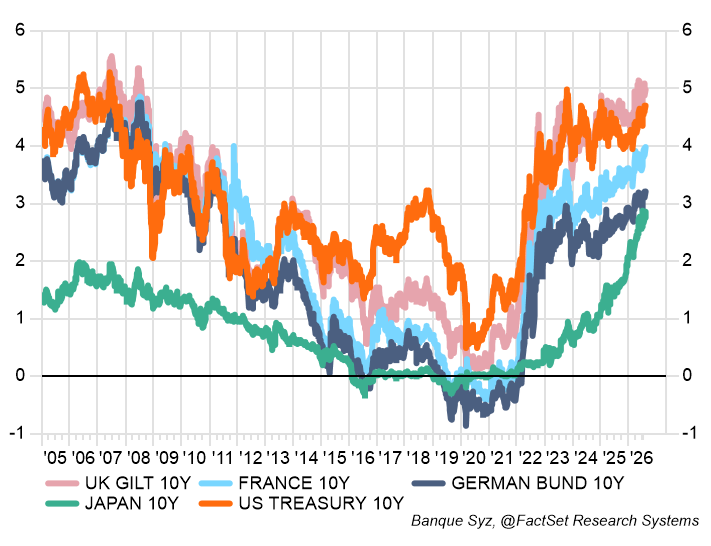
Long-term government bond yields continued to rise across major markets, with the latest move taking several benchmarks to multi-year or multi-decade highs.

Japan stands out most clearly: the 10-year JGB reached 2.96%, its highest level since 1996, as expectations of an earlier BoJ tightening cycle combined with inflation and fiscal concerns.

In Europe, the 10-year Bund climbed above 3.20%, its highest level in around 15 years, while the French OAT rose above 4% for the first time since 2011 and now trades above the Italian BTP. French yields are also being pressured by renewed concerns over the country’s fiscal outlook.

In the US, the 10-year Treasury moved above 4.7%, a level only briefly reached in early 2025 and late 2023 since the GFC. The UK has also seen significant long-end pressure. Across markets, persistent inflation risks, higher energy prices, fiscal concerns and increased government debt supply are reinforcing the upward pressure on term premia.

What happened last week?

Central banks

Fed pricing is in focus this week after having eased earlier this month on softer employment and inflation data. Futures markets now price less than one full 25bp rate hike by year-end. The July FOMC minutes due Wednesday may provide some useful insight in the middle of the summer lull for Fed members. With Kevin Warsh stepping back from policy guidance since he became Chair, the minutes may offer greater insight into the debate over inflation risks and the urgency to act, following three dissents in favour of a 25bp hike. The next FOMC meeting is scheduled for September 15-16, with the policy decision due on September 16, while the Jackson Hole symposium on August 27-29 will likely be the next major communication event for Kevin Warsh and his fellow Fed officials.

In Europe, ECB Chief Economist Philip Lane warned that inflation could remain well above 2% in 2026, with energy costs from the Iran war and food inflation adding upside risks. July inflation rose to 2.9%, while Q2 growth surprised at 0.4%. Lane stressed that the ECB will prioritize preventing inflation from remaining too high for too long, keeping further tightening firmly on the table. Future rate markets continue to expect one 25bp rate hike in September (or October at the latest), with a 70% chance of a second hike in December.

In Japan, following the FX intervention at the end of July, the yen’s renewed weakness is increasing pressure on the BoJ to tighten policy. Reports suggest Prime Minister Takaichi’s government supports a hike as soon as September or October, aligning concerns over imported inflation with efforts to reinforce recent currency intervention. Former Finance Ministry official Takehiko Nakao argued for hikes at every meeting, highlighting Japan’s deeply negative real rates. Future rate markets price a 80% chance of a 25bp hike in September, and around a 50% probability of two 25bp hikes by year-end.

Credit

Credit markets continued to split along quality lines last week, with High Yield outperforming as Investment Grade was pressured by the rise in longer-dated government yields. US IG spreads widened 2bp over the week to 80bp. Combined with the impact of rising rates, this led to a negative total return for the IG segment of the credit market last week. The widening was broad-based, with AAA, AA and single-A spreads each 2bp wider, while BBBs widened 1bp. Across maturities, spreads were generally 2bp wider, with 7-10y underperforming at 3bp wider. Duration was therefore the main drag as the Treasury curve bear-steepened.

US HY, by contrast, continued to grind tighter, with spreads narrowing 3bp to 267bp and now 18bp tighter MTD. Tighter spreads and the yield carry supported a positive total return despite the negative impact of rising interest rates. BBs and Bs led, tightening 3bp each versus 1bp for CCCs, while the long end outperformed, with 7-10y and 10y+ spreads 6bp tighter.

European credit was comparatively resilient: EUR IG corporate bonds returned -0.2%, while EUR HY gained +0.1%. US IG ETF flows surged to $1.7bn, a five-week high, led by broad-duration products such as LQD. HY ETFs, however, saw $343mn of outflows after $1.6bn of inflows the previous week. No major sector-specific divergence was evident.

Rates

Bond markets were caught between the Iran-US deadlock and mixed US inflation and activity data, with softer US data ultimately dominating the front end. Two-year Treasury yields fell 3bps to 4.17%, as markets reduced expectations of a September Fed hike following softer CPI, PPI, retail sales and consumer sentiment data. Reuters reported that July core CPI slowed to 2.5% YoY, while the probability of a September hike fell materially.

However, the long end sold off sharply: 10-year yields rose 5bps to 4.69% and 30-year yields 6bps to 5.26%, approaching their post-2007 highs. This steepening weighed heavily on duration, with 20y+ Treasuries falling 0.87% versus a 0.10% gain for 1-3y Treasuries. Reuters subsequently noted that long-end yields remained under pressure from inflation, fiscal and geopolitical concerns.

European sovereigns underperformed more materially. Bund 10-year yields rose 7bps to 3.20%, while OATs jumped 13bps to 4.04%, their highest since 2009. Gilts also sold off, with 10-year yields rising 12bps to 5.04%. Higher energy and food prices reinforced inflation concerns, with TTF gas up 11% and one-year Euro inflation swaps rising 20bps. EUR government bond ETFs consequently fell 0.55%, while EUR 10-15y declined 0.87%. The broader sell-off has since intensified, with multi-year highs yields across global bond markets amid renewed oil and inflation concerns.

Emerging markets

EM debt was mixed last week, with USD sovereign bonds declining 0.2% amid the rise in US Treasury yields, while EM corporate bonds gained marginally. Local-currency debt underperformed, with the JPM EM Local Currency Bond index down 0.3%, whereas USD Asia High Yield returned a solid 0.6%. Argentina was the weakest sovereign market, falling 2.0%, followed by Ukraine (-1.0%) and El Salvador (-0.9%). Ghana (+0.8%), Angola (+0.5%) and Ivory Coast (+0.5%) were the main outperformers.

Brazil remained in focus as Congress approved measures to curb mandatory spending growth when fiscal reports indicate a primary deficit. The framework is expected to generate around BRL10bn in savings in 2027, although fiscal risks remain elevated ahead of the October presidential election.

Poland continues to balance strong growth against rising fiscal and inflation risks. Robust activity and EU support underpin confidence, although Eurobond repayments reach $7.2bn in 2027. Mongolia faces greater near-term challenges, including fuel shortages, elevated food inflation and power constraints, with restrictive monetary policy likely to persist. Elsewhere, valuation dispersion remains significant, with South African and Saudi sovereign spreads wider than estimated fair value, while Colombian spreads have compressed sharply.


Our view on fixed income 

Rates
NEGATIVE in current environment

We maintain a Negative stance on government bonds. Government bonds remain under pressure from volatile energy prices, public debt dynamics and questions on the commitment of central banks to take necessary actions to contain inflationary pressures. They continue to appear less attractive than IG credit in a scenario of rangebound or rising rates. Government bonds still don't bring true diversification in multi-asset portfolios.  


Investment Grade
NEUTRAL, harvest the carry
We continue to find Investment Grade corporate bonds attractive, given their yield level and our still constructive economic scenario over the medium term. However, still tight credit spreads reduce the margin for safety, especially in a more uncertain macro-economic environment. As a result, we keep a Neutral stance on Investment Grade credit from an asset allocation perspective. 
High Yield
NEUTRAL, go short-term

We like High Yield bonds with short maturity for their attractive combination of yield and low sensitivity to interest rate movements. HY spreads remain tight, and those tight spreads are not attractive for medium-to-long term maturities as they do not compensate adequately for a potential deterioration in the economic environment. As such, we hold a Neutral view for High Yield in an allocation, with a clear preference for short-duration investments. We still find value in subordinated debt. 

 
Emerging Markets
NEUTRAL, with opportunities
EM debt remains our favored segment of the Fixed Income market. EM debt faces some geopolitical uncertainties and the impact of lower oil prices on Energy producers, but it remains supported by robust fundamentals. Global growth dynamics, contained public debt & corporate leverage across most EM countries are supportive for EM debt. This is largely reflected in current tight spreads’ levels. In this context, we stay selective, favoring short and medium-duration opportunities within EM Debt.  

Disclaimer

This marketing document has been issued by Bank Syz Ltd. It is not intended for distribution to, publication, provision or use by individuals or legal entities that are citizens of or reside in a state, country or jurisdiction in which applicable laws and regulations prohibit its distribution, publication, provision or use. It is not directed to any person or entity to whom it would be illegal to send such marketing material. This document is intended for informational purposes only and should not be construed as an offer, solicitation or recommendation for the subscription, purchase, sale or safekeeping of any security or financial instrument or for the engagement in any other transaction, as the provision of any investment advice or service, or as a contractual document. Nothing in this document constitutes an investment, legal, tax or accounting advice or a representation that any investment or strategy is suitable or appropriate for an investor's particular and individual circumstances, nor does it constitute a personalized investment advice for any investor. This document reflects the information, opinions and comments of Bank Syz Ltd. as of the date of its publication, which are subject to change without notice. The opinions and comments of the authors in this document reflect their current views and may not coincide with those of other Syz Group entities or third parties, which may have reached different conclusions. The market valuations, terms and calculations contained herein are estimates only. The information provided comes from sources deemed reliable, but Bank Syz Ltd. does not guarantee its completeness, accuracy, reliability and actuality. Past performance gives no indication of nor guarantees current or future results. Bank Syz Ltd. accepts no liability for any loss arising from the use of this document.

Read More

Straight from the Desk

Syz the moment

Live feeds, charts, breaking stories, all day long.

Thinking out loud

Sign up for our weekly email highlighting the most popular posts.

Follow us

Thinking out loud

Investing with intelligence

Our latest research, commentary and market outlooks