Maggie Cheng

Senior Fixed Income Analyst

Adrien Pichoud

Head of Fixed Income

The Chart of the week

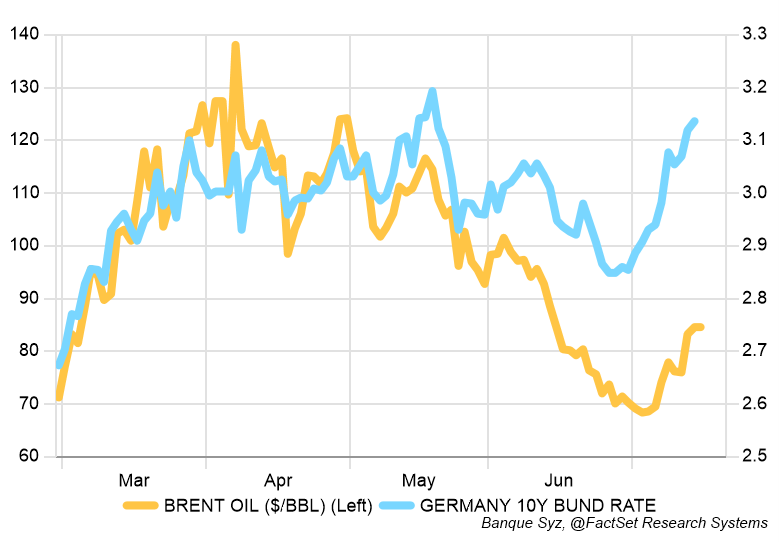
Oil prices reassert their influence on euro rates

Brent Oil price and German Bund 10-year yield since March

Since the escalation of tensions in the Middle East in March, oil prices have become the dominant driver of euro-area government bond yields. The strong correlation between Brent crude and German 10-year Bund yields has been particularly evident during periods of heightened geopolitical uncertainty, as higher energy prices have translated into renewed inflation concerns and a more hawkish outlook for the ECB.

The latest rebound in oil prices, triggered by renewed tensions around the Strait of Hormuz, has once again pushed European yields higher. Markets have responded by pricing in additional ECB tightening, while concerns over the inflationary impact of rising energy costs have outweighed soft macroeconomic data. German 10-year yields have consequently retraced much of their earlier decline, closely tracking the recovery in Brent prices.

What happened last week?

Central banks

The Federal Reserve generally struck a more hawkish tone in the recent days, even if the latest CPI inflation report showed milder than expected inflationary pressures in June. In his first congressional testimony as Chair, Kevin Warsh stressed the Fed’s independence and reaffirmed that restoring price stability remains the overriding objective after years of above-target inflation. He dismissed the softer-than-expected June CPI report as insufficient evidence that the inflation battle has been won and indicated a willingness to consider further tightening if needed. Earlier in the week, Governor Christopher Waller also warned that another strong core inflation reading could justify higher rates. Minutes from the latest FOMC meeting also pointed to the same direction, showing policymakers have abandoned any easing bias and now view inflation risks linked to energy, tariffs and AI-driven demand as the dominant policy concern. In this context, markets continue to expect at least one rate hike from the Fed by the end of 2026.

The ECB also remains focus on potential inflationary risks. Higher oil prices recently revived inflation concerns and minutes of the June meeting (when the key rate was raised by 25bp) emphasized a measured approach, with policymakers avoiding any pre-commitment on the future rate path. Market expectations for ECB rates have risen again with the latest rise in oil prices, and future rates now price an increase of 40bp by year end (i.e. one 25bp rate hike and a 60% probability of a second one). Expectations for BoE rates rose in parallel and also sit between one and two rate hikes by the end of the year.  

Credit

Corporate credit spreads were resilient last week despite higher government bond yields and the renewed US-Iran tensions. Total returns were broadly flat across high yield segments but negative in investment grade (IG). Rising U.S. Treasury and Bund yields were weighing on IG segment due to their longer duration nature.

Since mid-May, oil prices have fallen sharply while government bond yields have continued to rise, highlighting that interest rates, not energy prices, remain the primary driver of credit valuations.

Credit spreads in fact tightened across U.S. HY, EUR IG and EUR HY. The only exception was U.S. IG, where spreads widened modestly by 2 basis point (bp) to 77bp, reflecting exceptionally heavy primary issuance rather than deteriorating credit quality.

Amazon's $25 billion bond offering brought global hyperscaler issuance to nearly $200 billion year-to-date. Oversubscription for these jumbo technology transactions has declined to around 2x, compared with more than 4x late last year, suggesting some investor fatigue. Nevertheless, demand for non-USD hyperscaler issuance, particularly in euros and Swiss francs, remains strong.

EUR IG recorded another week of solid inflows, concentrated in intermediate maturities, while long-duration funds had four consecutive weeks of outflows. EUR HY also attracted fresh inflows.

On the corporate front, S&P downgraded Oracle to BBB- (Stable), citing higher-than-expected cash burn related to AI investments. Nevertheless, its legacy enterprise software business continues to generate recurrent cashflow.

Looking ahead, higher all-in yields should continue to underpin investor demand. Last week, all-in yield increased by 10 bp higher to 5.3% in U.S. IG and 3.6% in EUR IG, offering attractive income without materially increasing default risk.

Rates

Government bond markets were under pressure from renewed geopolitical tensions and a resulting rise in oil prices, even if softer US inflation data moderated the impact on US Treasuries compared to European sovereign yields. In the US, Treasury yields initially moved higher but reversed sharply following a much weaker-than-expected June CPI report. Headline inflation recorded its largest monthly decline since April 2020, while core CPI unexpectedly posted its first monthly fall in more than four years, reinforcing expectations that underlying price pressures are easing. The 10-year Treasury yield rose toward 4.6%, while the 2-year yield climbed toward 4.3% before retracing after the release of the CPI report that triggered a broad rally across the front end of the Treasury curve and a modest bull steepening.

In Europe, German Bunds and other core sovereign bonds underperformed US Treasuries as higher oil prices and geopolitical tensions rekindled inflation concerns. Yields across the German, French and Dutch curves moved modestly higher, while peripheral spreads remained broadly stable as investors balanced stronger inflation risks against still-subdued economic growth. Although Brent crude briefly climbed above USD 87/bbl before retreating, energy prices and developments in the Middle East remained the main drivers of inflation expectations, yield volatility and sovereign bond market performance.

Emerging market

Emerging market (EM) USD credit posted modest negative returns last week despite tighter credit spreads, as higher U.S. Treasury yields outweighed resilient credit fundamentals.

Renewed inflationary pressures are expected to slow EM growth in 2026. Meanwhile, a Super El Niño heatwave could pose an upside risk to food inflation later this year, Nevertheless, the sharp decline in oil prices in recent months, despite the unresolved U.S.-Iran conflict, suggests inflationary pressures should eventually ease. This could pave the way for monetary easing in Brazil, Colombia and Mexico, where real interest rates remain elevated. Beyond this, inflation is expected to moderate, supporting a recovery in growth in 2027.

Fiscal spending has generally remained disciplined across emerging markets. However, higher energy costs have recently widened fiscal deficits in some countries as governments expanded subsidies to shield households, particularly in Indonesia. On the other hand, Argentina, Peru and Chile should maintain very prudent budget management.

In fact, EM sovereign balance sheets have overall strengthened as hard-currency debt has fallen to around 23% of total public debt, from 28% before the pandemic. However, with fiscal deficits still elevated and investor demand remaining buoyant, EM sovereign issuance in international markets is likely to pick up.

Fund flows into EM debt have stayed positive year-to-date, extending the strong inflows seen in 2025 after three consecutive years of outflows. However, the annual USMCA review (US-Mexico- Canada Agreement) is likely to keep Mexico's trade relationship with the U.S. under scrutiny.

We continue to expect carry to be the primary driver of EM returns. The wide dispersion in EM credits fundamentals create selective opportunities, particularly at the short end of the credit curve, where investors can capture attractive yields without taking excessive credit risk.


Our view on fixed income 

Rates
NEGATIVE in current environment

We maintain a Negative stance on government bonds. Government bonds now face a less negative outlook with the decline in oil prices and the commitment of central banks to contain inflationary pressures. However, they still appear less attractive than IG credit in a scenario of rangebound rates. Government bonds still don't bring true diversification in multi-asset portfolios. 


Investment Grade
NEUTRAL, harvest the carry
We continue to find Investment Grade corporate bonds attractive, given their yield level and our still constructive economic scenario over the medium term. However, still tight credit spreads reduce the margin for safety, especially in a more uncertain macro-economic environment. As a result, we keep a Neutral stance on Investment Grade credit from an asset allocation perspective. 
High Yield
NEUTRAL, go short-term

We like High Yield bonds with short maturity for their attractive combination of yield and low sensitivity to interest rate movements. HY spreads remain tight, and those tight spreads are not attractive for medium-to-long term maturities as they do not compensate adequately for a potential deterioration in the economic environment. As such, we hold a Neutral view for High Yield in an allocation, with a clear preference for short-duration investments. We still find value in subordinated debt. 

 
Emerging Markets
NEUTRAL, with opportunities
EM debt remains our favored segment of the Fixed Income market. EM debt faces the recent strengthening of the USD and the impact of lower oil prices on Energy producers, but it remains supported by robust fundamentals. Global growth dynamics, contained public debt & corporate leverage are supportive for EM debt. This is largely reflected in current tight spreads’ levels. In this context, we stay selective, favoring short and medium-duration opportunities within EM Debt. 

Disclaimer

This marketing document has been issued by Bank Syz Ltd. It is not intended for distribution to, publication, provision or use by individuals or legal entities that are citizens of or reside in a state, country or jurisdiction in which applicable laws and regulations prohibit its distribution, publication, provision or use. It is not directed to any person or entity to whom it would be illegal to send such marketing material. This document is intended for informational purposes only and should not be construed as an offer, solicitation or recommendation for the subscription, purchase, sale or safekeeping of any security or financial instrument or for the engagement in any other transaction, as the provision of any investment advice or service, or as a contractual document. Nothing in this document constitutes an investment, legal, tax or accounting advice or a representation that any investment or strategy is suitable or appropriate for an investor's particular and individual circumstances, nor does it constitute a personalized investment advice for any investor. This document reflects the information, opinions and comments of Bank Syz Ltd. as of the date of its publication, which are subject to change without notice. The opinions and comments of the authors in this document reflect their current views and may not coincide with those of other Syz Group entities or third parties, which may have reached different conclusions. The market valuations, terms and calculations contained herein are estimates only. The information provided comes from sources deemed reliable, but Bank Syz Ltd. does not guarantee its completeness, accuracy, reliability and actuality. Past performance gives no indication of nor guarantees current or future results. Bank Syz Ltd. accepts no liability for any loss arising from the use of this document.

Read More

Straight from the Desk

Syz the moment

Live feeds, charts, breaking stories, all day long.

Thinking out loud

Sign up for our weekly email highlighting the most popular posts.

Follow us

Thinking out loud

Investing with intelligence

Our latest research, commentary and market outlooks