.png)
What happened last week?
At Jackson Hole, Fed Chair Powell acknowledged upside inflation risks and rising employment concerns, hinting that the Fed may adjust policy to bring its key rate closer to neutrality. Strong US PMIs and July’s above-expectation PPI and CPI data support continued price pressures, though softening labour data—like downward revisions to payrolls—complicate the outlook. Markets now assign a 85% probability to a rate cut in September, and over two rate cuts by year-end. Separately, Trump’s threat to remove Fed Governor Lisa Cook raised concerns about the Fed’s independence, potentially undermining investor confidence in US monetary policy and the US dollar.
In the Eurozone, negotiated wages’ growth picked up in Q2, from +2.5% to +4.0% YoY. This indicator is closely followed by the ECB for gauging underlying inflationary pressures. This pickup in wage growth, along with reassuring economic indicators in August, further increases the likelihood that the ECB may have already reached the end of its easing cycle. Future markets currently assign a 40% chance of a 25bp cut by the end of the year (hence a two-third probability that rates will remain unchanged till the end of 2025).
The probability of a rate cut by the Swiss National Bank, that would drive short-term CHF rates back in negative territory, also declined last week (from 40% to 30%).
In the UK, the CPI inflation report for July was released above consensus expectations and continued to fuel the repricing in BoE rate cut expectations at play since the beginning of the month. Future markets now assign only a 45% probability of a 25bp rate cut by the end of the year (vs a 60% chance a week ago and close to 100% at the beginning of August).
In Sweden, the Riksbank kept its key rate unchanged at 2.0% last week, as expected. Future markets continue to price a 25bp rate cut by the end of 2025 as the most likely scenario (80% probability).
Last week also saw the Bank Indonesia cut its key rate by 25bp to 5.00%, the 4th rate cut of the easing cycle that started a year ago.
The People’s Bank of China left its key 1-year and 5-year Prime Loan rates unchanged, respectively at 3.0% and 3.5%.
Credit markets continued to attract substantial inflows into EUR Investment Grade, EUR High Yield and US Investment Grade segments.
The prospect of Fed cuts in coming FOMC meetings and a still-high bar for recession suggest a benign environment for credit investors.
Corporate fundamentals remain supportive. US corporates closed the first half of the year on a constructive note: margins edged higher, leverage held stable, and tariff impacts in Q2 were largely manageable. By sector, industrials and consumer face the largest cost pressures, but proactive cost controls, supply-chain adjustments, and pricing actions are expected to offset much of the headwind by year-end. Telecoms and consumer staples experienced only modest direct tariff effects, with Management stressing operational flexibility.
Performance was broadly positive. US Investment Grade and US High Yield ETFs advanced last week (Vanguard USD Corporate Bond ETF and iShares Broad USD High Yield both +0.6%), supported by lower US Treasury yields. In Europe, EUR Investment Grade ETFs posted a modest gain (+0.1%). EUR High Yield slipped slightly (-0.1%) as spreads widened, though it remained tighter than US High Yield.
Looking ahead, September’s heavy issuance calendar may weigh on spreads. Positively, attractive yields, strong technical support from fund flows, and steady coupon reinvestment should limit the extent of any widening.
U.S. Treasury yields ended lower last week despite an earlier increase following the release of strong August flash PMIs. Jerome Powell’s speech in Jackson Hole led to a sudden drop in USD yields at the end of the week as it hinted at potentially more Fed rate cuts than what was previously expected, and at the same time conveyed a less upbeat view of labor market developments that could weigh on growth and inflation going forward.
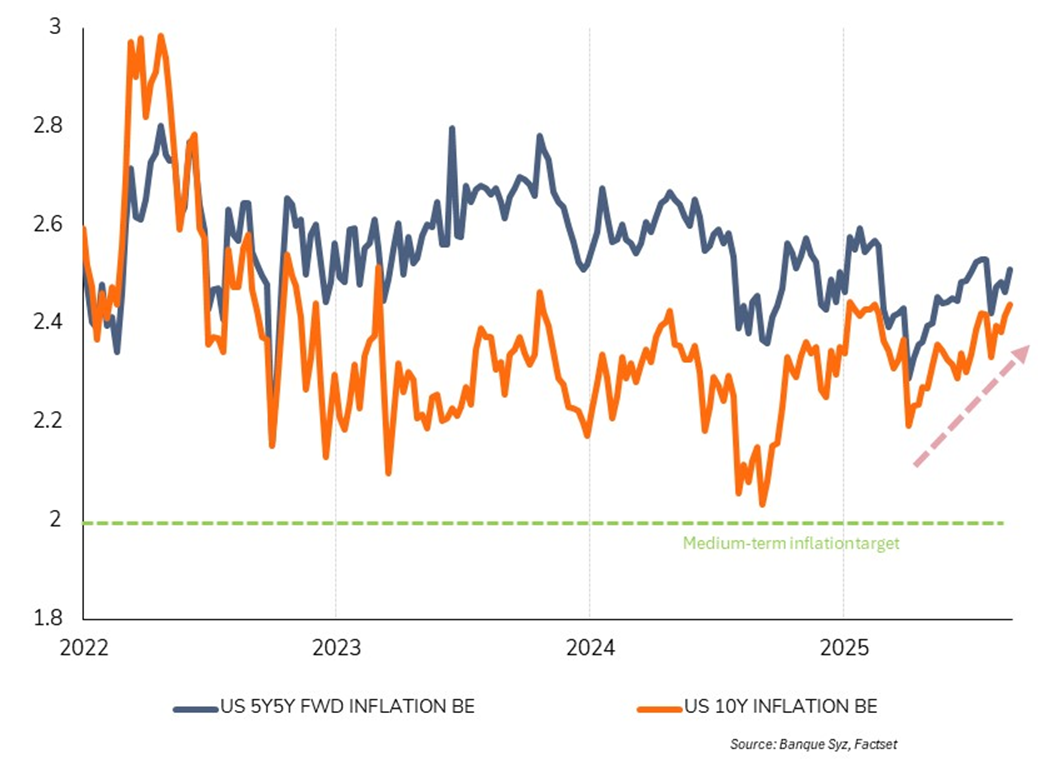
USD rates declined across all maturities: the US Treasury 2y yield was down -5bp to 3.70%, the 5y fell by -8bp to 3.76% while the 10y was down -6bp to 4.25% and the 30y drifted -4bp to 4.88%. Interestingly, the combination of a potentially more accommodative FFed’s monetary policy and of continuing political influence on the Fed likely was behind a pickup in inflation expectations. The US 10-year inflation breakeven rate rose +3bp and contributed to an outperformance of TIPS over nominal US Treasury bonds.
Indeed, the iShares USD TIPS ETF was up +0.8% last week, while the broad USD Treasuries ETF rose by +0.3%. US Treasury ETF’s performances were positive in absolute terms across all maturities: +0.2% for the 1-3y, +0.4% for the 3-7y, +0.6% for the 7-10y and +0.7% for longer-term bonds.
EUR rates also rose last week amid reassuring economic data including better-than-expected PMI activity indicators for August. As in the US markets, yields declined across all maturities, with the German 2y down -3bp to 1.95%, the 5y losing -6bp to 2.28% and the 10y down -7bp to 2.72%. Yields also declined for other European sovereigns, even if the movement was slightly less pronounced (France 10y -5bp to 3.42%, Italy 10y -6bp to 3.53%, Spain 10y -5bp to 3.30%).
Emerging market
Sovereign USD bonds advanced again last week, driven by lower US Treasury yields and growing expectation of Fed rate cuts. Ukrainian bonds rallied, buoyed by ongoing negotiations with the US and Europe that raise hopes for a possible ceasefire with Russia.
In Argentina, President Javier Milei narrowly blocked a proposed pension increase, consistent with his austerity agenda and offering markets some relief.
The political agenda will become busy in the coming months, particularly in Latin America, with major elections in Argentina (October 2025), Chile (November 2025), Colombia (March 2026), Peru (April 2026) and Brazil (October 2026). While this could drive more disciplined fiscal policies, it could also create episodes of market volatility.
Performance remained broadly positive. Both EM USD sovereign bond and corporate bond indices gained +0.3% on the week. The VanEck J.P. Morgan EM Local Currency Bond ETF rose +0.5%, while the iShares USD Asia High Yield Bond ETF slipped -0.2%.
Despite tight EM credit spreads, EM bonds should be supported by a weak dollar and the highly anticipated Fed easing cycle.