Maggie Cheng

Senior Fixed Income Analyst

Adrien Pichoud

Head of Fixed Income

The Chart of the week

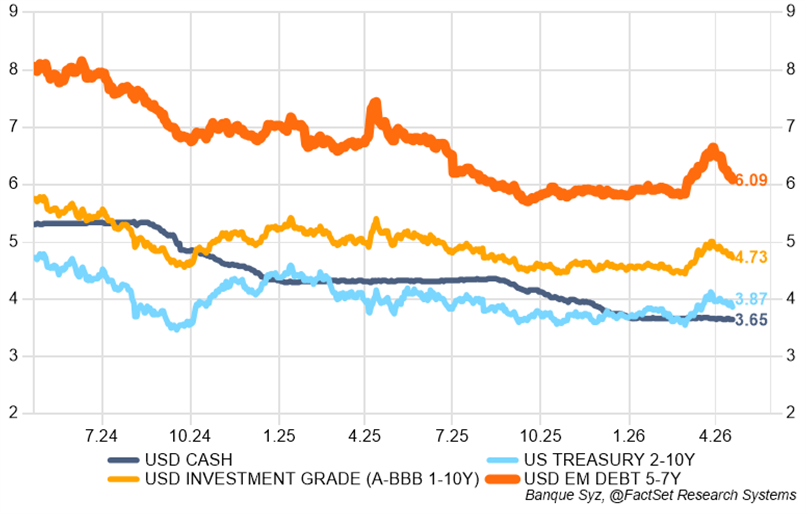
Emerging Market yields attract inflows again

EM debt proved its mettle in March. Despite the geopolitical and energy price shocks, Investment Grade spreads widened only marginally—broadly in line with moves seen in US and European credit markets. The uptick in yields was primarily a rates story, driven by higher US Treasury yields, rather than any meaningful deterioration in EM credit spreads. And since early April, the reversal has been swift and striking.
That shift has not gone unnoticed. Flows into Global EM funds turned positive last week, as investors were attracted by the asset class’s most compelling features: yield. The premium over Investment Grade credit indeed remains substantial.

Crucially, this is not just a yield story, it’s also a quality story. Many EM issuers enter this phase with solid balance sheets, often carrying less leverage than their developed market peers, and supported by robust standalone credit profiles.

In a world where global growth continues to hold up, EM debt stands out: not simply as a high-yielding alternative, but as a segment where carry and credit fundamentals are increasingly aligned.  

What happened last week?

Central banks

The Federal Reserve remains firmly in wait-and-see mode ahead of its April 29th meeting, as the Iran conflict sustains inflation uncertainty via higher energy prices. Officials including Austan Goolsbee and Beth Hammack signaled last week rates are likely to stay on hold, with two-sided risks depending on inflation persistence and labor market resilience. While some, such as Christopher Waller, warn inflation risks may be underpriced, others like Stephen Miran still see scope for cuts later this year. Political uncertainty also lingers around leadership, with Kevin Warsh’s nomination in focus ahead of its confirmation hearing on April 21st. Markets expect no change at the April meeting and there is still only a 35% chance of one 25bp rate cut by the end of the year.

The European Central Bank faces a “delicate” balancing act ahead of its April 30th meeting. Policymakers including Joachim Nagel and Christine Lagarde stress high uncertainty around energy prices and inflation spillovers. Markets continue to price a status quo at the next meeting and at least two rate hikes by the end of the year. But officials emphasize optionality, with no pre-commitment as they assess growth risks and second-round effects.

At the Bank of England, divisions are emerging as the April 30th meeting looms. Huw Pill leans hawkish, warning against inaction, while Megan Greene sees limited need for aggressive tightening. The next policy meeting appears likely to be less consensual than the previous one but markets still expect no change in rate. One or two 25bp rate hikes are still expected for the second half of the year.

While the next scheduled policy meeting is still far away (June 18th), the Swiss National Bank has communicated a still dovish stance, keeping rates at zero while prioritizing FX intervention readiness. President Martin Schlegel views current inflation as temporary, with risks tied mainly to global developments and franc strength. Despite this rather dovish rhetoric, future markets continue to attach a moderate probability of an SNB rate hike in the second half of the year (60%). 

Credit

The peace talks triggered a V-shaped recovery even after the US and Iran failed to reach a lasting agreement on reopening the Strait of Hormuz. Brent crude oil prices were broadly unchanged week over week but will remain volatile as the Strait of Hormuz opens and closes.

Total returns were positive across credit segments last week, as a result of both tighter corporate credit spreads and lower U.S. Treasury and German Bund yields. EUR investment grade (IG) rebounded more quickly than during the initial phase of Russia–Ukraine de-escalation.

Fund flows into credit funds have recovered as rate volatility eased. EUR IG currently offer yields well above levels seen over the past 20 months. EUR high yield (HY) recorded their first weekly inflow after seven consecutive weeks of outflows.

A large majority of consumer goods company now trade tighter than pre-conflict levels, given expectations of government support to cushion the cost-of-living impact. IG energy spreads are at all-time tights. The software sector also rebounded quietly last week, with discounts to net asset value among listed BDCs (Business Development Companies) beginning to stabilise.

In any case, software represents less of a credit risk concern in Europe than in the US. The primary risk within EUR high yield (HY) lies in the chemicals sector, where Chinese overcapacity and dumping of chemical products abroad pose a real threat to European chemical companies.

U.S. Big Banks kicked off 1Q earnings with another strong quarter. Goldman Sachs, Bank of America, JP Morgan and Morgan Stanley all released a double-digit earnings growth. For the remainder of the year, their capital markets outlooks remain largely optimistic: the good momentum in dealmaking, and elevated client activity in the volatile market conditions. U.S. Banks see continued resilience in consumer credit and spending trends in the face of Iran situation and energy prices.

Despite the sharp market recovery, credit dispersion continues to create opportunities, with some issuers still trading wider than pre–U.S.–Iran conflict levels. Moreover, credit inflows are expected to persist in the coming weeks, if rate volatility decline further while interest rates remain elevated.

Rates

Sovereign bond markets rallied over the week, as easing concerns around an energy-driven inflation shock supported a broad decline in yields across major economies. In Europe, the shift in monetary policy expectations was particularly pronounced: the probability of an April ECB rate hike dropped sharply from 34% to just 9%. This repricing drove a significant bull steepening in core curves, with German 2-year Bund yields falling 19bps to 2.41%—their largest weekly decline since April 2025—while 10-year yields declined 10bps to 2.96%.

Peripheral spreads also tightened amid the rally, with 10-year yields in France (-13bps), Italy (-17bps), Spain (-13bps), Portugal (-12bps), and Ireland (-12bps) all moving lower. In the US, Treasuries followed suit as markets increasingly priced in policy easing, with the implied probability of a Fed rate cut by December rising to 61% from 26% the prior week. Yields declined across the curve, led by the front end (2-year -9bps), while 10-year yields fell 7bps to 4.25%. Both real yields (-4bps) and breakevens (-3bps) edged lower.

Performance across fixed income ETFs was positive, particularly in longer-duration segments, reflecting the supportive rate backdrop. 

Emerging market

Emerging market (EM) sovereign USD bonds posted another strong rebound last week. Argentina, Colombia and Hungary were among the outperformers, while China and Romania lagged, albeit still recording moderate gains.

EM corporate credits followed a similar recovery trend. Latin American high yield corporates have proved the most resilient segment, as they benefit from energy producer returns and the conflict hit corporates differently across regions. The worst performers were property and energy companies directly exposed to the conflict.

Global EM funds recorded their first weekly inflow after five consecutive weeks of outflows.

Higher oil prices have supported the rally in Venezuela and PDVSA bonds. However, the market might have overlooked the government’s prioritisation of reconstruction and imports over servicing legacy debt, with rising imports potentially weighing on repayment capacity.

In its first 100 days, the Venezuelan government under Delcy Rodríguez has accelerated the reopening of the oil and gas sector, supported by U.S. licences allowing Chevron, Shell and Repsol to expand joint ventures with PDVSA.

However, President Trump’s Executive Order has restricted any private credit claims on Venezuela’s oil revenue, which is the only real USD source. At the same time, significant operational hurdles persist, including power shortages, lack of diluent to Venezuela’s heavy crude, insufficient storage capacity and equipment. A recovery in oil production to the ~3.5 million barrel per day (bpd) levels seen in the 1990s could take at least one to two decades, from currently 990,000 bpd.

Given the commodity-driven nature of these economies, improved fiscal discipline, and generally conservative corporate balance sheets, EM credits could remain resilient, provide that credit selection remains rigorous.



Our view on fixed income 

Rates
NEGATIVE in current environment

We maintain a Negative stance on government bonds. Renewed price pressures from the surge in oil & gas prices and prospects of more profligate fiscal policies reduce the attractiveness of long-term government bonds as a potential hedge for economic downturn. Reduced prospects of further central banks’ rate cuts and unattractive yield curve slopes at the front-end also lower the attractiveness of government bonds on short-to-medium term maturities. 


Investment Grade
NEUTRAL, harvest the carry
We continue to find Investment Grade corporate bonds attractive, given their yield level and our still constructive economic scenario over the medium term. However, tight credit spreads reduced the margin for safety. As a result, we keep a Neutral stance on Investment Grade credit from an asset allocation perspective. The credit market's overall health is supported by robust demand and strategic maturity management.
High Yield
NEUTRAL, go short-term

We like High Yield bonds with short maturity for their attractive combination of yield and low sensitivity to interest rate movements. HY spreads remain tight, and those tight spreads are not attractive for medium-to-long term maturities as they do not compensate adequately for a potential deterioration in the economic environment. As such, we hold a Neutral view for High Yield in an allocation, with a clear preference for short-duration investments. We continue to find value in subordinated debt. 

 
Emerging Markets
NEUTRAL, with opportunities
We advocate for a careful selection of issuers to benefit from attractive absolute yields. Global growth dynamics, contained public debt & corporate leverage in many EM economies along with strong flows are supportive for EM debt However, risks persist, with rich valuations and unpredictable Trump’s policies. Idiosyncratic risks also remain, notably in Brazil and India. Given this backdrop, we stay selective, favoring short and medium-duration opportunities while remaining Neutral on the broad EM debt asset class in a multi-asset portfolio context.

Disclaimer

This marketing document has been issued by Bank Syz Ltd. It is not intended for distribution to, publication, provision or use by individuals or legal entities that are citizens of or reside in a state, country or jurisdiction in which applicable laws and regulations prohibit its distribution, publication, provision or use. It is not directed to any person or entity to whom it would be illegal to send such marketing material. This document is intended for informational purposes only and should not be construed as an offer, solicitation or recommendation for the subscription, purchase, sale or safekeeping of any security or financial instrument or for the engagement in any other transaction, as the provision of any investment advice or service, or as a contractual document. Nothing in this document constitutes an investment, legal, tax or accounting advice or a representation that any investment or strategy is suitable or appropriate for an investor's particular and individual circumstances, nor does it constitute a personalized investment advice for any investor. This document reflects the information, opinions and comments of Bank Syz Ltd. as of the date of its publication, which are subject to change without notice. The opinions and comments of the authors in this document reflect their current views and may not coincide with those of other Syz Group entities or third parties, which may have reached different conclusions. The market valuations, terms and calculations contained herein are estimates only. The information provided comes from sources deemed reliable, but Bank Syz Ltd. does not guarantee its completeness, accuracy, reliability and actuality. Past performance gives no indication of nor guarantees current or future results. Bank Syz Ltd. accepts no liability for any loss arising from the use of this document.

Read More

Straight from the Desk

Syz the moment

Live feeds, charts, breaking stories, all day long.

Thinking out loud

Sign up for our weekly email highlighting the most popular posts.

Follow us

Thinking out loud

Investing with intelligence

Our latest research, commentary and market outlooks