

.png)
What happened last week?
Federal Reserve: As pressure mounts on Fed Chair Jerome Powell to resign, the Federal Reserve finds itself navigating a complex mix of inflation risks, softening economic activity, political interference, and fiscal expansion.
In a week with limited economic and inflation data, political developments took center stage. President Trump’s public criticism of Powell and renewed calls for aggressive rate cuts have intensified concerns over the Fed’s future independence.
Meanwhile, the threat of increased tariffs on major trading partners by the August 9 deadline is keeping inflation risks elevated—though the erratic nature of trade policy over the past three months makes outcomes hard to predict.
The minutes from the June 18 FOMC meeting revealed a divided committee, with members emphasizing patience amid the prevailing uncertainty. Notably, market expectations for rate cuts remained stable last week despite the volatile news flow, pricing in roughly two 25bp cuts by the end of 2025.
ECB: The European Central Bank faces a less complex environment. Inflation is near its 2% target, and economic activity remains soft but resilient. Following the June meeting and President Lagarde’s remarks, markets are debating whether one final 25bp cut is necessary. The euro’s pullback has helped ease fears of FX-driven deflation, and as a result, the probability of a year-end cut has declined. An additional 25bp cut by the end of the year is no longer being fully taken for granted.
BoE: In the UK, soft macro data—consistent with the Bank of England’s baseline—support the continuation of a quarterly easing cycle.
BoJ: In Japan, reports suggest the Bank of Japan may raise its inflation forecasts at the month-end meeting due to persistent food price pressures. Consequently, the odds of another rate hike this year have increased.
Tariffs have returned to the forefront, with a new round of increases set to take effect across multiple countries on August 1.
After reaching recent lows, U.S. credit spreads widened last week, as renewed tariff headlines and rising Treasury yields erased earlier gains.
Over the weekend, the U.S. announced plans to raise tariffs on EU imports to 30%—up from the initial 20% on Liberation Day, but less than the threatened 50%. EUR credit spreads proved resilient, tightening further.
Corporate bond demand remained robust. U.S. investment grade primary issuance surpassed expectations, highlighted by NTT Finance’s $17.7 billion deal—oversubscribed more than five times with over $100 billion in orders.
Flows into EUR credit remained concentrated in short- and medium-term maturities, supported by fixed maturity fund launches, while longer-dated EUR funds saw outflows.
US investment grade (IG) spreads widened by 3 bps to 83 bps; U.S. high yield (HY) by 17 bps to 297bps, largely reversing the prior week’s tightening.
The U.S. IG bond ETF lost 0.2% (+3.2% year-to-date), with U.S. HY ETF declined 0.1% (+4.5% YTD).
By contrast, EUR IG spreads narrowed by 3bps to 82 bps; EUR HY tightened by 16 bps to 289 bps, but lowest CCC-rated segment underperformed.
Despite tighter EUR credit spreads, higher German Bund yield weighed on total return for EUR IG because of the longer duration nature.
Euro IG ETF loss 0.3% (+1.8% YTD), but Euro HY ETF gained 0.3% (+3.2% YTD).
Riskier segments performed well: euro hybrid corporate bonds gained 0.1% (+3.3% YTD), and Additional Tier-1 bank capital (AT1s) gained +0.2% (+4.6% YTD) as investors sought additional risk premium.
Looking ahead, U.S. and EUR rates could remain volatile, warranting a prudent approach to duration risks.
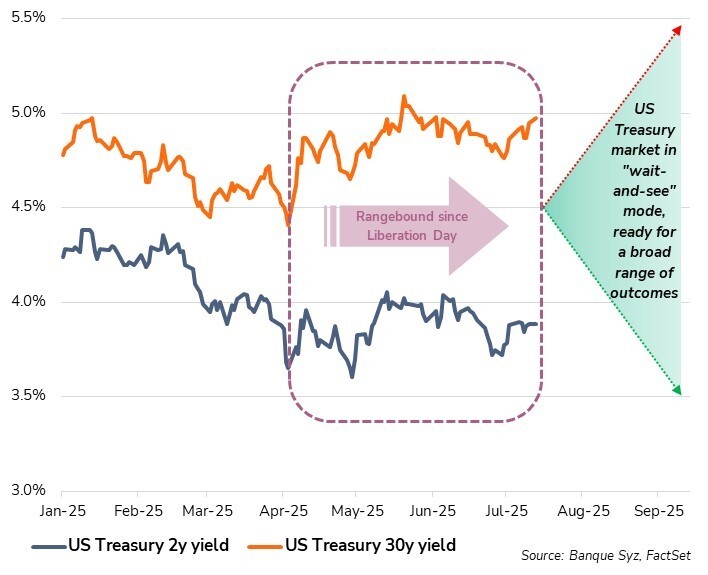
USD interest rates continued their upward trend in July, particularly at longer maturities. Renewed tariff threats and political interference in Fed policy have heightened inflation risks.
The US 10-year inflation breakeven rose 5bp to 2.39%, its highest since the April 2 “Liberation Day” announcements. This reflects growing concerns that tariffs, rising fiscal deficits, and a potential shift in Fed inflation tolerance could drive inflation higher. This rise in inflation expectations pushed the 10-year Treasury yield up 8bp last week to 4.42%. TIPS outperformed nominal Treasuries (iShares USD TIPS ETF was flat for the week).
The yield curve steepened as shorter maturities remained stable while long-end yields climbed. The 30-year yield rose 11bp to 4.97%, nearing the 5% mark. As a result, long-duration US Treasury ETFs posted a second consecutive negative week: iShares 10–20 Year Treasury: -1.0%; iShares 20+ Year Treasury: -1.4%. Shorter-duration ETFs held better, with the short-term 1-3 Year flat and the 3-7 Year losing a modest -0.1%.
European sovereign yields also rose last week, with the German 10-year government yield reaching its highest level since the end of March (+11bp to 2.72%) and Euro sovereign spreads widening on top of the Bund yield rise (French OAT 10y +14bp to 3.42%, Italian BTP 10y +13bp to 3.58%). In this context, the European government bond market lost some ground as well last week: the iShares EUR Government Bonds 3-7y was down -0.5% and the 10-15y equivalent fell -1.3%. Worth highlighting, unlike for USD yields, the rise in EUR yields last week was not driven by higher inflation expectations, but by an increase in real yields. After the volatility of the previous week, GBP yields had a quieter week, with Gilt 10-year yields rising in the wake of global yields but experiencing a milder increase (+7bp to 4.62%). Still, the performance of the iShares UK Domestic Government Bond 3-7 Year was negative (-0.6%).
Finally, in Japan, expectations of upwardly revised inflation forecasts lifted Japanese government bond yields. The JGB 10-year and 30-year yields approached their March peaks—the highest since 2008—at 1.58% and 3.18%, respectively.
Emerging market
Emerging market (EM) sovereign dollar bonds extended their rally, as investors look beyond safe heaven into higher yielding investments. With spreads tightening broadly across the asset class, with Turkey and El Salvador among the top performers.
Romania unveiled a comprehensive package of spending cuts and tax increases to address its fiscal deficit, and the government will seek expedited parliamentary approval next week. Markets responded favorably to the new budget plan, with Romania’s sovereign USD bonds rallying on the news.
Trump threatens extra 10% tariff for “anti-American” BRICS policies. (BRICS: Brazil, Russia, India, China and South Africa).
Vietnam reached a framework deal with the U.S. on a 20 % tariff on most Vietnamese exports and a steeper 40 % tariff targeting “trans-shipments” (Chinese goods routed through Vietnam).
Indonesia is poised to sign an agreement to boost imports of U.S. fuels, agricultural commodities, and critical-minerals projects—to avert the looming 32 % U.S. tariff.
EM sovereign hard currency bond issuance reached $3.1 billion in June - the highest monthly level ever recorded for this period – yet strong investor inflows absorbed the increased supply.
EM local bonds continued their strong performance, buoyed by a weak dollar.
EM government bonds delivered solid returns in both local currency and USD. The VanEck J.P. Morgan EM Local Currency Bond ETF rose 1.0% last week, while the benchmark EM USD sovereign bond index advanced 0.7%.
EM corporate bonds edged up 0.2%, and the iShares USD Asia High Yield Bond ETF climbed 0.4%.