

Adrien Pichoud

Head of Fixed Income

What happened last week?

Central banks

Global central banks remain in an easing stance, with 168 rate cuts over the past year, the fastest pace since 2020 and third-highest in 25 years. Despite global dovishness, the U.S. Federal Reserve remains cautious. A potential government shutdown is unlikely to sway the Fed for now, though a prolonged disruption could prompt risk-management cuts, particularly if it dampens consumption or clouds labor and inflation data.

In political developments, the U.S. Supreme Court rejected former President Trump's request to immediately remove Fed Governor Lisa Cook, keeping her in place until January hearings. Meanwhile, Treasury Secretary Bessent signaled that Fed candidate interviews are progressing, with several names soon to be presented for consideration.

Data-wise, U.S. indicators were mixed: the ADP report showed job losses in September, though alternative data suggested payroll gain. Friday’s ISM services index fell sharply to 50.0, raising stagflation fears, particularly as prices paid unexpectedly rose.

Markets leaned dovish, with Fed rate cut pricing by year-end increasing to 46bps, and the probability of an October cut at 96%.

Elsewhere, the SNB intervened in FX markets for the first time in over three years, while the RBA and RBI held rates steady.

Credit

U.S. credit markets were surprisingly resilient last week amid the US government shutdown. Treasury yields fell across the curve on weaker-than-expected labour data. Credit spreads showed only limited widening in high yield, while investment grade spreads remained stable—more than offset by the lower Treasury yields. Total returns were positive across U.S. credit, with investment grade outperforming on the back of lower Treasury yields.

In Europe, credit market performance was also solid. EUR investment grade spreads were broadly stable, while high yield tightened modestly despite the uptick in euro area inflation in September, keeping total returns in positive territory. Within EUR investment grade, banks and real estate sectors led the gains. We believe the EUR real estate sector still has further upsides, supported by solid rent growth in both residential and retail segments, combined with a stable interest rate environment - favourable to property valuations.

With the Fed widely expected to cut rates further, while the ECB maintains that it is “in a good place”, some EUR high yields now appear more attractive than U.S. high yield on an FX-hedged basis. Notably, the default rate among EUR BB issuers has remained at zero for the past 14 months.

The Vanguard USD Corporate Bond ETF advanced +0.6%, driven by the decline in Treasury yields—double the prior week’s loss. The iShares Core Euro IG Corporate Bond ETF also gained +0.3%.

In high yield, USD credits slightly outperformed EUR peers, returning +0.3% versus +0.2%, respectively.

Given the favourable rate environment and prudent corporate balance sheet, investing for carry trades remains the dominant investment strategy in the current context.

Rates

Government bonds rallied globally last week, driven by soft U.S. labor data and improved risk sentiment in Europe. U.S. Treasuries saw strong demand as the ADP report pointed to private sector job weakness, while official data was delayed due to the shutdown. The 2-year yield fell 7bps to 3.58% and the 10-year declined 6bps to 4.12%, although both reversed slightly on Friday (+3.7bps and +3.6bps respectively). Breakevens narrowed 4bps, while real yields eased modestly.

In Europe, bond markets also advanced. The 10-year Bund yield fell 5bps to 2.70%, with French OATs (-6bps) and Italian BTPs (-7bps) outperforming ahead of key political developments in France. Peripheral yields, including Spain and Portugal, tightened by 8bps.

UK 10-year yields declined 6–8bps, while Swiss and Japanese yields bucked the trend, edging higher.

ETF performance reflected this rally, with longer-duration U.S. Treasuries outperforming — the iShares 20+ Year Treasury ETF gained 0.54%, while European government bond ETFs also posted gains, led by the iShares EUR 10–15 Year ETF (+0.59%).

Emerging market

Emerging Market (EM) sovereign USD bonds have further reasons to stay bullish, supported by the U.S. government shutdown and a weaker dollar. Argentina’s bonds, while volatile, rebounded after U.S. Treasury Secretary Bessent reaffirmed Washington’s backing.

Global market volatility continued to ease, driving credit spreads to their tightest levels since 2007. Within EM, investment-grade sovereigns outperformed high-yield peers on a total return basis.

In the first nine months of 2025, EM sovereigns issued USD 205 billion in Eurobonds, a sharp increase from USD 149 billion over the same period last year. Meanwhile, global EM debt funds recorded 24 consecutive weeks of inflows, reflecting sustained investor appetite.

Performance remained broadly positive across EM asset classes — both hard-currency and local-currency bonds advanced, with the iShares EM Sovereign Bond ETF and J.P. Morgan EM Local Currency Bond ETF each gaining +0.4%. EM corporates and Asian high yield also rose +0.3%.

While valuations no longer provide a wide cushion against slower global growth, EM yields and carry remain attractive, and a weaker USD continues to lend meaningful support to the asset class.

Our view on fixed income 

Rates
NEGATIVE in current environment

We shift to a Negative stance on government bonds. Positive global growth dynamics, price pressures in the US and profligate fiscal policies reduce the attractiveness of long-term government bonds as a potential hedge for economic downturn and increase the risk of higher long-term yields. Limited prospects of further central banks’ rate cuts and unattractive yield curve slopes at the front-end also reduce the attractiveness of government bonds on short-to-medium term maturities. 


Investment Grade
NEUTRAL, harvest the carry
We continue to find Investment Grade corporate bonds attractive in the current environment, given their yield level and our constructive economic scenario. However, tight credit spreads have reduced the margin for safety in credit, that can be deemed as expensive from a valuation standpoint. As a result, we hold a Neutral stance on Investment Grade credit from an asset allocation perspective. The credit market's overall health is supported by robust demand and strategic maturity management. 
High Yield
NEUTRAL, go short-term

We still like High Yield bonds with short maturity for their attractive combination of yield and low sensitivity to interest rate movements. HY spreads have tightened, signaling economic stability and contained default risk in the short run. However, those tight spreads are not attractive for medium-to-long term maturities as they do not compensate adequately for a potential deterioration in the economic environment. As such, we hold a Neutral view for High Yield in an allocation, with a clear preference for short-duration investments. We continue to find value in subordinated debt.

 
Emerging Markets
NEUTRAL, be selective
We  advocate for a careful selection of issuers to benefit from attractive absolute yields. Substantial inflows into EM debt this year have been fueled by a weak dollar along with EM corporates’ solid credit metrics and support the asset class. However, risks persist, with rich valuations and unpredictable Trump’s trade policies. Idiosyncratic risks also remain, notably in Brazil and India. Given this backdrop, we stay selective, favoring short-duration opportunities while remaining Neutral on the broad EM debt asset class. 

The Chart of the week

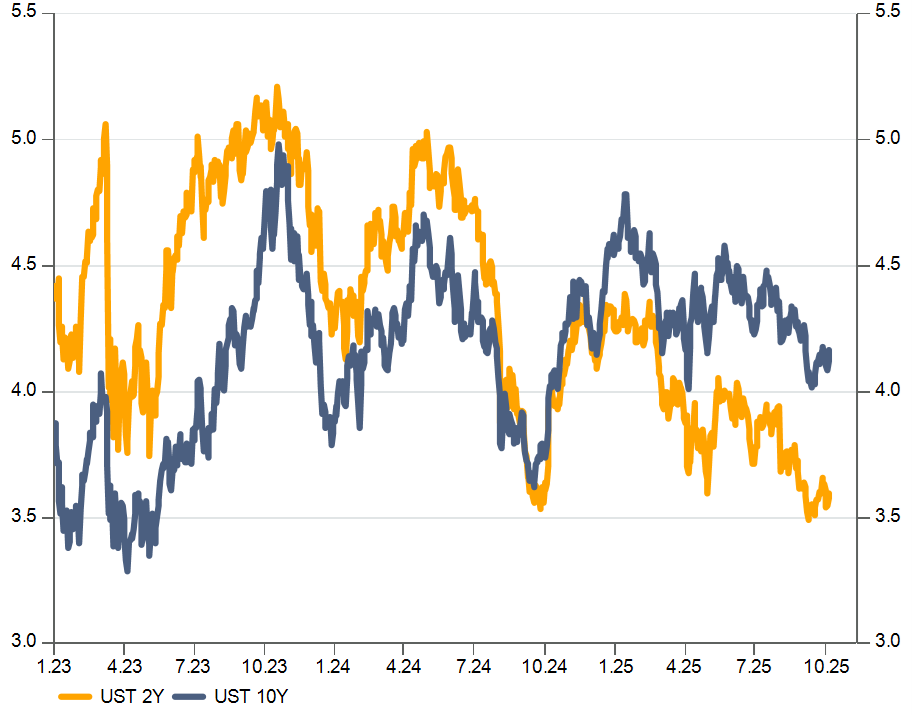
Inflation and public debt fears anchor US long-term rates

Since last August, concerns around the US job market’s dynamic and rising political pressure on the Fed have driven rate cut expectations higher and short-term US Treasury lower. The US Treasury yield has dropped 38bp to 3.58% over the period, close to their lowest level in 3 years.

Long-term US Treasury yields have also declined since August (-25bp for the UST 10y), mostly due to lower real rates while inflation expectations were barely changed.

However, recent developments in the US and the latest available economic data may gradually shift the needle for USD long-term bonds. PMI and ISM indices have pictured a resilient US economy, that might have been growing at a strong 3.8% annualized rate according to the Atlanta Fed GDPNow live estimate.

With lingering inflationary pressures and prospects of resilient domestic demand, US 10-year yields now appear anchored above the 4% level, with limited prospects of extending the downward trend at play since the beginning of the year. Unless of course the ongoing shutdown last for too long and economic data releases postponed for lack of public servants to release them end up being surprisingly negative.

Disclaimer

This marketing document has been issued by Bank Syz Ltd. It is not intended for distribution to, publication, provision or use by individuals or legal entities that are citizens of or reside in a state, country or jurisdiction in which applicable laws and regulations prohibit its distribution, publication, provision or use. It is not directed to any person or entity to whom it would be illegal to send such marketing material. This document is intended for informational purposes only and should not be construed as an offer, solicitation or recommendation for the subscription, purchase, sale or safekeeping of any security or financial instrument or for the engagement in any other transaction, as the provision of any investment advice or service, or as a contractual document. Nothing in this document constitutes an investment, legal, tax or accounting advice or a representation that any investment or strategy is suitable or appropriate for an investor's particular and individual circumstances, nor does it constitute a personalized investment advice for any investor. This document reflects the information, opinions and comments of Bank Syz Ltd. as of the date of its publication, which are subject to change without notice. The opinions and comments of the authors in this document reflect their current views and may not coincide with those of other Syz Group entities or third parties, which may have reached different conclusions. The market valuations, terms and calculations contained herein are estimates only. The information provided comes from sources deemed reliable, but Bank Syz Ltd. does not guarantee its completeness, accuracy, reliability and actuality. Past performance gives no indication of nor guarantees current or future results. Bank Syz Ltd. accepts no liability for any loss arising from the use of this document.

Read More

Straight from the Desk

Syz the moment

Live feeds, charts, breaking stories, all day long.

Thinking out loud

Sign up for our weekly email highlighting the most popular posts.

Follow us

Thinking out loud

Investing with intelligence

Our latest research, commentary and market outlooks