
.png)
Source: Charlie Bilello

We are sorry that for legal reasons we are not able to help US citizens or Canadian residents other than in Ontario, Quebec, or Alberta. Best wishes for the future…
We are sorry that for legal reasons we are not able to help US citizens or Canadian residents other than in Ontario, Quebec, or Alberta. Best wishes for the future…
You chose the following profile. If you made a mistake, please change here USA
This marketing document has been issued by Bank Syz Ltd. It is not intended for distribution to, publication, provision or use by individuals or legal entities that are citizens of or reside in a state, country or jurisdiction in which applicable laws and regulations prohibit its distribution, publication, provision or use. It is not directed to any person or entity to whom it would be illegal to send such marketing material.
This document is intended for informational purposes only and should not be construed as an offer, solicitation or recommendation for the subscription, purchase, sale or safekeeping of any security or financial instrument or for the engagement in any other transaction, as the provision of any investment advice or service, or as a contractual document. Nothing in this document constitutes an investment, legal, tax or accounting advice or a representation that any investment or strategy is suitable or appropriate for an investor's particular and individual circumstances, nor does it constitute a personalized investment advice for any investor.
This document reflects the information, opinions and comments of Bank Syz Ltd. as of the date of its publication, which are subject to change without notice. The opinions and comments of the authors in this document reflect their current views and may not coincide with those of other
Syz Group entities or third parties, which may have reached different conclusions. The market valuations, terms and calculations contained herein are estimates only. The information provided comes from sources deemed reliable, but Bank Syz Ltd. does not guarantee its completeness, accuracy, reliability and actuality. Past performance gives no indication of nor guarantees current or future results. Bank Syz Ltd. accepts no liability for any loss arising from the use of this document.

Charles-Henry Monchau, CFA, CMT, CAIA
Chief Investment Officer
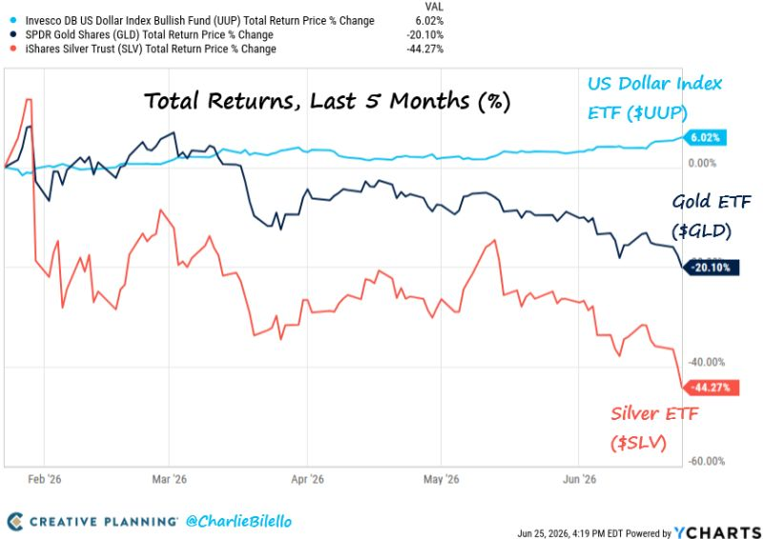
Five months ago, the consensus was clear: the dollar was done, and gold and silver were heading higher.
Five months later:
US dollar: +6%
Gold: -20%
Silver: -44%
Narratives tend to trail prices more often than the reverse. Markets have a way of making consensus views and trades look foolish.
Source: Charlie Bilello
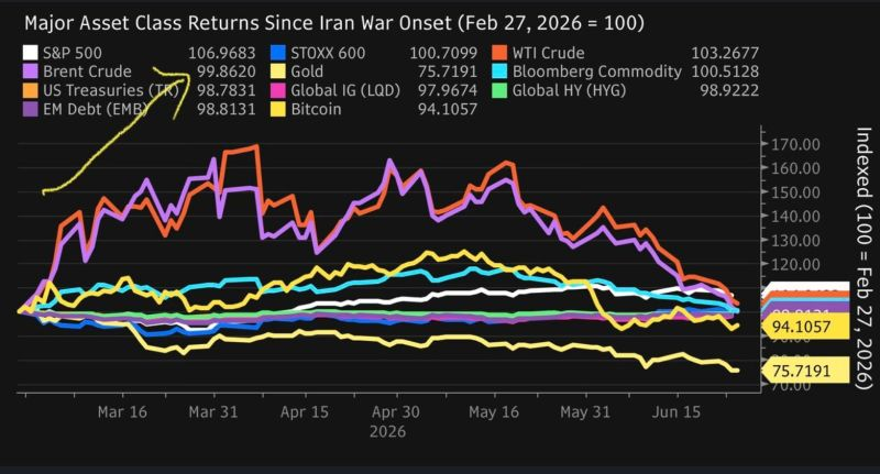
Brent crude has fallen back below the level it was trading at before the Iran conflict started. Let that sink in.
Prices have effectively absorbed the assumption of a clean resolution to one of the most significant geopolitical energy shocks in recent memory.
It is a strong reminder that markets do not wait for clarity before acting, they move on to the most probable outcome.
Yet the disappearance of a geopolitical risk premium from prices does not mean the underlying risk itself has gone away.
 Source: Blackrock, UBS
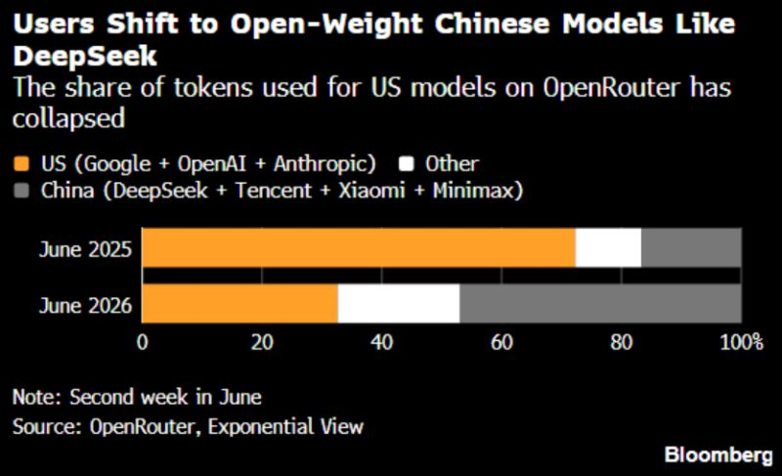
The share of tokens requested from Google, OpenAI and Anthropic dropped to 33% in June 2026, down from 72% a year prior.
Tokenomics matters or will soon enough. The market share gains made by Chinese AI players have been striking.
 Source: Bloomberg, Negligible capital
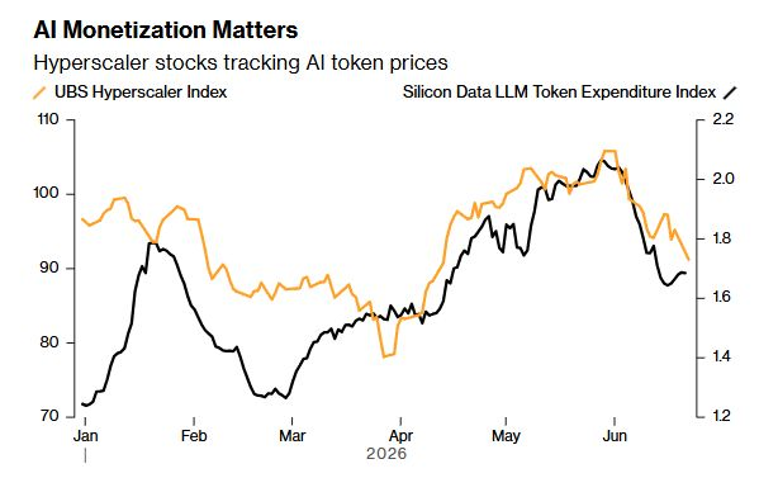
A chart worth paying attention to. Hyperscaler stocks are now tracking the LLM tokens index quite closely, suggesting that AI monetisation is increasingly becoming a meaningful market driver.
Source: C.Barraud, UBS, Bloomberg, Silicon data
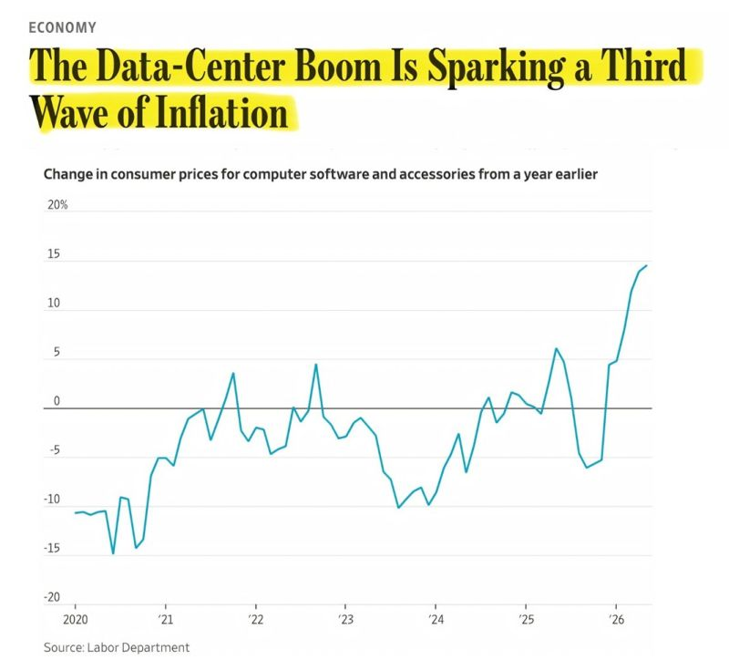
Tim Cook recently remarked that the current cost pressures are unlike anything he has encountered in over 40 years in the industry.
The first inflation wave stemmed from supply chain disruptions. The second was fuelled by tariffs and energy prices. The third could be fundamentally different.
Tariffs can be renegotiated. Oil prices tend to correct as supply responds. AI infrastructure spending does not follow that logic.
This is not a temporary supply shock. It is a large-scale demand shock that remains in its early stages.
The five largest hyperscalers are projected to spend around $741bn on AI infrastructure this year, roughly 75% more than last year. A significant portion of that capital has yet to translate into physical deployments.
That means the price pressures visible today may be the start, not the ceiling.
The reason comes down to components. AI systems require vast quantities of high-bandwidth memory and advanced chips, the same components that go into smartphones, laptops, gaming consoles, cars, and a wide range of other electronics.
As AI companies capture an ever-larger share of available supply, they are not only driving up the cost of AI itself but pushing prices higher across the broader electronics market.
The signs are already there. Apple and Microsoft have raised prices on products including MacBooks, iPads, and Xbox consoles, citing higher component costs and memory constraints. Nintendo and Sony had already flagged similar increases weeks before.
This is not one company absorbing higher costs. It is an entire hardware industry repricing around the same supply bottleneck.
The Federal Reserve's baseline assumption is that AI will eventually counteract these inflationary pressures through productivity gains. That may prove correct in time.
But analysts, including those at UBS, argue that the productivity benefits could take years to fully materialise, while the cost increases are already here.
That puts the Fed in an uncomfortable position: holding rates elevated through a period where the very technology expected to bring inflation down over the long run may be pushing it higher in the near term.
If this dynamic persists, this inflation cycle may turn out to be more complicated than the tariff- and energy-driven shocks policymakers have navigated so far.
Source: Bull Theory on X
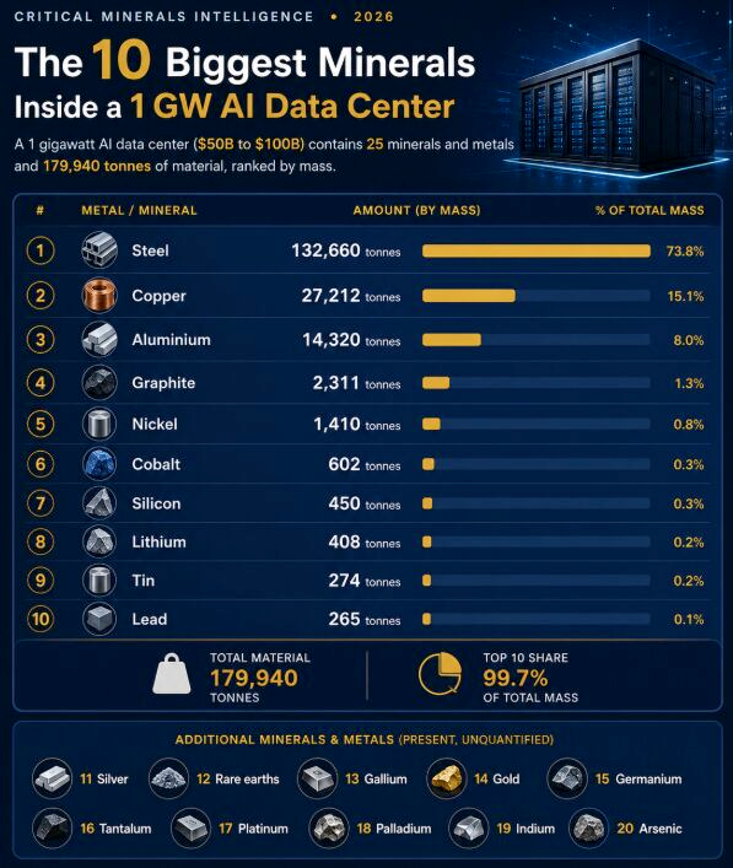
A single AI data centre uses 27,000 tonnes of copper.
Everyone talks about AI chips. Almost nobody talks about the metals beneath them.
A 1-gigawatt AI data centre requires:
• 179,940 tonnes of raw materials
• 25 distinct minerals
• 132,660 tonnes of steel (74% of the total)
• 27,212 tonnes of copper (15% of the build)
Copper is far more than a commodity input. It is the infrastructure that keeps AI alive.
Every server, every rack, every transformer, every kilometre of cable depends on it.
Remove copper from the equation and AI stops working.
Then come the other critical materials:
→ Aluminium: 14,320 tonnes
→ Graphite
→ Nickel
→ Silicon
→ Cobalt
→ Lithium
→ Tin
→ Lead
The top 10 materials account for 99.7% of total mass.
And that is before adding the strategic minerals:
• Rare earth elements
• Gallium
• Germanium
• Tantalum
• Indium
Step back for a moment. Hundreds of AI data centres are going up around the world. Every new gigawatt of AI compute demands tens of thousands of tonnes of copper to be mined, refined, and delivered.
The AI revolution is not purely a software story— it’s a commodities story. Which makes copper miners some of the most overlooked beneficiaries of the AI boom.
Metal must come first. There is no scaling AI without it.
Source: Jack Prandelli on X
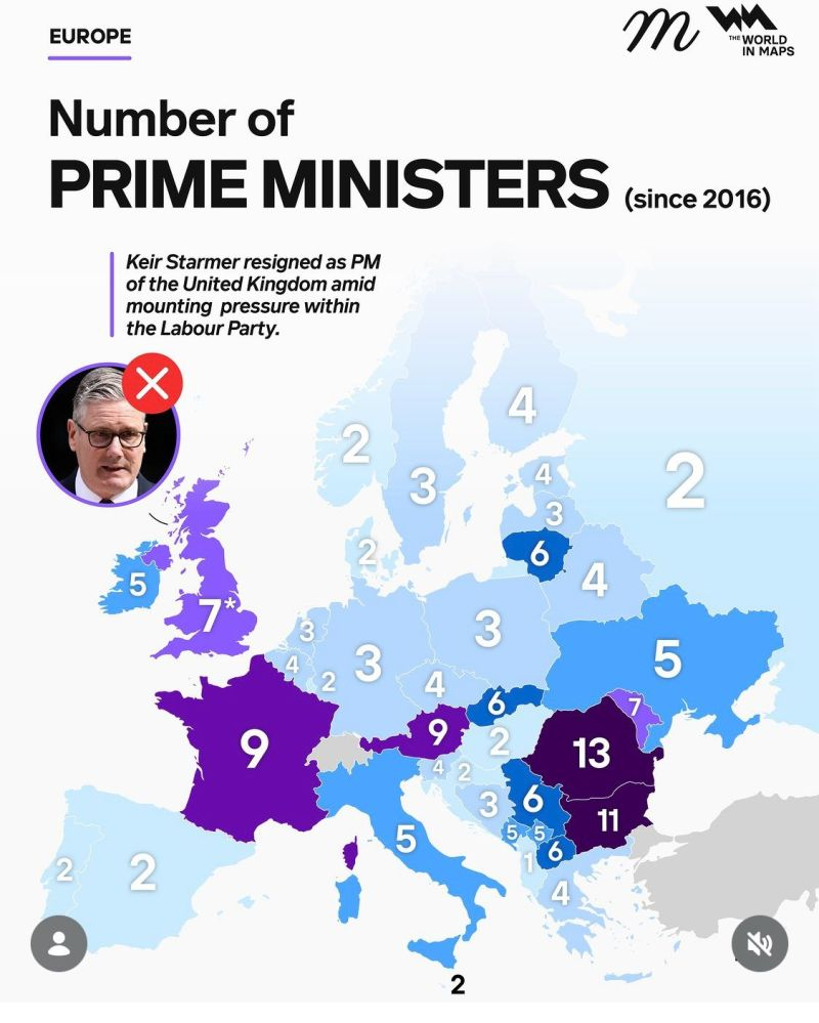
Britain is not alone in Europe when it comes to significant leadership changes at the top.
Source: World in map on X
This marketing document has been issued by Bank Syz Ltd. It is not intended for distribution to, publication, provision or use by individuals or legal entities that are citizens of or reside in a state, country or jurisdiction in which applicable laws and regulations prohibit its distribution, publication, provision or use. It is not directed to any person or entity to whom it would be illegal to send such marketing material. This document is intended for informational purposes only and should not be construed as an offer, solicitation or recommendation for the subscription, purchase, sale or safekeeping of any security or financial instrument or for the engagement in any other transaction, as the provision of any investment advice or service, or as a contractual document. Nothing in this document constitutes an investment, legal, tax or accounting advice or a representation that any investment or strategy is suitable or appropriate for an investor's particular and individual circumstances, nor does it constitute a personalized investment advice for any investor. This document reflects the information, opinions and comments of Bank Syz Ltd. as of the date of its publication, which are subject to change without notice. The opinions and comments of the authors in this document reflect their current views and may not coincide with those of other Syz Group entities or third parties, which may have reached different conclusions. The market valuations, terms and calculations contained herein are estimates only. The information provided comes from sources deemed reliable, but Bank Syz Ltd. does not guarantee its completeness, accuracy, reliability and actuality. Past performance gives no indication of nor guarantees current or future results. Bank Syz Ltd. accepts no liability for any loss arising from the use of this document.
Meanwhile, earnings growth, not valuation expansion, is doing the heavy lifting behind the S&P 500’s rally. Each week, the Syz investment team takes you through the last seven days in seven charts.
Meanwhile, what does Anthropic’s $2tn valuation assume about future growth? Each week, the Syz investment team takes you through the last seven days in seven charts.
Meanwhile, US earnings growth leaves the rest of the world behind. Each week, the Syz investment team takes you through the last seven days in seven charts.
Live feeds, charts, breaking stories, all day long.
Our latest research, commentary and market outlooks