
Charles-Henry Monchau

Chief Investment Officer

Chart #1 — 

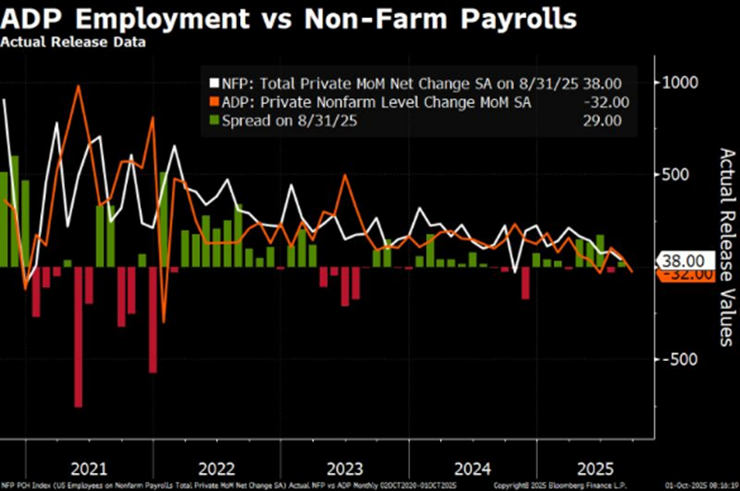
Softening labour market shifts focus from inflation to growth 


US headline inflation edged up from 2.7% to 2.9% in August, yet tariff passthrough proved milder than feared. As a result, market focus shifted from upside inflation risks to growing concerns over economic slowdown. While overall activity data remained solid, labour market conditions softened. In the three months to August, job creation averaged just 29,000 per month, compared with 99,000 in the prior three-month period. The Bureau of Labor Statistics also revised payroll figures down by 911,000 for the year to March 2025, suggesting the economy was less robust than previously thought.

Despite these headwinds, underlying growth remained resilient. Revised GDP data showed the US economy expanding at an annualised rate of 3.8% in Q2, supported by steady consumer spending and contained core inflation.

In the Eurozone, the services sector expanded in Germany, Italy, and Spain, while France continued to lag amid political uncertainty. External demand stayed weak, with export orders falling for the 28th consecutive month.

UK inflation persisted at 3.8% in August, driven by higher food, energy, and utility costs.
Source:  Bloomberg 
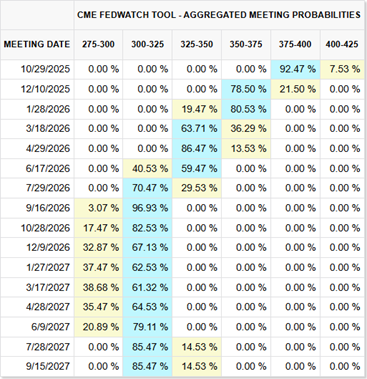

Chart #2  — 

The Fed’s “risk-management cut”

The Fed delivered its first rate cut since the end of last year, lowering its benchmark rate from 4.25-4.50% to 4.00-4.25%. Surprisingly, the decision passed with broad consensus, with only new Fed governor Miran, a President Trump nominee, dissenting in favour of a larger, half-point cut. The Fed’s latest projections show a median forecast of 2 additional cuts this year.

The updated economic projections led to some confusion: median inflation expectations for 2026 and 2027 were revised higher, while unemployment forecasts for the next two years were lowered. Ordinarily, that would suggest fewer rate cuts. Yet the new FOMC outlook shows more cuts ahead. Powell described the move as a ‘risk management cut’, citing new data that points to a higher risk of a faster-than-expected weakening in the labour market.

Overseas, the ECB kept its key interest rate unchanged at 2% in both July and September after seven consecutive cuts. The Bank of England cut rates for the first time since 2020, from 4.25% to 4.0%.

Finally, in Japan, the BoJ held rates at 0.5% despite an inflation level now well above its 2% target and an upward revision of its own inflation forecasts. 

Source:  CME Fedwatch Tool 


Chart #3  — 

US equities: a straight line higher  

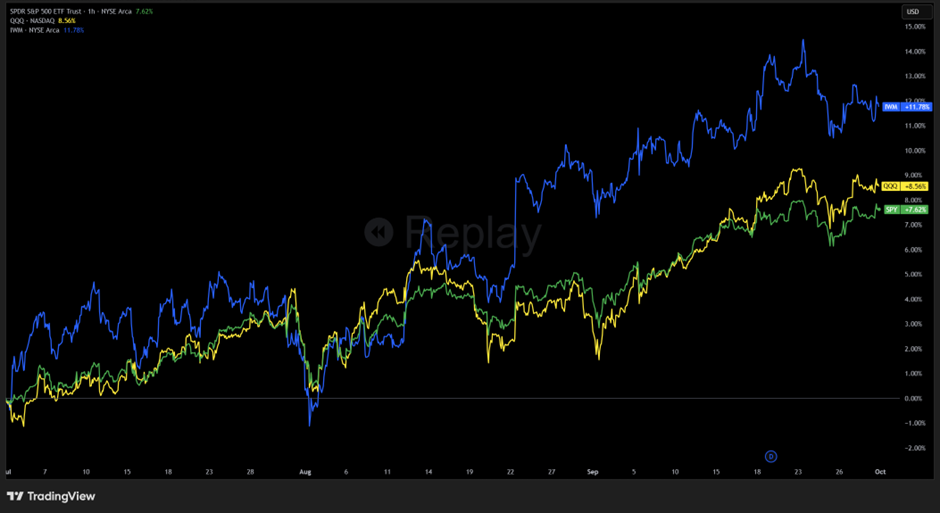
After April’s tariff-driven selloff, markets traced an almost unbroken upward path. The S&P500 rose 8.1%, defying the historically weak September effect.

The rebound was fuelled by easing trade tensions after the US reached agreements with multiple trading partners. Investors grew increasingly confident on the back of solid corporate earnings, signs of economic resilience early in the quarter and growing expectations of Fed rate cuts. Artificial intelligence remained the market's winning theme. Companies continued to unveil substantial AI infrastructure investments, propelling technology stocks higher and reinforcing conviction that the AI boom is far from over.

The Magnificent 7 remained in the lead. Tesla gained nearly 50% over the quarter, driven by a September rush ahead of the $7,500 EV tax credit expiration. Alphabet (38%), Apple (22%) and Nvidia (22%) also posted strong returns.

The September rate cut and improving risk sentiment created a more supportive environment for smaller companies. The Russell 2000 Index jumped 12.4% over the quarter, nearing its record high from November 2021.

Healthcare and consumer staples sectors lagged the broader market. Despite a 3.8% quarterly gain, the healthcare sector remains the only S&P 500 component in negative territory year-to-date. Ongoing challenges including drug pricing reforms, tariff-related uncertainty, and rising operational costs have compressed earnings expectations. Toward the end of the quarter, sentiment in pharmaceuticals improved slightly after a pricing deal with Pfizer. Surprisingly, energy equities (7.35% over the quarter) performed well despite the decline in oil prices.

Source:  Performance comparison of Russell 2000 (IWM), S&P 500 (SPY), and Nasdaq-100 (QQQ), TradingView 


Chart #4 — 

A strong quarter for Asian markets 


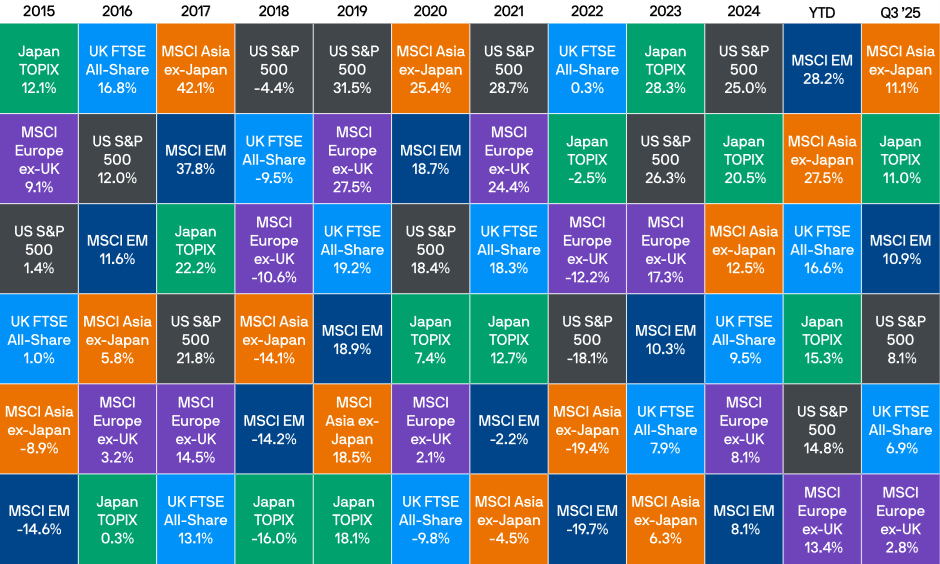
Pushed by the rallying technology sector, the MSCI Asia ex-Japan was the best performing major equity index this quarter, while the MSCI Emerging Markets ranked third. This highlights the outperformance of Emerging Market equities compared to developed markets over the quarter.

The Hang Seng Tech Index gained 22.1% over the quarter, as policy support for domestic chipmakers, alongside an acceleration in AI spend and product rollout from some of China’s biggest tech names like Alibaba and Baidu fuelled the rally. This strong performance highlighted the widening disconnect between Chinese equity performance and the country’s economic fundamentals.

Thailand, Taiwan, and South Korea also posted gains, with major chipmakers Samsung Electronics and SK Hynix riding the wave of tech enthusiasm. India was the laggard, posting a negative return for the quarter as trade tensions with the US intensified following the introduction of a 50% tariff on key Indian exports.

The Japan TOPIX gained 11%, supported by a weaker yen, a US-Japan deal (lowering US tariffs from 25 to 15%), resilient macro data, and ongoing corporate governance reforms. 

Source:  JP Morgan Asset Management 


Chart #5 — 

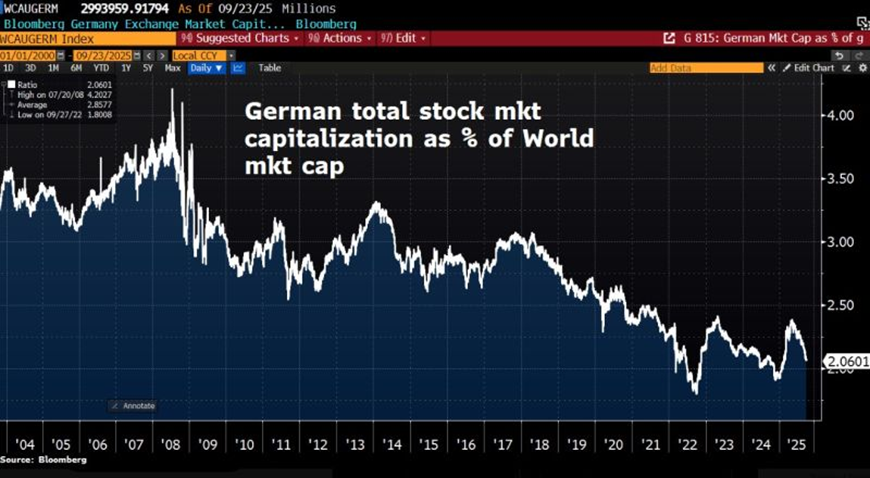
Germany limits Europe’s equity performance  


European equities posted gains in the third quarter, though they lagged global markets. The region’s performance was held back by Germany, where GDP contracted by 0.3% in Q2, worse than expected, raising fears of a potential recession. The weakness was most visible in the auto sector, as profit warnings from Porsche and Volkswagen weighed heavily on sentiment, leaving the DAX as the only major global index to end the quarter in negative territory.

The MSCI Europe ex-UK Index gained 2.8%, dragged down by Germany’s 1.2% decline, while French equities advanced 3.3% despite domestic political instability. Within the eurozone, financials and healthcare led the advance, supported by robust bank earnings, while telecoms and communication services underperformed.

In contrast, UK equities outperformed strongly, with the FTSE 100 recording its best quarter since 2022 and surpassing 9,000 for the first time ever, lifted by strong results from healthcare and defence names such as AstraZeneca, GSK, Rolls-Royce, and BAE Systems.

Source: Bloomberg


Chart  #6 — 

EM debt drives bond market gains 

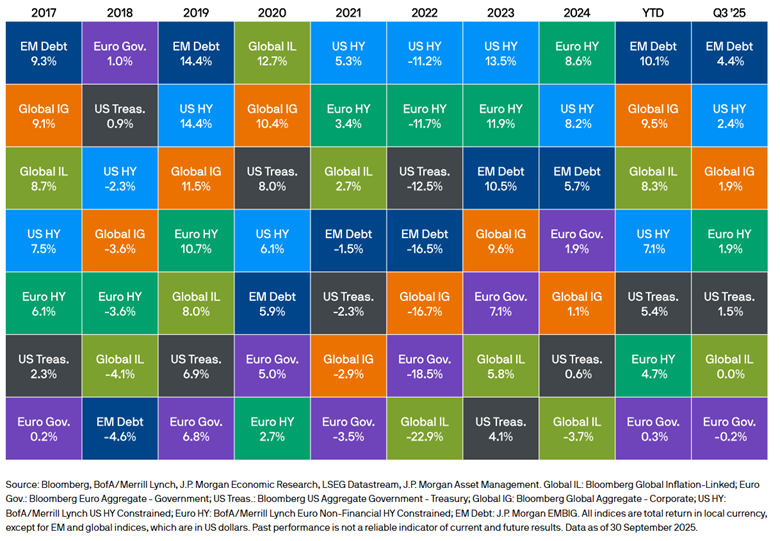
Bond markets remained volatile through the quarter as fiscal concerns and political uncertainty dominated sentiment. Despite the turbulence, the Bloomberg Global Aggregate Bond Index gained 0.6%, supported by a rally in US Treasuries and tighter credit spreads.

US government bonds advanced 1.5%, with short-term yields declining as investors shifted focus from inflation risks to slowing growth. The yield curve initially steepened, reflecting rate-cut expectations and questions over the Fed’s independence.

US investment-grade and high yield spreads tightened to near multi-decade lows. The rally was underpinned by resilient consumer spending, solid corporate earnings, and sustained demand for yield.

Emerging Market debt was the best-performing segment this quarter, rising 4.4% on support from a softer US dollar. In the UK, persistent inflation and fragile government finances ahead of the November budget pushed 30-year Gilt yields in September to their highest level since May 1998.

Japanese government bonds underperformed, falling 1.5%. Political instability following the ruling party’s July election loss and Prime Minister Ishiba’s resignation, combined with hawkish Bank of Japan signals, drove yields higher and weighed on sentiment.


Source: JP Morgan Asset Management 


Chart #7 — 

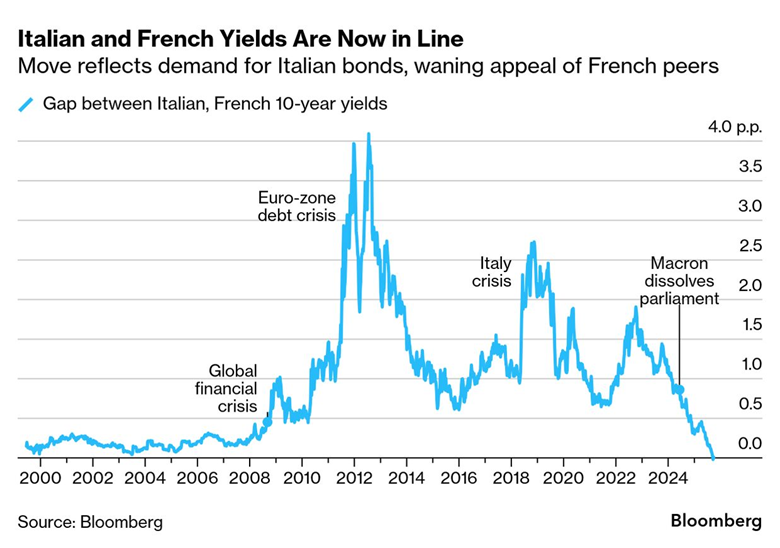
Investors demand a higher risk premium for France 

European government bonds slipped 0.2% over the quarter, and France stood out as the main underperformer.

Political instability resurfaced after President Macron appointed his fifth prime minister in less than two years, who resigned last week, fuelling doubts about the country’s fiscal direction and its ability to address a 6% budget deficit.

The spread between 10-year OATs and German Bunds widened to its highest level since January. France is increasingly viewed as Europe’s new fiscal laggard, with its bond yields now converging toward Italy’s. A record number of European companies, including L’Oréal, Airbus and AXA, are borrowing at lower yields than the French state.

Source: Bloomberg  


Chart #8 — 

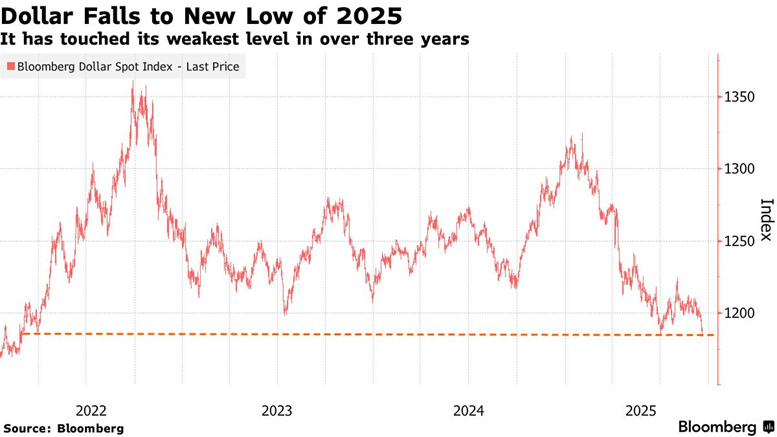
Political shifts fail to lift the dollar 


Despite a rebound in US tech stocks and political shifts in Japan, France, and the UK, none of these developments were sufficient to spark a recovery in the oversold dollar.

Meanwhile, Emerging Market currencies were the best performers. Sovereign debt adjustments boosted the Colombian peso, the Turkish lira, the Brazilian real, and the Mexican peso also saw notable gains.

Source:  Bloomberg 


Chart #9 — 

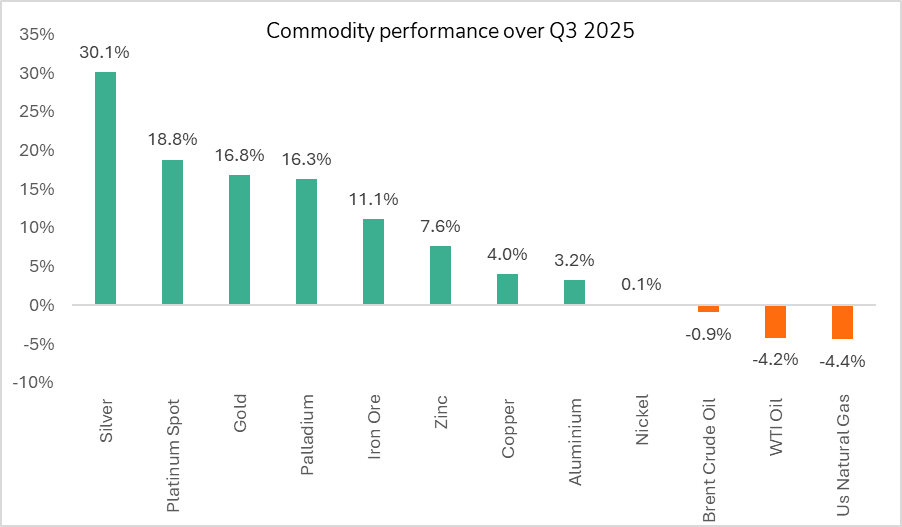
The bull market in gold has also spread to silver, platinum, palladium and even copper 


The Broad Bloomberg Commodity Index gained 3.7% for the third quarter. Gold delivered another stellar quarter, surging approximately 16%. For the year, gold is up over 46%, its best performance since 1979. The rally was fuelled by geopolitical tensions, a weaker dollar, falling real yields, and strong demand from both retail investors and central banks. Gold mining equities outperformed the physical metal. The NYSE Arca Gold Miners Index rallied 46% for the quarter and 21% in September alone. The bull market in gold extended to silver (30% over the quarter), platinum (19%), and palladium (16%).

Industrial metals surged over 23% as measured by the MSCI World Metals & Mining Index. Infrastructure stimulus, re-shoring initiatives, and supportive Chinese policy measures drove the rally. Copper climbed 4% in September following supply concerns after a mudslide at Indonesia's Grasberg mine disrupted production.

Energy lagged once more. Oil prices remained muted amid persistent oversupply concerns. Brent crude fell about 1% over the quarter.

Source:  Bloomberg  


Chart #10 — 

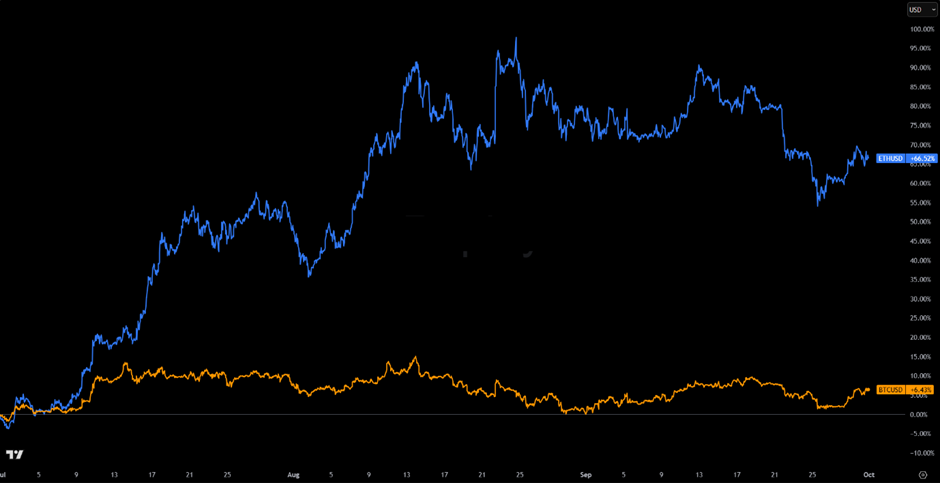
Ethereum reclaims the spotlight 

Digital assets rebounded in Q3 2025, driven by regulatory progress and renewed institutional interest. Ethereum (ETH) was the clear standout, surging 67% over the quarter as its ecosystem of decentralized finance, stablecoins, and tokenised real-world assets accelerated. The passage of the GENIUS Act in July provided long-awaited clarity for stablecoins, strengthening confidence in Ethereum’s ecosystem.

Interestingly, Bitcoin’s performance remained more modest last quarter. The cryptocurrency rose 7%, reaching an all-time high of 124’500 in August. Concerns around Bitcoin treasury firms and their balance sheet, limited the upside.

Source: TradingView 


Disclaimer

This marketing document has been issued by Bank Syz Ltd. It is not intended for distribution to, publication, provision or use by individuals or legal entities that are citizens of or reside in a state, country or jurisdiction in which applicable laws and regulations prohibit its distribution, publication, provision or use. It is not directed to any person or entity to whom it would be illegal to send such marketing material. This document is intended for informational purposes only and should not be construed as an offer, solicitation or recommendation for the subscription, purchase, sale or safekeeping of any security or financial instrument or for the engagement in any other transaction, as the provision of any investment advice or service, or as a contractual document. Nothing in this document constitutes an investment, legal, tax or accounting advice or a representation that any investment or strategy is suitable or appropriate for an investor's particular and individual circumstances, nor does it constitute a personalized investment advice for any investor. This document reflects the information, opinions and comments of Bank Syz Ltd. as of the date of its publication, which are subject to change without notice. The opinions and comments of the authors in this document reflect their current views and may not coincide with those of other Syz Group entities or third parties, which may have reached different conclusions. The market valuations, terms and calculations contained herein are estimates only. The information provided comes from sources deemed reliable, but Bank Syz Ltd. does not guarantee its completeness, accuracy, reliability and actuality. Past performance gives no indication of nor guarantees current or future results. Bank Syz Ltd. accepts no liability for any loss arising from the use of this document.

Read More

Straight from the Desk

Syz the moment

Live feeds, charts, breaking stories, all day long.

Thinking out loud

Sign up for our weekly email highlighting the most popular posts.

Follow us

Thinking out loud

Investing with intelligence

Our latest research, commentary and market outlooks