

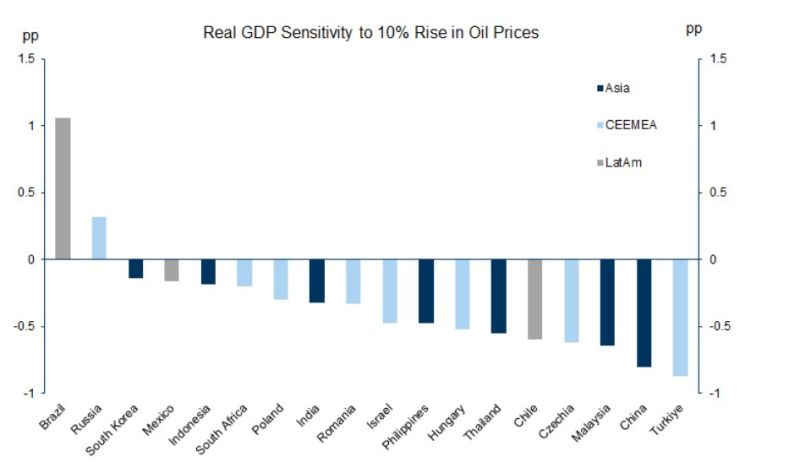
Research from Goldman shows that rising oil prices hurt emerging market economies as a whole.
Disclaimer
This marketing document has been issued by Bank Syz Ltd. It is not intended for distribution to, publication, provision or use by individuals or legal entities that are citizens of or reside in a state, country or jurisdiction in which applicable laws and regulations prohibit its distribution, publication, provision or use. It is not directed to any person or entity to whom it would be illegal to send such marketing material. This document is intended for informational purposes only and should not be construed as an offer, solicitation or recommendation for the subscription, purchase, sale or safekeeping of any security or financial instrument or for the engagement in any other transaction, as the provision of any investment advice or service, or as a contractual document. Nothing in this document constitutes an investment, legal, tax or accounting advice or a representation that any investment or strategy is suitable or appropriate for an investor's particular and individual circumstances, nor does it constitute a personalized investment advice for any investor. This document reflects the information, opinions and comments of Bank Syz Ltd. as of the date of its publication, which are subject to change without notice. The opinions and comments of the authors in this document reflect their current views and may not coincide with those of other Syz Group entities or third parties, which may have reached different conclusions. The market valuations, terms and calculations contained herein are estimates only. The information provided comes from sources deemed reliable, but Bank Syz Ltd. does not guarantee its completeness, accuracy, reliability and actuality. Past performance gives no indication of nor guarantees current or future results. Bank Syz Ltd. accepts no liability for any loss arising from the use of this document.
Related Articles
The 10y breakeven inflation rate, a common market measure of expected inflation over the next decade, only nudged to 1.91%; still below the 2% threshold and well under the roughly 3% levels seen after Russia invaded Ukraine. This suggests that markets do not currently expect the conflict to have lasting inflationary effects. Source: Bloomberg, HolgerZ
Gulf oil exporters are facing a scenario few markets are pricing in. With exports disrupted through the Strait of Hormuz, some of the world’s largest oil producers may soon hit a hard physical limit: Storage capacity. If crude cannot leave the Gulf and storage tanks fill up, producers will have no choice but to shut down production at some of the largest oil fields on earth. Countries exposed to this risk include: Iraq, Kuwait, the UAE, Qatar, and Saudi Arabia. And shutting down oil wells is not like flipping a switch. Depending on the geology of the reservoir and extraction technology, halting production can damage fields and infrastructure, sometimes permanently. Restarting production is costly, slow, and in some cases impossible at previous levels. That means the impact wouldn’t just be temporary. It could lead to a medium-to-long-term reduction in Middle Eastern oil supply. If that happens, markets won’t just price in disruption. They will price in scarcity. The result: a massive risk premium on global oil prices, especially for regional crude grades. And here’s the critical detail most people miss: Storage tanks are rarely filled beyond ~80% capacity for operational and safety reasons. So the real countdown to forced production cuts may be much shorter than expected. Two more strategic realities: • Some producers—especially Saudi Arabia and the UAE—could redirect part of their exports through alternative pipelines and routes. • But those routes would instantly become high-value strategic targets in any regional escalation. At that point, the stakes change. This is no longer just about the survival of Iran. If production across the Gulf begins to halt, the economic survival of major producers like Saudi Arabia and Iraq—the first and second largest producers in OPEC—would also be at risk. And when the core of the global oil system is threatened with shutdown… The pressure for the war to expand becomes almost inevitable. Source: Francesco Sassi, Bloomberg
Source: TME, LSEG Workspace