

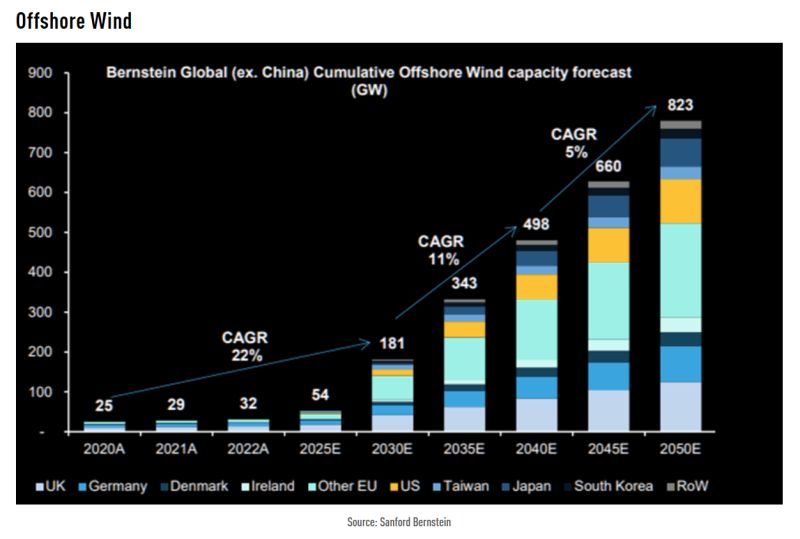
While renewables energy have been a bug disappointment for investors over the last few years, long-term forecasts for offshore wind capacity remain quite attractive.
Disclaimer
This marketing document has been issued by Bank Syz Ltd. It is not intended for distribution to, publication, provision or use by individuals or legal entities that are citizens of or reside in a state, country or jurisdiction in which applicable laws and regulations prohibit its distribution, publication, provision or use. It is not directed to any person or entity to whom it would be illegal to send such marketing material. This document is intended for informational purposes only and should not be construed as an offer, solicitation or recommendation for the subscription, purchase, sale or safekeeping of any security or financial instrument or for the engagement in any other transaction, as the provision of any investment advice or service, or as a contractual document. Nothing in this document constitutes an investment, legal, tax or accounting advice or a representation that any investment or strategy is suitable or appropriate for an investor's particular and individual circumstances, nor does it constitute a personalized investment advice for any investor. This document reflects the information, opinions and comments of Bank Syz Ltd. as of the date of its publication, which are subject to change without notice. The opinions and comments of the authors in this document reflect their current views and may not coincide with those of other Syz Group entities or third parties, which may have reached different conclusions. The market valuations, terms and calculations contained herein are estimates only. The information provided comes from sources deemed reliable, but Bank Syz Ltd. does not guarantee its completeness, accuracy, reliability and actuality. Past performance gives no indication of nor guarantees current or future results. Bank Syz Ltd. accepts no liability for any loss arising from the use of this document.
Related Articles
The US share of EU LNG imports surged from 28% in early 2021 to 63.2% today. IEEFA projects up to 80% by 2028. Two shocks accelerated the shift: Europe’s phaseout of Russian LNG and disruptions to Qatari supply. American cargoes offer flexibility. But they follow the highest bidder. When Asia pays more, Europe must compete—or pay up. Europe escaped one energy dependence. Is it building another? At almost two-thirds of imports, is US LNG Europe’s security—or its next vulnerability? Source: Jack Prandelli on X
Greenland Energy shares surged 164.17% to $3.17 following reports of Trump's 🇺🇸 security agreement between the US and Greenland. Source: Q-Tech News
And this was a calculated gamble. Storage facilities are just 67% full—13 percentage points below last year—as Europe bet on the Strait of Hormuz reopening and Qatari LNG supplies returning. Neither happened. Dutch gas futures are now approaching €80/MWh, while spot prices have surged 75% since June. Europe’s energy gamble is becoming America’s windfall. US LNG exporters can sell every cargo they are able to load. One region’s supply risk is another region’s pricing power. Source: Kurt S. Altrichter, CRPS