

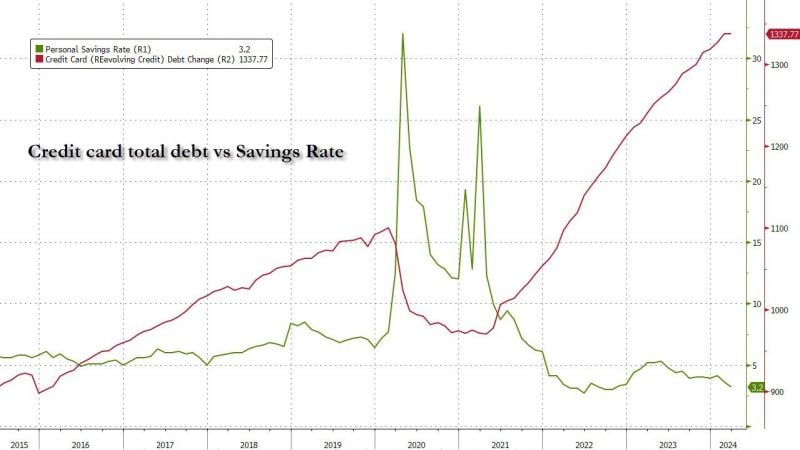
The US consumer (risk) in one chart: credit card debt at record high, personal savings rate record low
Disclaimer
This marketing document has been issued by Bank Syz Ltd. It is not intended for distribution to, publication, provision or use by individuals or legal entities that are citizens of or reside in a state, country or jurisdiction in which applicable laws and regulations prohibit its distribution, publication, provision or use. It is not directed to any person or entity to whom it would be illegal to send such marketing material. This document is intended for informational purposes only and should not be construed as an offer, solicitation or recommendation for the subscription, purchase, sale or safekeeping of any security or financial instrument or for the engagement in any other transaction, as the provision of any investment advice or service, or as a contractual document. Nothing in this document constitutes an investment, legal, tax or accounting advice or a representation that any investment or strategy is suitable or appropriate for an investor's particular and individual circumstances, nor does it constitute a personalized investment advice for any investor. This document reflects the information, opinions and comments of Bank Syz Ltd. as of the date of its publication, which are subject to change without notice. The opinions and comments of the authors in this document reflect their current views and may not coincide with those of other Syz Group entities or third parties, which may have reached different conclusions. The market valuations, terms and calculations contained herein are estimates only. The information provided comes from sources deemed reliable, but Bank Syz Ltd. does not guarantee its completeness, accuracy, reliability and actuality. Past performance gives no indication of nor guarantees current or future results. Bank Syz Ltd. accepts no liability for any loss arising from the use of this document.
Related Articles
However, at the moment, he does NOT believe it will be necessary for the central bank to increase rates again in 2027. John Williams is widely considered a centrist on monetary policy, though he often tilts dovish compared to the rest of the market Source: Gregory Daco
France’s fiscal troubles dominate the headlines. Yet its neighbour deserves more attention. Switzerland wasn’t always a model of sound public finances. During the 1990s, federal debt surged. Then came a turning point. In 2001, 85% of Swiss voters approved a constitutional “debt brake”, implemented in 2003. The principle is simple: → Save when the economy is strong. → Allow deficits during downturns. → Balance spending and revenues over the economic cycle. → Permit exceptional spending during major crises. The results? Federal debt fell from 56.2% of GDP in 2003 to 37.5% in 2024. Economic growth and rising revenues helped. The rule provided a framework that constrained persistent deficits while preserving room to respond to shocks. Switzerland and France have different institutions. Copying a rule alone would not guarantee the same outcome. But the Swiss experience challenges the idea that rising debt is inevitable. Fiscal discipline requires more than promises. It requires credible rules—and the political commitment to respect them. Should Switzerland feature more prominently in Europe’s fiscal debate? Source: Riccardo Trezzi
I cut off the peaks so we can better see the troughs. -- For decades, this was THE gauge to measure the labor market. Now it's making a case this is the best US labor market in our lifetime... Source: Jim Bianco