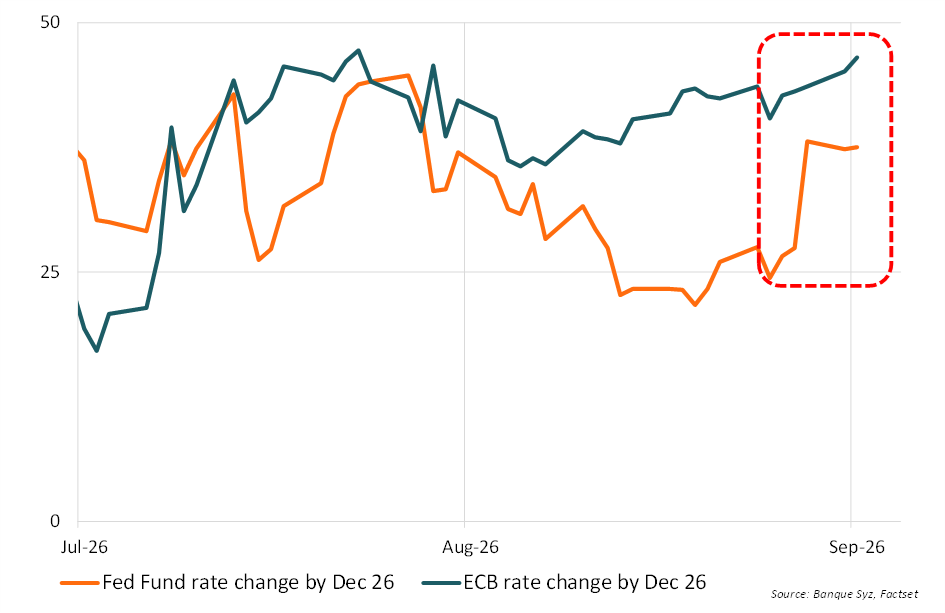
Government bond markets saw a pronounced flattening bias last week, driven by a repricing of near-term Fed tightening expectations following Chair Warsh’s hawkish Jackson Hole remarks. In the US, the 2Y Treasury yield rose 11bp to 4.34%, while longer maturities rallied, with the 10Y falling 2bp and the 30Y declining 7bp. The 2Y/10Y curve flattened 13bp to 37bp, reversing much of the previous steepening as the market priced the September FOMC meeting as effectively a toss-up and almost a full 25bp hike by October.
European sovereign markets also weakened, with core yields rising across the German curve: Bund 2Y +6bp, 5Y +4bp, 10Y +2bp to 3.28%. Peripheral bonds held slightly better, with the France 10Y yield down -1bp to 4.13%. Japanese government bonds also droped, with the JGB 10Y yield rising 4bp to 2.93%.
US Treasury ETF performance reflected the pronounced flattening of the yield curve, with short-duration exposures underperforming while longer-duration segments benefited from the decline in long-end yields. The iShares 1–3Y Treasury ETF fell -0.13%, while the 3–7Y was down -0.19%. By contrast, longer-duration exposures performed positively, with the 7-10y up +0.03%, the 10–20Y ETF gaining 0.62% and the 20Y+ ETF rising 1.01%. The performance dispersion highlights the impact of the sharp rise in front-end yields versus the rally at the long end.
Emerging markets
EM debt markets remained well supported in the final full week of August, with subdued volatility and sovereign bonds gaining 0.20%.
Investment grade modestly outperformed high yield (+0.22% versus +0.17%), although the narrow gap highlights increasingly compressed risk premia: sovereign HY-to-IG spreads tightened to 184bp, their narrowest level in two decades, raising concerns that valuations are becoming disconnected from global financial and geopolitical risks.
Regionally, Latin American spreads remained resilient, with Brazil at 160bp despite tight monetary policy and slow fiscal consolidation, while Colombia’s 162bp offers relative value on expectations of improved fiscal dynamics.
In Asia, Indonesia and the Philippines continued to trade at tight levels of 74bp and 72bp, respectively, supported by solid fundamentals, while China remained inside USTs at -32bp amid limited liquidity. MENA spreads benefited from elevated oil prices, although Hormuz disruptions pose risks. South Africa outperformed in Africa, while Egypt remained pressured by regional tensions.
Rating actions were broadly positive, with Pakistan upgraded by both Moody’s and S&P, and Kazakhstan raised to BBB by S&P.




.png)