Unusual divergences emerged across major sovereign bond markets in 2025. Despite resilient economic growth, sticky inflation, and the continuation of expansionary fiscal policies, US Treasury yields declined, with the USD yield curve experiencing a “bull steepening.” Two-year yields fell broadly in line with the Fed funds rate (-75bp to 3.5%). Meanwhile, the 10-year Treasury yield was volatile in the first half of the year, trading in a 4.0%/4.5% range, before drifting lower in the second half toward 4%. It ended the year down 40bp at 4.15%, driven mainly by a decline in real yields (-30bp), while inflation breakevens fell only modestly (-10bp). Longer-dated maturities were also volatile, but the 30-year yield closed the year unchanged at 4.8%.
In contrast, euro-area government yields rose in a “bear steepening” move, triggered by Germany’s fiscal U-turn in March and the announcement of a decade-long public investment plan. While the front end of the curve was anchored by the ECB’s policy rate stabilization at 2%, long-term German yields rose to their highest level since 2023, with the 10-year Bund up 50bp to 2.9%.
French government bonds were pressured by political instability and concerns over the public debt trajectory. The 10-year OAT yield rose 40bp to 3.6%, becoming the highest 10-year yield among euro-area sovereigns. Other European yields also increased, though more moderately, as sovereign spreads vs Germany tightened overall (Italy 10y +5bp to 3.57%, Spain 10y +25bp to 3.3%, Portugal 10y +30bp to 3.15%, Ireland 10y +40bp to 3.05%).
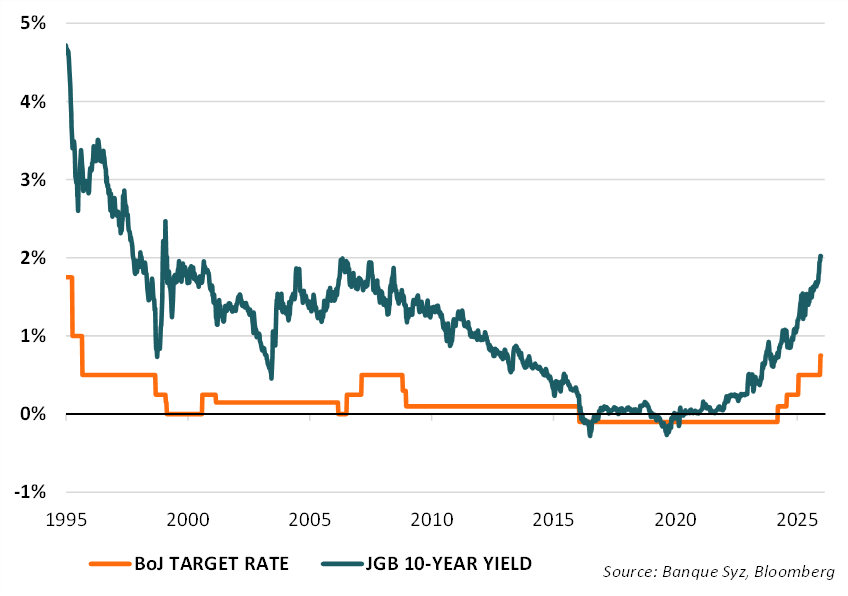
Japanese government bond yields recorded the largest increase among major markets. Rising short-term rates, persistent inflationary pressures, supportive fiscal policy, and concerns over public debt dynamics pushed the 10-year JGB yield up by 90bp, above 2% for the first time since 1999.
UK government bond yields were volatile but largely range-bound amid growth, inflation, and fiscal concerns. The 10-year gilt ended the year only marginally lower (-5bp) at 4.5%. Swiss Confederation long-term yields hovered just above zero for most of the year, with the 10y rate closing 2025 broadly unchanged at 0.34%.
Emerging market
Tariffs, trade tensions, and interest-rate uncertainty have remained persistent features throughout 2025. Yet, against this unsettled backdrop, emerging market (EM) corporate dollar credit has surprised decisively to the upside, delivering a total return of +8.5% year-to-date, the strongest performance of the past five years.
EM credit spreads have tightened to historical lows, even as issuers continued to access primary markets despite higher interest rates. Nevertheless, all-in yields remain attractive, at the 57th percentile of the past ten years.
Performance, however, has not been uniform. Brazilian high-yield corporates materially underperformed, driven by idiosyncratic credit events in the petrochemical sector that weighed on sentiment across the global chemicals complex.
Countries and corporates have learnt to adapt, renegotiate tariffs and reconfigure supply chains. In many respects, this has been a blessing in disguise: corporates are reluctant to start new projects but preserving balance-sheet strength, good for bondholders.
Brent crude briefly touched $59/barrel, the lowest level since 2021. Yet, EM corporates have so far navigated commodity price volatility effectively, sustaining resilient fundamentals.
Flows also tell a powerful story. Fund inflows into EM debt have been very positive in 2025, following three consecutive years of outflows, marking a meaningful shift in investor positioning.
Looking ahead to 2026, returns are likely to moderate but should remain positive, underpinned by solid corporate fundamentals, the prospect of Fed rate cuts, and a potentially weak dollar.




.png)