Maggie Cheng

Senior Fixed Income Analyst

Adrien Pichoud

Head of Fixed Income

The Chart of the Week

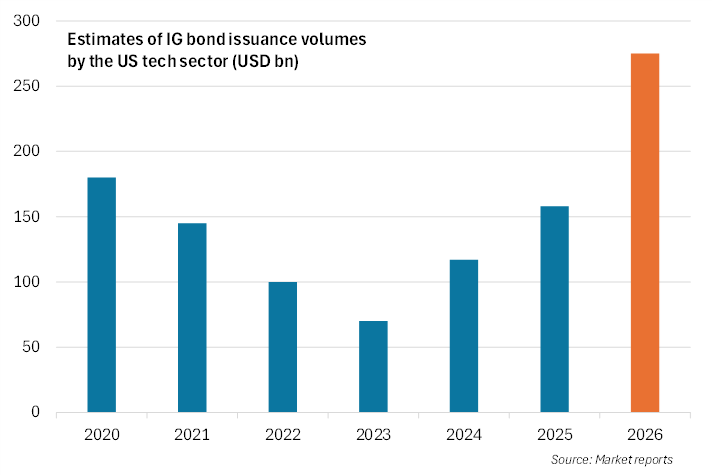
US tech companies are set to issue a record amount of IG bonds in 2026

AI infrastructure investment needs have led to a surge in bond issuances from US tech companies in 2025, emerging as a new source of concern in credit markets. Since last September, jumbo bond offerings from Meta (USD 30bn), Alphabet (USD 25bn), Amazon (USD 15bn) and Oracle (USD 18bn) have drawn significant attention.

This trend signals a shift in the dynamics of the AI capex wave: investment needs have become so large that they increasingly require debt financing. Given the scale of projected AI-infrastructure spending, this wave of AI-related issuance is unlikely to fade. Instead, it is set to become a major segment of fixed-income markets, just as it has already reshaped equity markets.

Selectivity and differentiation will be key in 2026, with opportunities to be picked among companies with strong balance sheets, diversified business models and robust margin and earnings trajectories. On the other hand, companies taking on substantial leverage without sufficient balance sheet strength, adequate gross margins or clear earnings prospects may increasingly be under pressure from this rise in debt levels. 

What do we expect for 2026?

Central banks

Expectations for central bank policies in 2026 point to a broadly cautious landscape as monetary policy is close to a neutral level across most regions.

In the United States, additional policy easing can still be expected, especially with the looming change in Fed’s leadership. However, while markets currently price more than two additional rate cuts in 2026 and a Fed Fund rate at 3% by the end of the year, economic resilience and inflation dynamics may eventually limit the magnitude of the policy easing next year. In the United Kingdom, the Bank of England is also expected to extend its rate cut cycle into 2026, with almost two 25bp rate cut currently priced in by future markets to bring the base rate down to 3.25%. However, here too the combination of supportive fiscal policies, lingering inflationary pressures and resilient economic activity could lead the BoE to cut less rather than more during next year.

In the euro area, the policy backdrop is influenced by a renewed fiscal impulse, particularly in Germany, where stimulus measures should fuel a gradual improvement in growth. In this context, the European Central Bank is likely to keep rates unchanged at 2.00% through most of the year, before possibly considering a potential tightening later in 2026. The Bank of Canada is expected to follow a similar path, with no more rate cut in sight, a stable O/N lending rate at 2.25% and possibly a rate hike at the end of the year.

Rate hikes are priced in for the Reserve Banks of Australia and of New Zealand in the second half of 2026. The Bank of Japan is expected to carry on its ongoing monetary policy normalization, as strong fiscal policy support and yen weakness fuel upside risks on inflation. JPY short-term rates are on track to be raised by 25bp to 1% next year.

Switzerland stands out for its low-inflation environment. With inflation expected to remain between 0% and 1%, and possibly dip temporarily below zero, SNB policy rates are likely to remain anchored at zero throughout 2026.

Overall, 2026 is likely to be characterized by patient, data-dependent central banking rather than aggressive shifts in policy direction.

Credit

The outlook for credit in 2026 is constructive, supported by an environment of range-bound sovereign yields and continued, albeit moderate, economic growth. With limited directionality expected from government rates, credit markets are well positioned to contribute and improve bond returns primarily through carry. Although credit spreads across both Investment Grade and High Yield remain tight by historical standards, this pricing reflects solid underlying fundamentals rather than complacency.

Corporate balance sheets are generally healthy, with leverage contained and, in many cases, lower relative to economic output than in past cycles. Positive growth prospects help limit financial stress, while corporate earnings resilience continues to underpin credit quality. As a result, the risk of a sharp and sustained spread widening appears limited under our central scenario, even if further spread compression potential is modest. In such a setting, adding selective credit exposure remains one of the most effective ways to enhance portfolio income.

Default dynamics reinforce this view. Recent defaults have been largely idiosyncratic rather than cyclical, and historical experience shows strong resilience in Investment Grade credit, with extremely low default rates even during past crises. In High Yield, easing financing conditions, resilient revenues and lower macro uncertainty should keep default rates contained into 2026.

From a thematic perspective, two areas stand out. First, the AI-driven capex cycle is reshaping parts of the credit universe. Investors should favor issuers with strong cash generation, disciplined leverage management and proven execution, rather than pure growth ambitions. Second, European real estate credit offers selective opportunities, supported by rental growth, tight supply in logistics and residential segments, and improving fundamentals in certain retail assets.

Finally, diversification within High Yield remains essential, with a clear bias toward short-duration bonds. Niche segments such as Nordic High Yield offer attractive spreads, shorter maturities and lower interest rate sensitivity, providing a differentiated source of carry within global credit allocations.

Rates

Our most reasonable assumption for 2026 is a scenario of range-bound rates, in which bond performance is driven primarily by coupon income rather than significant capital gains. Following the sharp adjustment of recent years, interest rates across major markets have normalized, standing above inflation and broadly in line with long-term historical averages. This backdrop pleads for a defensive, low-volatility fixed-income allocation focused on income generation.

Under conditions of continued economic growth and moderate inflation, medium- and long-term government bond yields are expected to remain largely range-bound in 2026. Solid nominal growth provides a floor under yields, while the absence of major inflation shocks limits the risk of a sharp upward move. Market sentiment will continue to fluctuate with changes in growth and inflation expectations, but sustained trends in either direction appear unlikely. If anything, ongoing fiscal support and rising public debt levels may exert mild upward pressure on longer maturities.

In this environment, we expect 5- to 10-year US Treasury yields to trade within a 3.5%–4.5% range. In the euro area, German government bonds of similar maturities should remain between 2% and 3%. UK gilt yields are likely to stay elevated, above 4%, reflecting persistent inflation dynamics and fiscal uncertainties, while Swiss yields should remain anchored close to zero.

This setting restores bonds’ traditional role as a source of stable income. Investors should not expect significant capital gains from sovereign bonds in 2026; instead, coupons will be the primary contributor to total returns. While downside risks on rates coming from a sharp growth slowdown, or upside risks from overheating inflation cannot be dismissed, they currently appear to have low probabilities.

In any case, for multi-asset portfolios, government bonds should no longer be viewed as a systematic hedge against equity risk. Their historical role as a reliable diversifier was closely linked to a low-inflation regime, which no longer prevails. With inflation still above 2% in most developed markets, the bond–equity correlation is more unstable, reducing the defensive value of sovereign bonds in diversified portfolios.

Emerging market

The outlook for Emerging Market debt in 2026 is broadly constructive, supported by a combination of improving global growth dynamics, easing trade uncertainty, and relatively contained inflation outside a few developed economies. In our central scenario of range-bound global interest rates, EM debt stands out as an attractive source of yield carry, even though valuations are no longer cheap by historical standards.

Spreads across EM hard- and local-currency debt have tightened significantly over the past two years, reflecting improved macro fundamentals, proactive policy frameworks, and reduced external vulnerabilities in many countries. While the scope for further spread compression is limited, the risk of a sharp and sustained widening appears contained in an environment of positive global growth. As with other segments of fixed income, carry is therefore expected to be the dominant driver of total returns in 2026.

Several structural factors are supportive. Many emerging economies have emerged from the recent inflation shock with healthier balance sheets, lower fiscal deficits, and improved current account positions. The expected easing of global trade tensions and the restart of the global capex cycle should further support export-oriented EM economies and investment flows. In addition, a relatively benign inflation environment across much of the EM universe gives local policymakers room to maintain accommodative stances, which is supportive for both growth and debt sustainability.

Selectivity will remain crucial. Investors should focus on countries with credible policy frameworks, improving growth trajectories, and stable political backdrops, while avoiding issuers vulnerable to fiscal slippage or external financing shocks. Local-currency debt offers opportunities where real yields remain attractive and inflation expectations are well anchored, while hard-currency bonds can provide more defensive exposure.

Overall, EM debt in 2026 should offer attractive income and diversification benefits within fixed-income portfolios, provided allocations are carefully constructed and actively managed.



Our view on fixed income 

Rates
NEGATIVE in current environment

We maintain a Negative stance on government bonds. Positive global growth dynamics, price pressures in the US and profligate fiscal policies reduce the attractiveness of long-term government bonds as a potential hedge for economic downturn and increase the risk of higher long-term yields. Limited prospects of further central banks’ rate cuts and unattractive yield curve slopes at the front-end also reduce the attractiveness of government bonds on short-to-medium term maturities. 


Investment Grade
NEUTRAL, harvest the carry
We continue to find Investment Grade corporate bonds attractive in the current environment, given their yield level and our constructive economic scenario. However, tight credit spreads have reduced the margin for safety in credit, that can be deemed as expensive from a valuation standpoint. As a result, we hold a Neutral stance on Investment Grade credit from an asset allocation perspective. The credit market's overall health is supported by robust demand and strategic maturity management. 
High Yield
NEUTRAL, go short-term

We still like High Yield bonds with short maturity for their attractive combination of yield and low sensitivity to interest rate movements. HY spreads have tightened, signaling economic stability and contained default risk in the short run. However, those tight spreads are not attractive for medium-to-long term maturities as they do not compensate adequately for a potential deterioration in the economic environment. As such, we hold a Neutral view for High Yield in an allocation, with a clear preference for short-duration investments. We continue to find value in subordinated debt.

 
Emerging Markets
NEUTRAL, be selective
We  advocate for a careful selection of issuers to benefit from attractive absolute yields. Substantial inflows into EM debt this year have been fueled by a weak dollar along with EM corporates’ solid credit metrics and support the asset class. However, risks persist, with rich valuations and unpredictable Trump’s trade policies. Idiosyncratic risks also remain, notably in Brazil and India. Given this backdrop, we stay selective, favoring short-duration opportunities while remaining Neutral on the broad EM debt asset class. 

Disclaimer

This marketing document has been issued by Bank Syz Ltd. It is not intended for distribution to, publication, provision or use by individuals or legal entities that are citizens of or reside in a state, country or jurisdiction in which applicable laws and regulations prohibit its distribution, publication, provision or use. It is not directed to any person or entity to whom it would be illegal to send such marketing material. This document is intended for informational purposes only and should not be construed as an offer, solicitation or recommendation for the subscription, purchase, sale or safekeeping of any security or financial instrument or for the engagement in any other transaction, as the provision of any investment advice or service, or as a contractual document. Nothing in this document constitutes an investment, legal, tax or accounting advice or a representation that any investment or strategy is suitable or appropriate for an investor's particular and individual circumstances, nor does it constitute a personalized investment advice for any investor. This document reflects the information, opinions and comments of Bank Syz Ltd. as of the date of its publication, which are subject to change without notice. The opinions and comments of the authors in this document reflect their current views and may not coincide with those of other Syz Group entities or third parties, which may have reached different conclusions. The market valuations, terms and calculations contained herein are estimates only. The information provided comes from sources deemed reliable, but Bank Syz Ltd. does not guarantee its completeness, accuracy, reliability and actuality. Past performance gives no indication of nor guarantees current or future results. Bank Syz Ltd. accepts no liability for any loss arising from the use of this document.

Read More

Straight from the Desk

Syz the moment

Live feeds, charts, breaking stories, all day long.

Thinking out loud

Sign up for our weekly email highlighting the most popular posts.

Follow us

Thinking out loud

Investing with intelligence

Our latest research, commentary and market outlooks