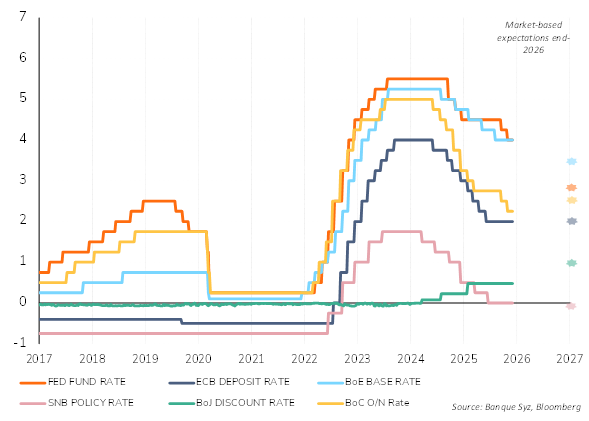
Global government bond markets endured a broad-based sell-off last week as investors repriced the medium-term policy path. While a December Fed cut remains more than 95% priced, conflicting US data triggered a hawkish shift further out the curve, reducing the amount of easing priced next year by 9bps. Treasury yields rose sharply, with the 2-year up +7bps to 3.56% and the 10-year +12bps to 4.14%, its largest weekly increase since April. Long-dated yields underperformed, with 30yr Treasuries rising +13bps to 4.79%, contributing to notable ETF declines: iShares Treasury 1–3yr (-0.37%), 3–7yr (-0.70%), 7–10yr (-1.06%), 10–20yr (-1.86%) and 20yr+ (-2.26%).
Japan provided an additional catalyst as comments from BoJ Governor Ueda increased market conviction of a December hike. JGBs sold off sharply, with 10yr yields jumping +14bps to 1.95% and reaching their highest level since 2008.
Europe was not spared, with Bunds (+11bps), OATs (+11bps) and BTPs (+9bps) all moving higher. Stronger-than-expected Euro Area inflation (+2.2% YoY) and an upgraded composite PMI (52.8) reinforced upward pressure on yields. EUR government bond ETFs mirrored this weakness, with iShares EUR 3–7yr (-0.39%), 10–15yr (-0.90%), core EUR government bonds (-0.63%) and EUR inflation-linked bonds (-0.56%).
Emerging market
Emerging market (EM) sovereign USD bonds traded steadily last week. Credit spreads held within a tight range, but prices fluctuating with U.S. Treasury yield moves. Sentiment remains constructive, albeit tempered by concerns over the tight spreads in EM corporates.
Performance was mixed across EM asset classes: EM hard-currency debt was flat (iShares EM Sovereign USD Bond ETF +0%), local-currency bonds outperformed slightly (J.P. Morgan EM Local Currency ETF +0.1%), EM corporates lost -0.2%, while Asian high yield gained +0.2%.
Global EM debt funds continue to attract strong inflows, having now posted gains in 32 weeks of past 33 weeks.
EM corporates began to integrate lower oil prices in their strategic plan. In Brazil, Petrobras released a more conservative 2026–2030 strategic plan, it will need Brent at roughly $59/barrel to keep financial leverage stable. In Colombia, Ecopetrol also presented lower production guidance for 2026 based on Brent at $60/barrel with focus shifts toward profitability and liquidity, supportive to credit.
The attempted coup in Benin was swiftly suppressed. Nigerian forces intervened to restore order, constitutional authority has been re-established, and President Talon remains in power. Historically, market volatility around coups faded once political order is restored.
U.S. President Trump will meet Mexican President Sheinbaum on the sidelines of the 2026 World Cup draw in Washington. With the 2026 review of USMCA (United States-Mexico-Canada Agreement) approaching, the talks are expected to be constructive. The USMCA currently exempts 85% of Mexican exports from tariffs, keeping Mexico’s average tariff rate near 5% (OECD data), significantly below global averages and much lower than the tariffs now applied to many Chinese exports.
Corporates with solid balance sheets and disciplined cash management should be favoured, regardless of state ownership. State-owned corporates make up a large share of EM debt, but ultimately credit fundamentals matter more than flags.




.png)