Maggie Cheng

Senior Fixed Income Analyst

Adrien Pichoud

Head of Fixed Income

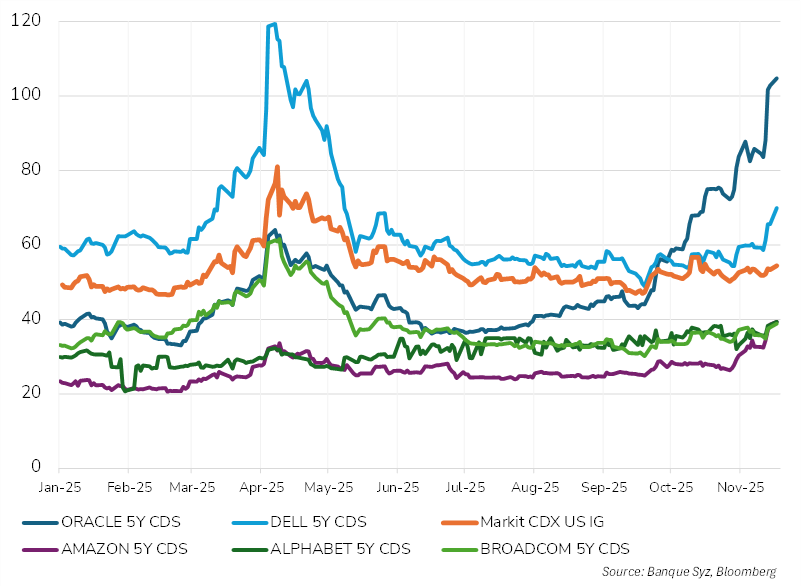
The Chart of the week

CDS of some AI-related issuers reflect concerns on the financing of the Capex boom 

The debt accumulation of some AI infrastructure providers such as Oracle or CoreWeave and the jumbo issuances from hyperscalers such as Meta, Alphabet or Amazon are raising concerns about massive AI investments.

However, those concerns remain, for the time being, concentrated on specific issuers, as bond investors distinguish between companies with strong underlying cash generation and those using debt aggressively to fund growth.

The broad US Investment Grade market is only marginally impacted by those developments so far.

What happened last week?

Central banks

Fed communication shifted firmly toward caution, with several officials stressing they are not in the camp of cutting rates swiftly, nor inclined to pre-announce any “Christmas present” for markets. Multiple regional presidents underscored that inflation remains uncomfortably high, reinforcing the need for patience. St. Louis Fed President Musalem, a voter this year, reiterated that policymakers must “tread with caution,” warning there is “limited room for further easing.” Daly kept an open mind on December, while Logan, Collins, and Kashkari signaled skepticism about near-term cuts. Collectively, the week’s messaging prompted a notable repricing in futures, with the implied probability of a December cut falling sharply as markets digested the Fed’s more hawkish tone: it fell toward 40%, from 65% early in the week.

In the UK, markets trimmed near-term rate-cut expectations following fiscal news from the UK government and after BoE policymaker Megan Greene maintained a hawkish stance despite rising unemployment. She warned that wage settlements may remain inconsistent with the 2% inflation goal and argued that current policy is not “meaningfully restrictive”.

ECB officials delivered a balanced message, with Rehn flagging downside inflation risks while Schnabel highlighted upside pressures from services and fiscal expansion. Kazaks said the current stance is appropriate with euro-area inflation near 2%, though geopolitical and trade uncertainties remain elevated. A key data for the ECB will be released this week, the evolution of negotiated wages in Q3, that is expected to slow down significantly, to their slowest level since 2021.

Stronger inflation and labour backdrop challenges expectations for RBA cuts in 2026, though analysts may reassess after the October CPI release.

This week, the South Africa Reserve Bank is expected to extend it rate cut cycle started a year ago, by lowering its key rate from 7.00% to 6.75%, a few days after Standard & Poor’s raised South Africa’s sovereign rating to BB+ with a positive outlook, supported by ongoing fiscal consolidation efforts and structural reforms’ dynamics. The Bank Indonesia will also hold its monetary policy meeting and is expected to hold its key rate unchanged at 4.75%.

Credit

Despite concerns over AI-related capex and the possibility that the Fed may skip a December rate cut, credit spreads remain broadly stable, with U.S. high yield even tightening. However, the rise in U.S. Treasury and German Bund yields has offset the modest spread compression.

Importantly, market positioning reflects rotation, not retreat. Risk appetite has softened but flows into USD and EUR investment-grade funds remain solid. EUR credit funds have now registered 29 weeks of inflows out of the past 30.

European bank earnings continued their positive momentum, with guidance upgrades from NatWest, ING, Commerzbank and BNP Paribas. Fundamentally, the three major French banks—BNP Paribas, Crédit Agricole and Société Générale—remain solid. BNP benefits from broad geographic diversification, Crédit Agricole stands out for its strongest capital position, and Société Générale continues its turnaround, delivering significantly higher pre-tax profit over the first nine months of 2025.

However, performance was broadly negative across credit segments, with the exception of EUR high yield. U.S. and EUR investment grade both returned -0.1%, while U.S. high yield declined -0.2%, weighted down by high U.S: Treasury and Bund yields. EUR high yield was the only outperformer, posting +0.1%.

While credit markets have stayed resilient despite rising equity volatility, central-bank easing is set to be far more moderate next year. A heavier bond-supply outlook driven by AI capex and renewed M&As could add to credit volatility. Still, corporate fundamentals remain solid heading into 2026, and default rates are expected to stay low in both U.S. and European high yield.

Rates

Global sovereign yields rose over the week as markets adjusted to a more hawkish policy outlook, particularly in the US. Fed speakers pushed back against expectations of swift easing, prompting investors to scale back the number of cuts priced for 2026. This repricing lifted Treasury yields across the curve: the 2y rose 4bps to 3.61% and the 10y increased 5bps to 4.15%. Long-end pressure was amplified by a weaker 30y auction, where issuance cleared 1bp above pre-sale levels, contributing to a 5bp rise in 30y yields. Breakevens were broadly stable, while real yields climbed, consistent with tighter policy expectations.

Euro-area yields also drifted higher, with Bunds up 5–6bps across the curve and similar moves in France, Italy, and Spain. The UK saw the largest adjustment, with 10y gilts surging 11bps on the week, reflecting volatility after the government reversed planned income-tax increases, raising uncertainty ahead of the 26 November budget. Elsewhere, Swiss and Japanese yields also edged higher.

Bond performance mirrored the rate move: US Treasury ETFs delivered negative returns, ranging from -0.2% in the 3–7y bucket to –0.78% in 20y+. EUR government bond ETFs also declined slightly.

Emerging market

Emerging market (EM) Sovereign $ bonds declined last week, once again pressured by higher US Treasury yields. Among the EM investment grade sovereigns, Chile and Peru were the top performers.

The outcome of Sunday’s first-round presidential vote in Chile strengthened the peso and supported investor sentiment, as it raises the prospect of a more market-friendly policy direction.

Peru’s economy continues to show resilience, supported by strong exports. The country is the world’s second-largest copper exporter, the top exporter of zinc, and a major supplier of gold and silver. Peru has one of the strongest foreign exchange reserves in EMs, covering three times of short-term external liabilities. The forthcoming presidential elections are expected to restore political stability and potentially lift GDP growth into 2026.

In Colombia, analysts widely expect a conservative victory in May Presidential vote, which could bring policy to lower fiscal deficit.

South Africa was upgraded by S&P to BB+ with a Positive outlook, supported by a third consecutive year of primary fiscal surpluses. With improving budget discipline and stronger revenue performance, the Country is positioned as a potential rising star among emerging markets.

On the U.S. tariff front, the Trump administration removed tariffs on more than 250 food products under its global reciprocal-tariff regime, with India among the key beneficiaries. It also lowered tariffs on selected agricultural imports from Latin America, including coffee, bananas, and beef from Brazil and Argentina, ahead of next week’s Thanksgiving holiday.

In local markets, EM currencies outperformed once again. J.P. Morgan EM Local Currency Bond ETF gained +0.4%.

The EM Sovereign USD Bond ETF slipped 0.1%, while EM USD corporates remained broadly flat and Asian high yield rebounded 0.4%.

The upcoming election cycle in Latin America certainly remains an important catalyst to watch. Nevertheless, the outsized market swings seen during the 2021-2022 cycle are unlikely to repeat. The U.S. dollar is significantly weaker today, and Latin American economies now operate from a far more resilient macro backdrop, supported by stronger external balances and improved inflation dynamics.



Our view on fixed income 

Rates
NEGATIVE in current environment

We shift to a Negative stance on government bonds. Positive global growth dynamics, price pressures in the US and profligate fiscal policies reduce the attractiveness of long-term government bonds as a potential hedge for economic downturn and increase the risk of higher long-term yields. Limited prospects of further central banks’ rate cuts and unattractive yield curve slopes at the front-end also reduce the attractiveness of government bonds on short-to-medium term maturities. 


Investment Grade
NEUTRAL, harvest the carry
We continue to find Investment Grade corporate bonds attractive in the current environment, given their yield level and our constructive economic scenario. However, tight credit spreads have reduced the margin for safety in credit, that can be deemed as expensive from a valuation standpoint. As a result, we hold a Neutral stance on Investment Grade credit from an asset allocation perspective. The credit market's overall health is supported by robust demand and strategic maturity management. 
High Yield
NEUTRAL, go short-term

We still like High Yield bonds with short maturity for their attractive combination of yield and low sensitivity to interest rate movements. HY spreads have tightened, signaling economic stability and contained default risk in the short run. However, those tight spreads are not attractive for medium-to-long term maturities as they do not compensate adequately for a potential deterioration in the economic environment. As such, we hold a Neutral view for High Yield in an allocation, with a clear preference for short-duration investments. We continue to find value in subordinated debt.

 
Emerging Markets
NEUTRAL, be selective
We  advocate for a careful selection of issuers to benefit from attractive absolute yields. Substantial inflows into EM debt this year have been fueled by a weak dollar along with EM corporates’ solid credit metrics and support the asset class. However, risks persist, with rich valuations and unpredictable Trump’s trade policies. Idiosyncratic risks also remain, notably in Brazil and India. Given this backdrop, we stay selective, favoring short-duration opportunities while remaining Neutral on the broad EM debt asset class. 

Disclaimer

This marketing document has been issued by Bank Syz Ltd. It is not intended for distribution to, publication, provision or use by individuals or legal entities that are citizens of or reside in a state, country or jurisdiction in which applicable laws and regulations prohibit its distribution, publication, provision or use. It is not directed to any person or entity to whom it would be illegal to send such marketing material. This document is intended for informational purposes only and should not be construed as an offer, solicitation or recommendation for the subscription, purchase, sale or safekeeping of any security or financial instrument or for the engagement in any other transaction, as the provision of any investment advice or service, or as a contractual document. Nothing in this document constitutes an investment, legal, tax or accounting advice or a representation that any investment or strategy is suitable or appropriate for an investor's particular and individual circumstances, nor does it constitute a personalized investment advice for any investor. This document reflects the information, opinions and comments of Bank Syz Ltd. as of the date of its publication, which are subject to change without notice. The opinions and comments of the authors in this document reflect their current views and may not coincide with those of other Syz Group entities or third parties, which may have reached different conclusions. The market valuations, terms and calculations contained herein are estimates only. The information provided comes from sources deemed reliable, but Bank Syz Ltd. does not guarantee its completeness, accuracy, reliability and actuality. Past performance gives no indication of nor guarantees current or future results. Bank Syz Ltd. accepts no liability for any loss arising from the use of this document.

Read More

Straight from the Desk

Syz the moment

Live feeds, charts, breaking stories, all day long.

Thinking out loud

Sign up for our weekly email highlighting the most popular posts.

Follow us

Thinking out loud

Investing with intelligence

Our latest research, commentary and market outlooks