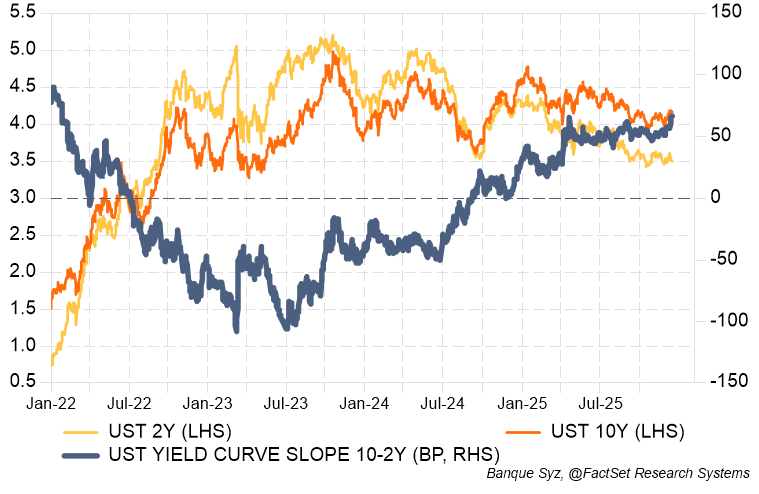
Government bond markets experienced a pronounced curve steepening over the week, driven primarily by developments in US monetary policy after the Fed’s rate cut and raising uncertainties around the medium-term inflation outlook.
As a result, in the US Treasury market, front-end yields declined modestly, with the 2yr yield falling 4bps to 3.52%. Further out the curve, yields rose, reflecting higher term premia. The 10yr yield increased 5bps to 4.18%, while the 30yr rose a similar amount to 4.84%, both marking their highest levels since September. As a result, the 2s10s slope reached its steepest level since January 2022. Performance mirrored these moves, with short-dated Treasury ETFs posting small gains (iShares Treasury 1-3y +0.1%), while long-duration funds underperformed sharply (iShares Treasury 7-10y down -0.3%, 10-20y down -0.7%, 20y+ down -0.9%).
European government bonds also sold off amid rising global yields and hawkish comments from ECB Executive Board member Isabel Schnabel. German 10yr bund yields rose 6bps to 2.86%, their highest weekly close since March. French OATs, Italian BTPs and other euro area sovereigns moved higher in tandem, although France modestly outperformed after parliament approved the social security budget. Euro-denominated government bond ETFs delivered negative weekly returns across maturities (iShares EUR 3-7y Government Bond -0.3%, iShares EUR 10-15y Government Bond -0.5%).
Emerging market
Emerging market (EM) sovereign USD bonds were down last week, driven by higher US Treasury yields. Latin American credits notably underperformed, led by Colombia, Mexico and Brazil. On the other hand, Egypt and Oman were more resilient to the broader downside. Fitch upgraded Oman to BBB-, a rising star, citing the sustained improvement in debt-to-GDP to 36% in 2025, from 68% in 2020. Oman should maintain its prudent policy stance in a lower oil price environment.
The U.S. imposed new tariffs on Mexico, India, Thailand and Indonesia to eliminate the transshipment bus by Asian exporters to circumvent U.S. tariffs. The new Mexican measures mainly target auto, textile, apparel, plastics and appliances with most items facing rates between 20-35%. Auto carries the highest tariff at 50%. China is Mexico’s largest auto importer, accounting for 20% of the Mexican car market.
Fitch upgraded Côte d’Ivoire by one notch to BB, following a largely peaceful October presidential election. The upgrade reflects strong growth prospects, with GDP expected to expand by 6.4% in 2025, 6.5% in 2026, and 6.6% in 2027, while inflation is projected to remain below 2% over the same period.
Global EM debt funds continue to see inflows, only one week of outflows the past 34 weeks.
Performance was again mixed across EM asset classes: EM hard-currency debt declined marginally (iShares EM Sovereign USD Bond ETF -0.1%), local-currency bonds outperformed again (J.P. Morgan EM Local Currency ETF +0.2%), EM corporates rose +0.1%, while Asian high yield gained +0.3%.
EM credits will enter 2026 against a backdrop of resilient corporate balance sheets and positive GDP growth across emerging markets.




.png)