Maggie Cheng

Senior Fixed Income Analyst

Adrien Pichoud

Head of Fixed Income

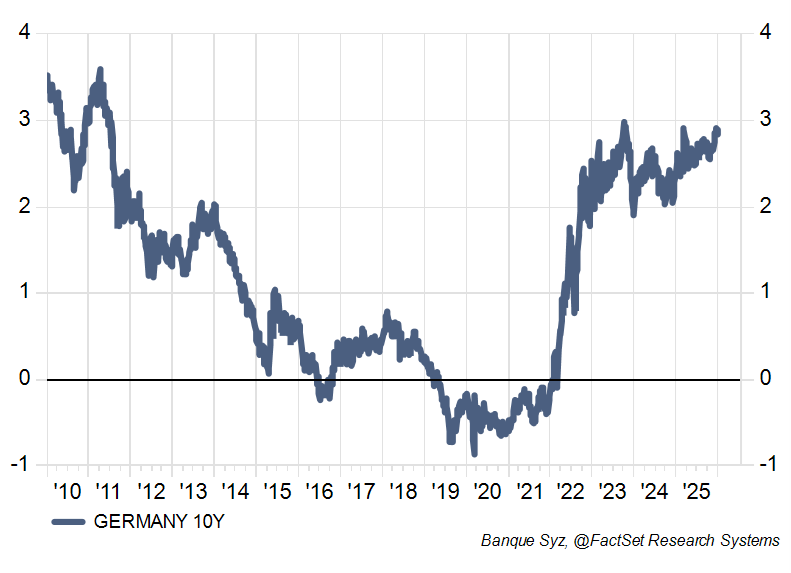
The Chart of the week

The German 10-year government yield is nearing 3% again 

The German 10-year Bund yield reached 2.9% again in the first days of 2026, after having already spiked twice to this level in 2025. It has been trending upward throughout the 4th quarter of last year, getting close to its 14-year high hit in 2023 (2.97%).

A combination of reassuring data on economic activity in Europe, of clear messages from the ECB that the rate cut cycle is over, of upward pressures on global rates stemming from Japan and of approaching German fiscal stimulus deployment have been driving European rates higher in the recent months.

The 3% level will be a major threshold for Bund yields this year, that could be crossed if the dynamics at play in late 2025 extend into 2026. However, slowing European inflation helps in keeping European sovereign yields in check for the time being. 

What happened last week?

Central banks

Most central bankers were on holiday last week, but there was some Fed-related news, dominated by policy debate and political noise. Minutes from the December FOMC highlighted a finely balanced decision, reinforcing expectations that rates will be held steady at the January meeting, with futures pricing only a 15% probability of a cut. While most officials still see scope for further easing if inflation continues to moderate, divisions remain over timing and magnitude, reflecting differing assessments of inflation versus labor-market risks. The December 9–3 vote to cut rates underscored these splits, with projections for 2026 ranging widely despite a median view of one further cut. Chair Powell argued policy is now restrictive enough to cool inflation while supporting employment. Separately, President Trump said he will announce Powell’s replacement “sometime in January,” with markets focused on potential implications for Fed independence ahead of the US Supreme Court hearing on Lisa Cook scheduled for January 21st.

ECB news was lighter on policy signals, with President Lagarde welcoming Bulgaria as the euro area’s 21st member, framing enlargement as a sign of European resilience amid geopolitical uncertainty. The comments were more symbolic than market-moving, offering little guidance on the near-term policy outlook.

BoJ minutes revealed growing concern about the persistence of very accommodative policy. Several board members highlighted that Japan’s real interest rate remains deeply negative and among the lowest globally, with some arguing that gradual rate hikes every few months may be appropriate to curb future inflation pressures and move policy closer to neutral.

Market pricing of monetary policy changes in 2026 did not significantly move last week. For the Fed, future markets currently price at least two 25bp cuts by the end of the year (one by June, the second by September), and a 40% chance of a third one. For the ECB, no change in rate is currently priced for 2026. For the BoE, future markets price one 25bp rate cut by June, and a 65% chance of a second one in the second half of the year. The SNB is expected to keep its key rate unchanged at 0% throughout 2026. And future markets price one 25bp rate hike by the BoJ before the end of the summer, and a 66% chance of a second rate hike by the end of 2026.

Credit

Credit markets delivered a mixed performance in a shortened trading week, with spread dynamics diverging between the U.S. and Europe. U.S. investment grade and high yield spreads were broadly unchanged, while European credit spreads widened moderately. In total return terms, investment grade marginally underperformed high yield, reflecting curve steepening in both U.S. Treasuries and German Bunds.

Over the weekend, American Airlines and Delta Air Lines began canceling flights to Caribbean destinations early Saturday in compliance with an overnight mandate from the Federal Aviation Administration (FAA). Caribbean airspace reopened shortly thereafter, prompting American Airlines to add approximately 5,000 seats to restore capacity. American Airlines’ 3-year CDS tightened further on improved investor sentiment. Prior to the disruption, American Airlines expects the business and premium travel demand to remain a bright spot into the first quarter of 2026.

Overall, credit fundamentals remain stable, and the continued resilience of high yield suggests that investors remain comfortable with below-trend default expectations, despite ongoing rate volatility.

Global banks are well positioned to benefit from a recalibration of capital requirements and expected pickup in M&A activity.

Heavy issuance expected in January is likely to be well absorbed, supported by strong investor demand. A higher-for-longer rate environment, coupled with the absence of further rate-hike expectations, bodes well for credit markets.

Rates

Sovereign bond markets remained under pressure over the New Year’s Eve week, with yields rising further across core and peripheral markets and extending the recent sell-off at the long end of curves. In the US, the move was led by intermediate and long maturities: the 10yr Treasury yield rose by around 6bps over the week to 4.19%, while the 30yr increased by a similar amount to 4.87%, both reaching their highest levels since early September. By contrast, the front end was relatively anchored, with the 2yr yield marginally lower on the week. As a result, curve steepening continued, with the US 2s10s spread closing above 70bps for the first time since January 2022. Inflation compensation also edged higher, with the US 10yr breakeven up 3bps, alongside a rise in real yields.

Reflecting these moves, broad Treasury ETF performance was mixed. Shorter-dated US government ETFs posted modest gains (e.g., 1–3y), while longer-duration ETFs underperformed, with the 10–20y and 20y+ segments bearing the brunt of negative returns.

European rates broadly followed the same pattern. The 10yr Bund yield rose 4bps to 2.90%, its highest level since October 2023, while the 30yr German yield pushed to levels last seen in 2011. Peripheral spreads were stable but yields increased across the board, with Italian and Spanish 10yr yields both up around 5–6bps. UK and Japanese yields also moved higher. Reflecting these dynamics, global aggregate bond indices posted modest negative returns, with losses concentrated in longer-duration Treasury and euro government bond ETFs, while short-dated segments proved more resilient.

In euro bond ETF land, short to medium euro government ETFs outperformed modestly, helped by yield moves at the front end, while longer-dated euro government and inflation-linked ETFs posted small negative returns.

Emerging market

Emerging market debt posted mixed results over the past week, with broadly stable spreads but returns constrained by higher global rates. In hard-currency markets, risk sentiment was generally unchanged, with CDX USD EM finishing the week flat. Against this backdrop, the Bloomberg Emerging Markets Hard Currency Aggregate Index eked out a small positive return.

Performance across EM bond ETFs was more uneven and increasingly differentiated by duration and credit quality. The iShares Emerging Market Sovereign Bond ETF delivered a modest negative return, reflecting its relatively long duration and sensitivity to the rise in US Treasury yields. Similarly, the EM corporate bond ETF slipped slightly, as higher core yields outweighed stable spread conditions.



Our view on fixed income 

Rates
NEGATIVE in current environment

We maintain a Negative stance on government bonds. Positive global growth dynamics, price pressures in the US and profligate fiscal policies reduce the attractiveness of long-term government bonds as a potential hedge for economic downturn and increase the risk of higher long-term yields. Limited prospects of further central banks’ rate cuts and unattractive yield curve slopes at the front-end also reduce the attractiveness of government bonds on short-to-medium term maturities. 


Investment Grade
NEUTRAL, harvest the carry
We continue to find Investment Grade corporate bonds attractive in the current environment, given their yield level and our constructive economic scenario. However, tight credit spreads have reduced the margin for safety in credit, that can be deemed as expensive from a valuation standpoint. As a result, we hold a Neutral stance on Investment Grade credit from an asset allocation perspective. The credit market's overall health is supported by robust demand and strategic maturity management. 
High Yield
NEUTRAL, go short-term

We still like High Yield bonds with short maturity for their attractive combination of yield and low sensitivity to interest rate movements. HY spreads have tightened, signaling economic stability and contained default risk in the short run. However, those tight spreads are not attractive for medium-to-long term maturities as they do not compensate adequately for a potential deterioration in the economic environment. As such, we hold a Neutral view for High Yield in an allocation, with a clear preference for short-duration investments. We continue to find value in subordinated debt.

 
Emerging Markets
NEUTRAL, be selective
We  advocate for a careful selection of issuers to benefit from attractive absolute yields. Substantial inflows into EM debt this year have been fueled by a weak dollar along with EM corporates’ solid credit metrics and support the asset class. However, risks persist, with rich valuations and unpredictable Trump’s trade policies. Idiosyncratic risks also remain, notably in Brazil and India. Given this backdrop, we stay selective, favoring short-duration opportunities while remaining Neutral on the broad EM debt asset class. 

Disclaimer

This marketing document has been issued by Bank Syz Ltd. It is not intended for distribution to, publication, provision or use by individuals or legal entities that are citizens of or reside in a state, country or jurisdiction in which applicable laws and regulations prohibit its distribution, publication, provision or use. It is not directed to any person or entity to whom it would be illegal to send such marketing material. This document is intended for informational purposes only and should not be construed as an offer, solicitation or recommendation for the subscription, purchase, sale or safekeeping of any security or financial instrument or for the engagement in any other transaction, as the provision of any investment advice or service, or as a contractual document. Nothing in this document constitutes an investment, legal, tax or accounting advice or a representation that any investment or strategy is suitable or appropriate for an investor's particular and individual circumstances, nor does it constitute a personalized investment advice for any investor. This document reflects the information, opinions and comments of Bank Syz Ltd. as of the date of its publication, which are subject to change without notice. The opinions and comments of the authors in this document reflect their current views and may not coincide with those of other Syz Group entities or third parties, which may have reached different conclusions. The market valuations, terms and calculations contained herein are estimates only. The information provided comes from sources deemed reliable, but Bank Syz Ltd. does not guarantee its completeness, accuracy, reliability and actuality. Past performance gives no indication of nor guarantees current or future results. Bank Syz Ltd. accepts no liability for any loss arising from the use of this document.

Read More

Straight from the Desk

Syz the moment

Live feeds, charts, breaking stories, all day long.

Thinking out loud

Sign up for our weekly email highlighting the most popular posts.

Follow us

Thinking out loud

Investing with intelligence

Our latest research, commentary and market outlooks