A manifesto becomes a fund
In June 2024, 22-year-old former OpenAI researcher, Leopold Aschenbrenner published a 165-page essay called Situational Awareness. Its argument was that superintelligence was arriving faster than almost anyone had priced, and that the road to it ran through an unprecedented build-out of semiconductors, memory, compute and electricity. Silicon Valley read it as scripture. Within weeks, Aschenbrenner turned his essay into a hedge fund of the same name, backed by Patrick and John Collison, Nat Friedman and Daniel Gross, and Jane Street.
The portfolio expressed the essay almost literally. On the long side sat the physical layer of the build-out: SK Hynix, Micron, Sandisk, CoreWeave, Nebius, Bloom Energy. On the short side sat the software incumbents that artificial intelligence was supposed to hollow out, Adobe among them. Both sides were financed, at times up to four times the fund's own capital.
For two years it worked spectacularly. The fund returned more than 1,000% from its July 2024 launch and 439% through June 2026. Retail traders parsed its filings and copied the book. By the first days of July 2026, it carried roughly $45bn in assets and Aschenbrenner had become the most watched investor in the sector.
Thirty days
July brought a broad de-rating of the entire artificial intelligence complex. The Nasdaq 100 gave up around 10% from its late-June high. Micron fell 39% from its record close of 25 June. Reports that Meta might resell surplus cloud capacity struck directly at the load-bearing assumption beneath the whole trade, which was that compute would stay scarce.
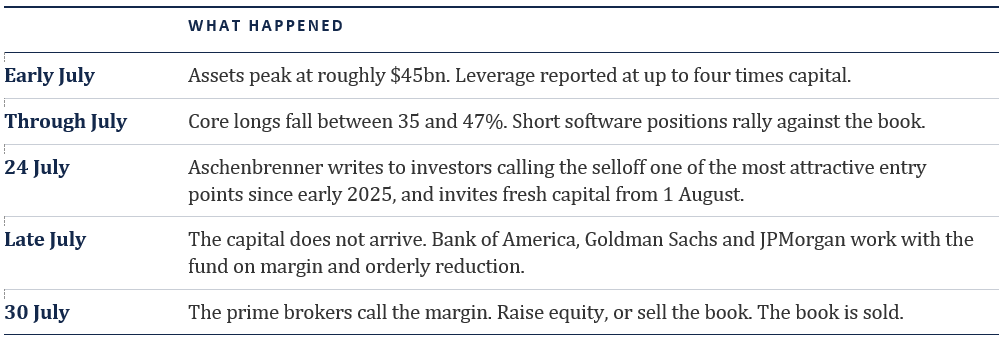
Two mechanics explain everything that followed, and neither is exotic. The first is arithmetic. At four times leverage, a 25% decline in the collateral pool does not produce a drawdown; it eliminates the equity sitting beneath the borrowing. The second is construction. Long semiconductors against short software looked like a hedged book, and in most market environments it would have behaved like one. In a repricing of the artificial intelligence narrative itself, it was a single directional bet written out twice, and both copies lost money on the same days.

Griffin's ticket
On 30 July, Ken Griffin's Citadel, with roughly $71bn under management, agreed to take the bulk of the listed portfolio. The Financial Times put the book at around $16bn billion. It went at a discount. The whole transaction was assembled inside 24 hours after a compressed conversation with several possible buyers; Goldman Sachs, JPMorgan, Bank of America and Citigroup arranged the transfer. Millennium and Jane Street looked at the portfolio and passed.
It is worth being precise about what this was, because the word circulating on trading desks has been “rescue”, and that is not what happened. Citadel does not underwrite other people's risk management. It bought a discounted portfolio from a seller who had no time, which is the oldest and most reliable trade on Wall Street. A month's worth of forced selling was compressed into one negotiated block, priced by the only participant with both the balance sheet to absorb it whole and the mandate to want it. Citadel already held versions of the same exposures, which tells you Griffin shares the medium-term view and simply has a capital structure that lets him wait for it.
The market understood immediately. The news that a single buyer had taken the portfolio, rather than the book being fed into the open market over several sessions, broke the reflexive selling loop and the sector rallied. Griffin bought the panic and was paid for ending it.

The residue
The fund is not closing. But what remains bears almost no relation to what existed four weeks ago.
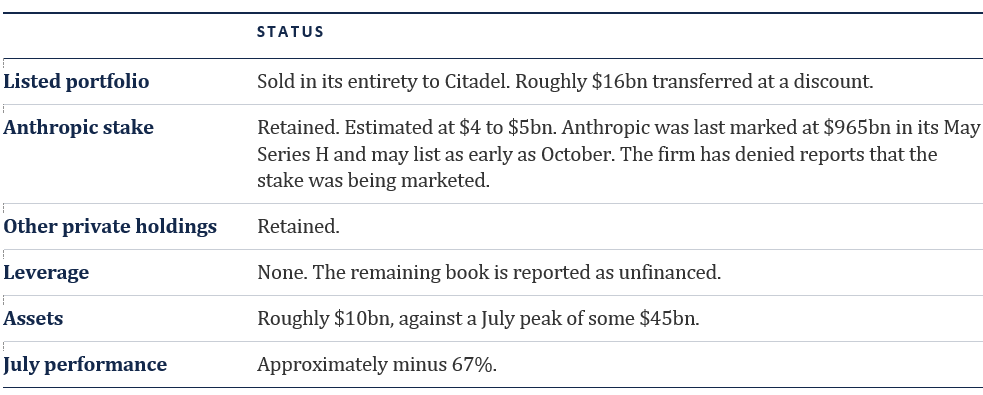
The asymmetry in that table is the most instructive thing in the whole affair. The private book did not survive because it was better constructed, better researched or better timed than the listed one. It survived because nobody can issue a margin call against an illiquid asset. The mark-to-market leg was liquidated; the mark-to-model leg is still standing. Whether it is genuinely worth $5bn will only be settled when Anthropic lists. In the meantime, it cannot be taken away, and that turns out to be the only property that mattered in July.
Functionally, Situational Awareness has stopped being a hedge fund. It is now a private holding company organised around one very large idea, run by a manager whose ability to express that idea in liquid markets has been removed from him.
What it teaches
Leverage is not a return multiplier. It is a contract with your lender about timing, and the lender writes the terms. You can be entirely right about the decade and still not be present for it. Being early and levered is operationally indistinguishable from being wrong, which is a distinction the industry keeps insisting on and the market keeps refusing to recognise.
Diversification is a property of behaviour, not of labels. Semiconductors on one side and software on the other satisfies every screen a risk system runs. It did not survive contact with a factor that owned both. Correlation is estimated in calm markets and discovered in stressed ones.
Gross exposure is not net capital. The $45bn and $20bn figures circulating in the press are probably both accurate, one measuring conviction and the other measuring capital. Every risk conversation should specify which of the two it is about. Very few of them do.
Crowding is the real position size. Global hedge funds have just recorded their worst monthly drawdown on record, with Asia-focused long/short averaging minus 18.6% through 28 July. When a thesis is universally held, your position is not the number in your own risk report. It is that number plus everything your peers will have to sell on the same morning.
Private marks are not a defence. Illiquidity is not risk reduction. It is risk deferral, and it flatters reported volatility precisely up to the moment cash is required, at which point it supplies none. Situational Awareness is the rare case where deferral happened to be the right side of the trade. It should not be mistaken for a strategy.
Long-Term Capital Management. Archegos. Three Arrows. Now this. None of them failed because every idea in the portfolio was foolish. They failed because lenders, collateral rules and timing took control of the decision to sell, and by then the quality of the ideas had stopped being relevant. The market does not grade the thesis. It grades the collateral.



.png)
