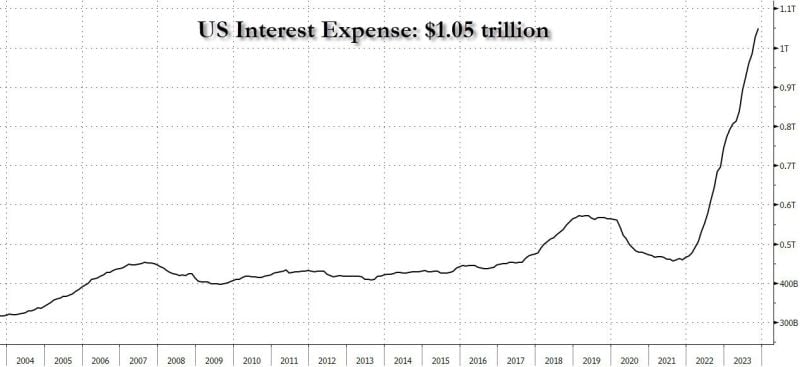
US Interest expense ~$1.1 trillion as of today
Disclaimer
This marketing document has been issued by Bank Syz Ltd. It is not intended for distribution to, publication, provision or use by individuals or legal entities that are citizens of or reside in a state, country or jurisdiction in which applicable laws and regulations prohibit its distribution, publication, provision or use. It is not directed to any person or entity to whom it would be illegal to send such marketing material. This document is intended for informational purposes only and should not be construed as an offer, solicitation or recommendation for the subscription, purchase, sale or safekeeping of any security or financial instrument or for the engagement in any other transaction, as the provision of any investment advice or service, or as a contractual document. Nothing in this document constitutes an investment, legal, tax or accounting advice or a representation that any investment or strategy is suitable or appropriate for an investor's particular and individual circumstances, nor does it constitute a personalized investment advice for any investor. This document reflects the information, opinions and comments of Bank Syz Ltd. as of the date of its publication, which are subject to change without notice. The opinions and comments of the authors in this document reflect their current views and may not coincide with those of other Syz Group entities or third parties, which may have reached different conclusions. The market valuations, terms and calculations contained herein are estimates only. The information provided comes from sources deemed reliable, but Bank Syz Ltd. does not guarantee its completeness, accuracy, reliability and actuality. Past performance gives no indication of nor guarantees current or future results. Bank Syz Ltd. accepts no liability for any loss arising from the use of this document.

Related Articles
The New York Fed’s Q3 2025 report shows total household debt rising $197 billion (+1%) to a new all-time high of $18.59 trillion. Here’s the breakdown 👇 🏠 Housing debt: $13.5T 💳 Non-housing debt: $5.1T Key highlights: 🏡 Mortgage balances up $137B → now $13.07T Delinquency: 0.83% (barely up from 0.82%) 💳 Credit card balances up $24B → now $1.23T Delinquency: 12.41%, highest since 2011 🚨 🚗 Auto loans steady at $1.66T 🎓 Student loans up $15B → $1.65T 90+ day delinquencies at 9.4% — surging after repayment resumed 🏡 HELOCs up $11B → $422B 🧾 In total: Non-housing balances rose 1% from last quarter. 📉 Consumer bankruptcies: 141,600 — the most since 2020. 🔍 What’s happening: “Household debt balances are growing at a moderate pace, with delinquency rates stabilizing,” said the NY Fed’s Donghoon Lee. True — but under the surface, cracks are widening. Credit card delinquencies are the highest in 14 years. Student loan defaults are accelerating — especially among borrowers 50+, where 1 in 5 loans is now delinquent. Mortgage resilience is holding — for now — but that may change if housing prices slip and credit tightens. 🧠 Big picture: Consumers are tapped out. The pandemic-era cushion is gone. Credit limits are rising, but so are missed payments.
The Federal Reserve announced it will end Quantitative Tightening (QT) and begin Quantitative Easing (QE) again — calling it a “technical adjustment.” But let’s be honest: That’s easing. And easing into this environment is something we’ve rarely seen in history. Let’s unpack what this means 👇 📉 Normally, QE happens during crisis. Low valuations, weak growth, wide credit spreads, and falling inflation. QE was meant to stimulate into a depression. 📈 This time is different. Stocks are near record highs AI and tech valuations are in bubble territory Unemployment is near record lows Inflation is still above target Credit and liquidity are abundant So if the Fed starts buying bonds and adding liquidity now — while deficits stay huge — it’s essentially monetizing government debt during a boom. That’s not “technical.” That’s a classic late-stage Big Debt Cycle move — where monetary and fiscal policy collide to keep the system afloat. 🧩 The mechanics: QE pushes real yields down Financial assets inflate (especially tech & gold) Wealth gaps widen Inflation reawakens — eventually forcing the Fed to tighten again ⚠️ And that’s when bubbles pop. So yes — the Fed may be stimulating into strength, not weakness. Into a bubble, not a bust. Into risk, not safety. This is the kind of pivot that separates traders from historians.
The ISM Manufacturing Index fell to 48.7 in October, marking the 8th STRAIGHT month of contraction. The US manufacturing sector has been in recession for 34 of the last 36 months. Backlogs of orders have been contracting for 3 years STRAIGHT. Source: Global Markets Investor @GlobalMktObserv