

Disclaimer
This marketing document has been issued by Bank Syz Ltd. It is not intended for distribution to, publication, provision or use by individuals or legal entities that are citizens of or reside in a state, country or jurisdiction in which applicable laws and regulations prohibit its distribution, publication, provision or use. It is not directed to any person or entity to whom it would be illegal to send such marketing material. This document is intended for informational purposes only and should not be construed as an offer, solicitation or recommendation for the subscription, purchase, sale or safekeeping of any security or financial instrument or for the engagement in any other transaction, as the provision of any investment advice or service, or as a contractual document. Nothing in this document constitutes an investment, legal, tax or accounting advice or a representation that any investment or strategy is suitable or appropriate for an investor's particular and individual circumstances, nor does it constitute a personalized investment advice for any investor. This document reflects the information, opinions and comments of Bank Syz Ltd. as of the date of its publication, which are subject to change without notice. The opinions and comments of the authors in this document reflect their current views and may not coincide with those of other Syz Group entities or third parties, which may have reached different conclusions. The market valuations, terms and calculations contained herein are estimates only. The information provided comes from sources deemed reliable, but Bank Syz Ltd. does not guarantee its completeness, accuracy, reliability and actuality. Past performance gives no indication of nor guarantees current or future results. Bank Syz Ltd. accepts no liability for any loss arising from the use of this document.
Related Articles
Source: Barchart
The U.S. remains heavily dependent on China for critical rare-earth materials, with roughly 70% of rare-earth imports coming from China. And Beijing has increasingly demonstrated its willingness to restrict exports of strategic minerals. The vulnerability goes far beyond fighter jets. Rare earths and related critical minerals are essential for missiles, radar systems, drones, satellites, precision-guided weapons, submarines and advanced electronics. If inventories are already tight, a prolonged disruption in Chinese supply could become a serious bottleneck for U.S. defense production. That creates a striking strategic paradox: America's military-industrial base still depends, in part, on supply chains dominated by its biggest geopolitical rival. China doesn't necessarily need to fire a shot to exert pressure. Sometimes the most powerful weapon is controlling what your opponent needs to keep fighting. Sun Tzu would understand the strategy. Source: Lukas Ekwueme
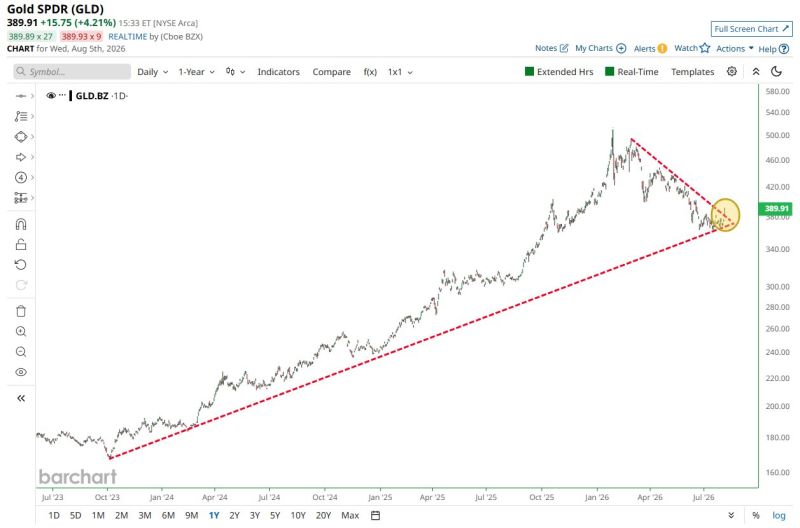
Asian gold ETF holdings have more than doubled over the past year, surpassing 500 tonnes for the first time this century, with China driving much of the surge. By contrast, gold ETF holdings in North America and Europe have remained broadly stable. And the macro backdrop supporting gold has barely changed: Government debt remains historically high Fiscal deficits remain elevated Non-bank credit continues to expand Leverage across the financial system remains substantial In other words, the structural case for gold remains firmly intact. What is changing is investor demand. Asian investors, particularly in China, are accumulating gold at an accelerating pace. And when structural macro support meets rising investment demand, the adjustment ultimately has to come through one place: The price of gold. Source: Bloomberg, Global Markets Investor