

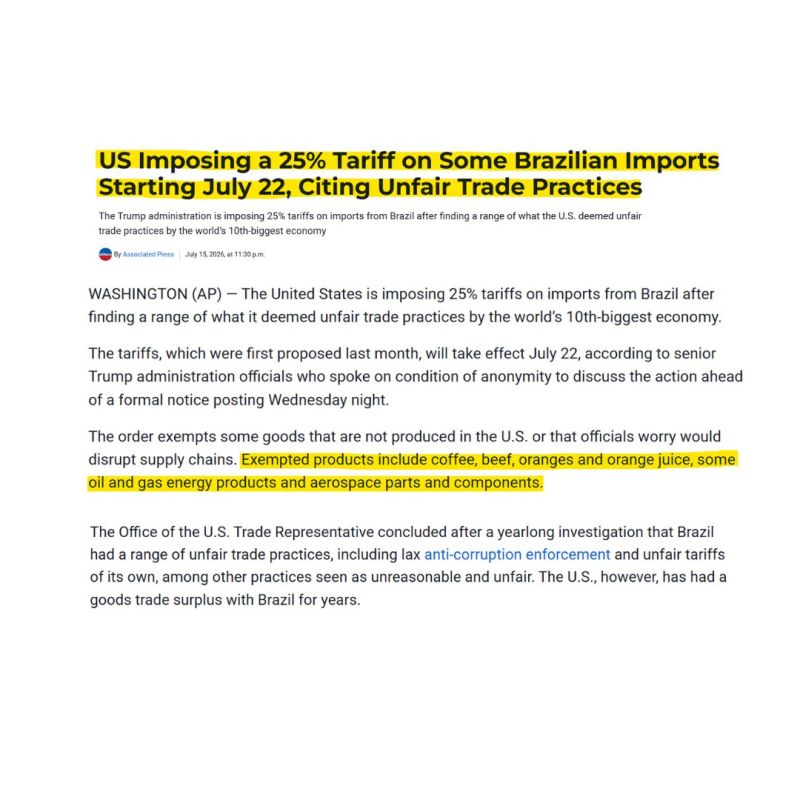
The U.S. will impose 25% tariffs on imports from Brazil, the world's 10th-largest economy.
Disclaimer
This marketing document has been issued by Bank Syz Ltd. It is not intended for distribution to, publication, provision or use by individuals or legal entities that are citizens of or reside in a state, country or jurisdiction in which applicable laws and regulations prohibit its distribution, publication, provision or use. It is not directed to any person or entity to whom it would be illegal to send such marketing material. This document is intended for informational purposes only and should not be construed as an offer, solicitation or recommendation for the subscription, purchase, sale or safekeeping of any security or financial instrument or for the engagement in any other transaction, as the provision of any investment advice or service, or as a contractual document. Nothing in this document constitutes an investment, legal, tax or accounting advice or a representation that any investment or strategy is suitable or appropriate for an investor's particular and individual circumstances, nor does it constitute a personalized investment advice for any investor. This document reflects the information, opinions and comments of Bank Syz Ltd. as of the date of its publication, which are subject to change without notice. The opinions and comments of the authors in this document reflect their current views and may not coincide with those of other Syz Group entities or third parties, which may have reached different conclusions. The market valuations, terms and calculations contained herein are estimates only. The information provided comes from sources deemed reliable, but Bank Syz Ltd. does not guarantee its completeness, accuracy, reliability and actuality. Past performance gives no indication of nor guarantees current or future results. Bank Syz Ltd. accepts no liability for any loss arising from the use of this document.
Related Articles
A Nikkei investigation found that Alphabet, Microsoft, Amazon, Meta, and Oracle have $1.65 trillion of off-balance-sheet obligations, exceeding the $1.35 trillion of debt they officially report. These commitments—GPU contracts, data center leases, and joint ventures—remain largely invisible under current accounting rules until facilities become operational. Meta alone reportedly has $420 billion in hidden obligations, while Oracle's exposure has exploded over the past four years. The key risk? Investors focusing on earnings may be seeing only part of the picture. As AI infrastructure comes online, these commitments will gradually move onto balance sheets. If AI demand falls short of expectations, expensive assets could face write-downs, with losses ultimately flowing to shareholders and the private credit investors who financed the AI buildout. Source: Hedgie
Total deals are worth over $60 BILLION, per Reuters. Chevron, ExxonMobil, Shell and more are also involved They also involved other industries, including healthcare, communications and infrastructure. It’s not clear when the oil deals will be able to create viable alternatives to the Strait of Hormuz, through which about a fifth of the world’s oil flows. Goldman Sachs estimates that pipelines in just one country take at least two and a half years to build, and these pipelines would travel through two or more nations. Iran has sought to close the Strait repeatedly since the U.S.-Iran war began Feb. 28, causing sharp gyrations in oil and gas prices. Alternatives routes for oil will weaken Iran's main bargaining power. Will China be the big loser here? Source: AP, Al Jazeera
Source: Evan @StockMKTNewz Bloomberg