

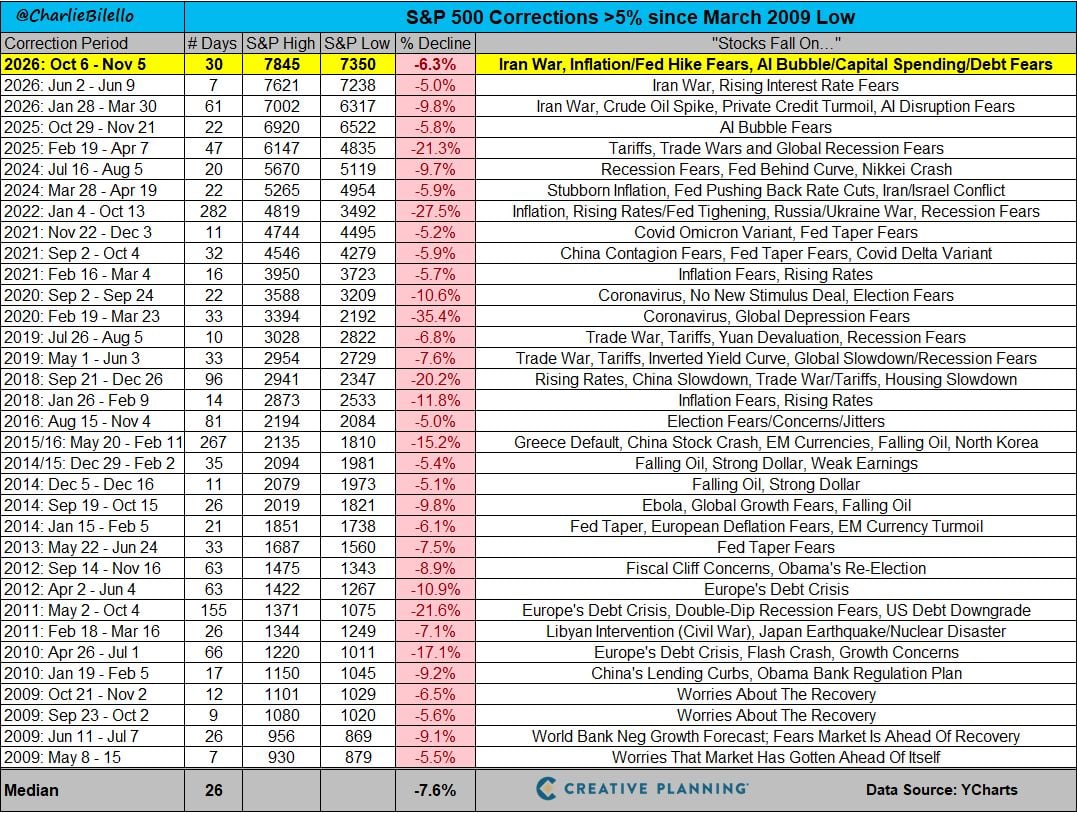
Since March 2009, the S&P 500 has now experienced 34 corrections of 5% or more
Disclaimer
This marketing document has been issued by Bank Syz Ltd. It is not intended for distribution to, publication, provision or use by individuals or legal entities that are citizens of or reside in a state, country or jurisdiction in which applicable laws and regulations prohibit its distribution, publication, provision or use. It is not directed to any person or entity to whom it would be illegal to send such marketing material. This document is intended for informational purposes only and should not be construed as an offer, solicitation or recommendation for the subscription, purchase, sale or safekeeping of any security or financial instrument or for the engagement in any other transaction, as the provision of any investment advice or service, or as a contractual document. Nothing in this document constitutes an investment, legal, tax or accounting advice or a representation that any investment or strategy is suitable or appropriate for an investor's particular and individual circumstances, nor does it constitute a personalized investment advice for any investor. This document reflects the information, opinions and comments of Bank Syz Ltd. as of the date of its publication, which are subject to change without notice. The opinions and comments of the authors in this document reflect their current views and may not coincide with those of other Syz Group entities or third parties, which may have reached different conclusions. The market valuations, terms and calculations contained herein are estimates only. The information provided comes from sources deemed reliable, but Bank Syz Ltd. does not guarantee its completeness, accuracy, reliability and actuality. Past performance gives no indication of nor guarantees current or future results. Bank Syz Ltd. accepts no liability for any loss arising from the use of this document.
Related Articles
What is Nvidia’s biggest risk? It has nothing to do with Jensen Huang. It is rather the fact that AI might keep booming while Nvidia would capture a smaller share of the spending. The uncertainty around Jensen Huang indeed comes at a difficult time. Two shifts are already testing Nvidia’s grip on the AI market. 1️⃣ Closed models are winning the dollars. As hyperscalers move more workloads onto their own chips, Nvidia could capture less of every dollar they spend on compute. 2️⃣ Open models are winning on volume. That should favor Nvidia’s general-purpose GPUs. But Chinese models are taking a meaningful share of that volume, which makes export controls one of the biggest questions for investors. Then there’s succession. Who could take over? Could Jensen still shape the technology roadmap in another role? The ripple effects go beyond Nvidia. ▪️ Circular AI financing faces a test. If your funding model assumes Nvidia will step in with a backstop, it’s time to reopen the spreadsheet. ▪️ Rival chipmakers and their suppliers could gain ground as customers diversify where they buy compute. Nvidia may look cheap. But low P/E is not an investment thesis. The 1 million dollar question is the following: How much of the next wave of AI spending will Nvidia actually capture? Source #chart: SPEAR INVEST
Nvidia was the world's largest company just a few weeks ago. Now: - Down 36% from its all time high. - Over $2 trillion wiped from its market cap. - Lost the No. 1 spot to Apple. - Hit its lowest level since July 2025. - Headed for its 6th straight weekly drop, the longest since 2012. - CEO resigned, with an ongoing investigation. Source: Bull Theory, companiesmarketcap.com
Anthropic will make ~1,000 employees worth +$100m at $2 trillion market cap. There's ~11,000 Americans with $100m in investable assets]. Source: shirish