

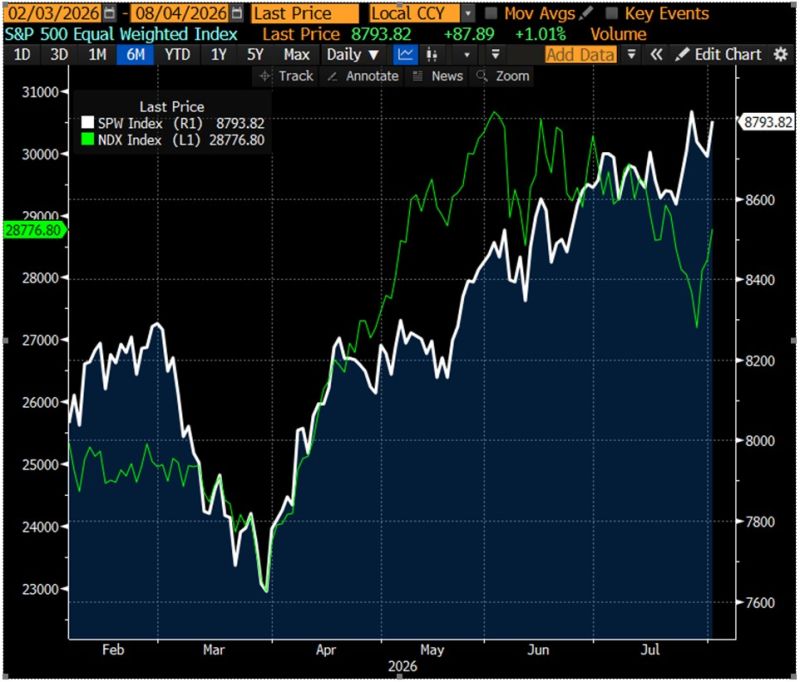
The market broadening in one chart
Disclaimer
This marketing document has been issued by Bank Syz Ltd. It is not intended for distribution to, publication, provision or use by individuals or legal entities that are citizens of or reside in a state, country or jurisdiction in which applicable laws and regulations prohibit its distribution, publication, provision or use. It is not directed to any person or entity to whom it would be illegal to send such marketing material. This document is intended for informational purposes only and should not be construed as an offer, solicitation or recommendation for the subscription, purchase, sale or safekeeping of any security or financial instrument or for the engagement in any other transaction, as the provision of any investment advice or service, or as a contractual document. Nothing in this document constitutes an investment, legal, tax or accounting advice or a representation that any investment or strategy is suitable or appropriate for an investor's particular and individual circumstances, nor does it constitute a personalized investment advice for any investor. This document reflects the information, opinions and comments of Bank Syz Ltd. as of the date of its publication, which are subject to change without notice. The opinions and comments of the authors in this document reflect their current views and may not coincide with those of other Syz Group entities or third parties, which may have reached different conclusions. The market valuations, terms and calculations contained herein are estimates only. The information provided comes from sources deemed reliable, but Bank Syz Ltd. does not guarantee its completeness, accuracy, reliability and actuality. Past performance gives no indication of nor guarantees current or future results. Bank Syz Ltd. accepts no liability for any loss arising from the use of this document.
Related Articles
Japan owns roughly $1.1 trillion in US government bonds. When it intervenes to support the yen, it needs dollars. Once its cash reserves are depleted, selling Treasuries becomes the most direct way to fund further intervention. That is a problem for the US. Large Treasury sales would increase bond supply, pushing prices lower and yields higher. With the 10-year Treasury yield recently climbing above 4.7%, Washington has strong incentives to avoid additional upward pressure. The solution is the Fed's FIMA Repo Facility. It allows foreign central banks to temporarily exchange Treasuries for dollars without selling the bonds into the market. Japan receives dollar liquidity, then later repays the funds and takes back its securities, leaving the bond market largely unaffected. The challenge is capacity. The facility is currently capped at $60 billion per day, while Japan is estimated to have spent $60–80 billion supporting the yen in just one week. According to reports, Bessent wants that limit increased. However, expanding the facility would require approval from the Federal Open Market Committee (FOMC), and the Federal Reserve has so far declined to comment. Source: Bull Theory
“Profit margins are probably the most mean-reverting series in finance, and if profit margins don't mean revert, then something has gone badly wrong with capitalism. If high profits don't attract competition, there's something wrong with the system.” - Jeremy Grantham Charlie Bilello
Omar Sharif of Inflation Insights points out that the ISM production index rose by the most for any July since 1951. Source: Lisa Abramowicz