

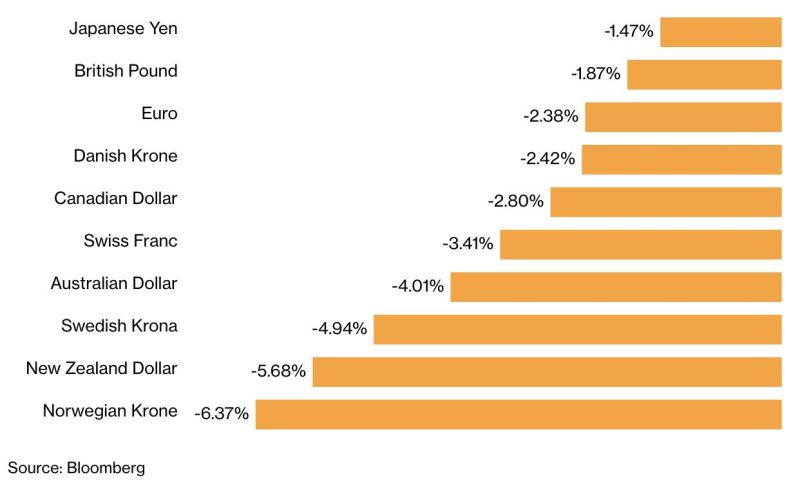
The US dollar has OUTPACED every G10 currency this month.
Disclaimer
This marketing document has been issued by Bank Syz Ltd. It is not intended for distribution to, publication, provision or use by individuals or legal entities that are citizens of or reside in a state, country or jurisdiction in which applicable laws and regulations prohibit its distribution, publication, provision or use. It is not directed to any person or entity to whom it would be illegal to send such marketing material. This document is intended for informational purposes only and should not be construed as an offer, solicitation or recommendation for the subscription, purchase, sale or safekeeping of any security or financial instrument or for the engagement in any other transaction, as the provision of any investment advice or service, or as a contractual document. Nothing in this document constitutes an investment, legal, tax or accounting advice or a representation that any investment or strategy is suitable or appropriate for an investor's particular and individual circumstances, nor does it constitute a personalized investment advice for any investor. This document reflects the information, opinions and comments of Bank Syz Ltd. as of the date of its publication, which are subject to change without notice. The opinions and comments of the authors in this document reflect their current views and may not coincide with those of other Syz Group entities or third parties, which may have reached different conclusions. The market valuations, terms and calculations contained herein are estimates only. The information provided comes from sources deemed reliable, but Bank Syz Ltd. does not guarantee its completeness, accuracy, reliability and actuality. Past performance gives no indication of nor guarantees current or future results. Bank Syz Ltd. accepts no liability for any loss arising from the use of this document.
Related Articles
The equal-weighted basket of 10 space sector stocks has COLLAPSED -50% since its peak, the largest drawdown since April 2025 and the 2nd-largest since the 2022 bear market. SpaceX, $SPCX, alone is down -32% since its mid-June peak. This comes after retail investors purchased $405 million of SpaceX shares during its first 5 trading days after its June 12 IPO, the largest first-week retail purchases of any IPO ever. Mom-and-pop investors also piled into leveraged ETFs linked to SpaceX, purchasing $65.8 million of the 2x Leveraged Long SpaceX ETF, $SPCH, over its first few trading sessions. The fund is down -56% since the June 16 peak, posted on the 2nd trading day after its launch. Source: Thomas Callum, Topdown charts
Here's why: Over the next 12 months, the US Treasury must refinance roughly $8 trillion of debt. The average interest rate on that debt is about 3.3%. Today, the 1-year Treasury yields around 4%. Simply refinancing that $8 trillion at current rates would increase annual interest costs by roughly $50 billion. And that's before accounting for interest on an ongoing $2 trillion annual budget deficit. This is why today's fiscal backdrop is fundamentally different from the early 1980s. When Paul Volcker raised rates into the double digits, the US had already benefited from years of high inflation that dramatically reduced the debt burden relative to the economy. Today, debt levels are far higher. Every percentage point increase in borrowing costs has a much larger impact on the federal budget. The Fed isn't just fighting inflation anymore. It's operating with one eye on a balance sheet that has become increasingly sensitive to higher rates. The higher rates stay, the more expensive America's debt becomes. Source: Lukas Ekwueme @ekwufinance FT
For centuries, gold anchored monetary systems and provided confidence when fiat currencies eventually lost it. Today, global debt has exploded to $350 trillion, while only about 25% of all fiat money is backed by the value of all the gold above ground, down from 60–100% throughout most of history. At the same time, governments continue printing money to finance ever-rising debt. China appears to understand this dynamic: it is simultaneously expanding debt and aggressively accumulating gold. If history rhymes, gold may not simply rise in price—it may be revalued as confidence in fiat currencies is tested. Source: jeroen blokland