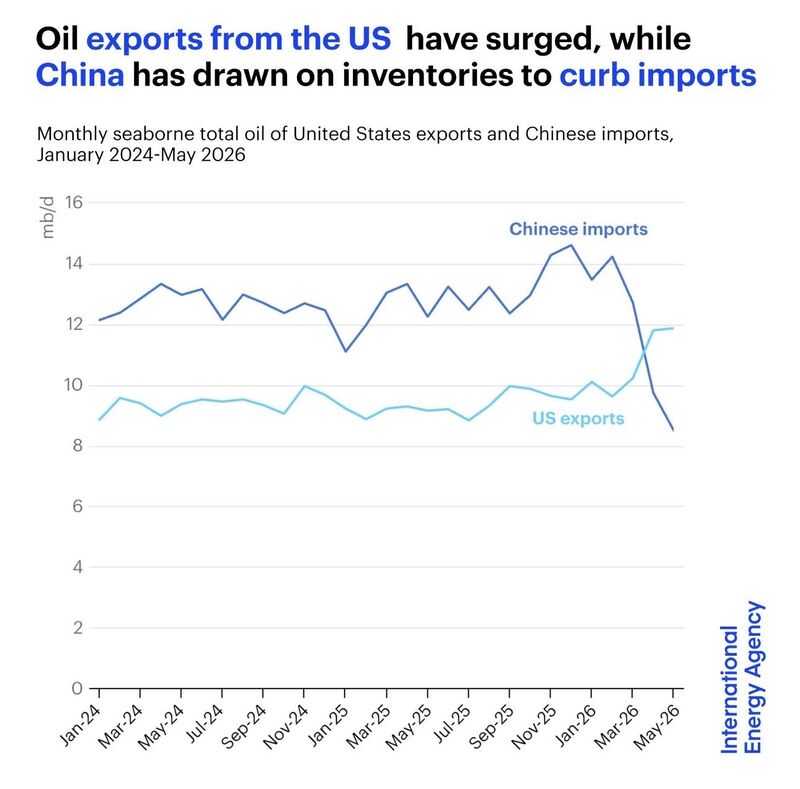

AMERICAN HOUSEHOLDS ARE MORE INVESTED IN STOCKS THAN EVER
Stocks now make up a record-high share of U.S. household assets, Axios reports. American household wealth is now more tied to equities than ever before, making consumers more exposed to market swings. Source: Coin Bureau
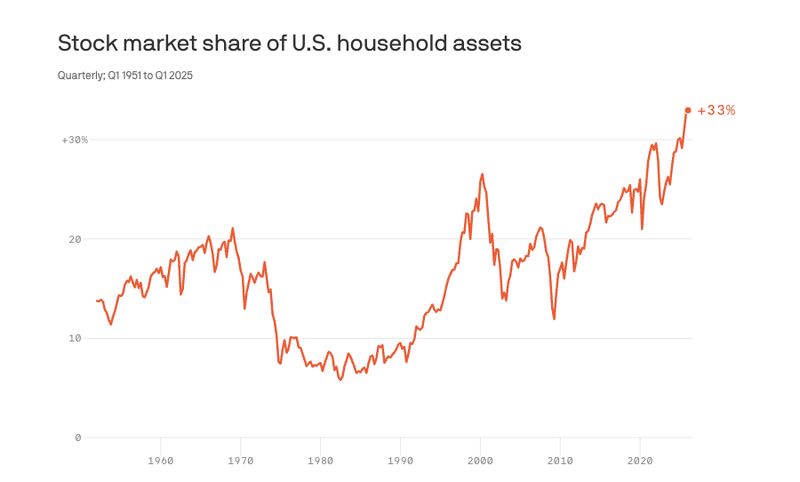
Are US semiconductor stocks priced for perfection?
The semiconductor sector is trading at historically high valuations, with the Philadelphia Semiconductor Index near 30x forward earnings and at a rare premium to the S&P 500. While AI remains a transformative technology, concerns are growing that investment is outpacing economic returns. Falling AI token prices and a widening gap between AI spending and AI-generated revenue suggest monetization is lagging. If hyperscalers fail to generate stronger returns from AI, current semiconductor valuations may become increasingly difficult to justify.
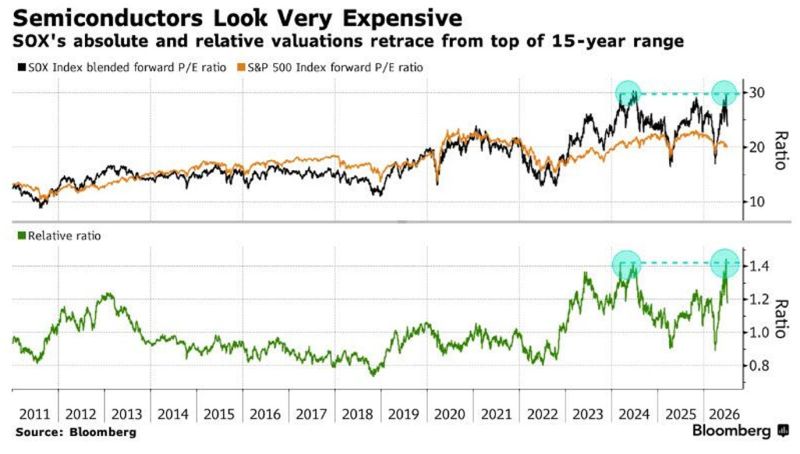
The investor who famously called the 2008 financial crisis is making his biggest bet yet.
A market strategist is betting on a 30–40% correction by March 2027, shorting Nvidia, Tesla, Caterpillar, and semiconductor stocks. He argues that AI infrastructure companies have soared while major AI buyers (Microsoft, Amazon, Google, Meta) have seen relatively weak returns, raising valuation concerns. He also points to stretched semiconductor valuations, extreme technical indicators, falling AI token prices, and underestimated depreciation costs. His core argument is that AI enthusiasm has outpaced economic returns, making the sector increasingly vulnerable to a sharp correction.
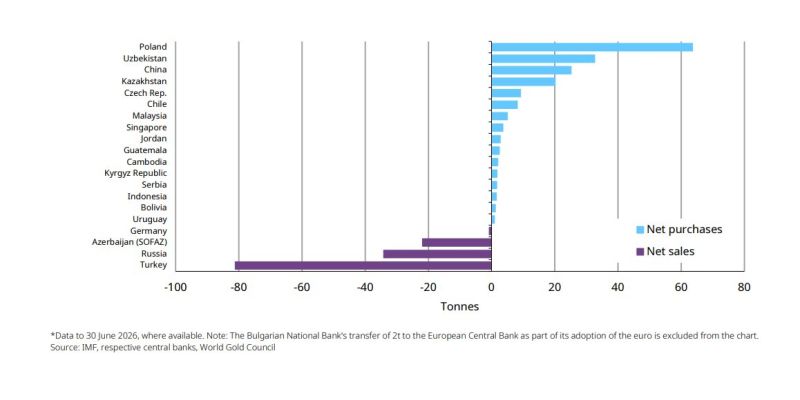
Central banks just doubled their gold buying in a single month.
The World Gold Council reported net central bank gold purchases of 41 tonnes in May, more than double April's 19 tonnes. Poland was the biggest buyer, adding 18 tonnes in May, bringing its 2026 total to 64 tonnes. Its reserves now stand at 614 tonnes. China added 10 tonnes, its biggest monthly purchase since December 2024 and its 20th straight month of buying. Total Chinese reserves now sit at 2,331 tonnes. Turkey was the only major seller, offloading 3 tonnes in May, extending its 2026 net sales to 81 tonnes as it draws on reserves to defend the lira. The 2026 Central Bank Gold Reserves Survey shows 89% of central banks expect global gold reserves to increase over the next 12 months. A record 45% plan to increase their own holdings. Gold gained +2% last week after four straight weekly declines but remains -25.4% below its peak. Source: Bull Theory
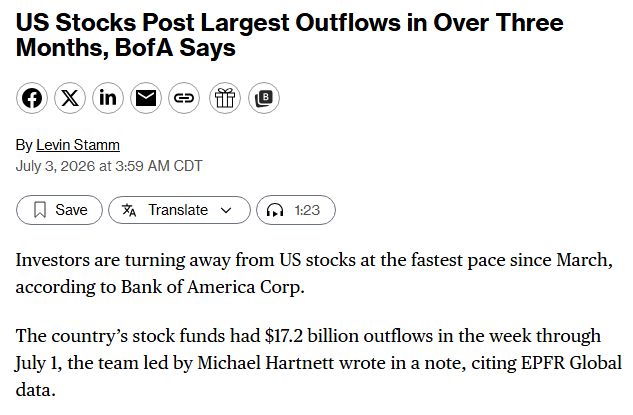
Investors dumped Stocks last week at the fastest pace since March
Source: BofA, Barchart
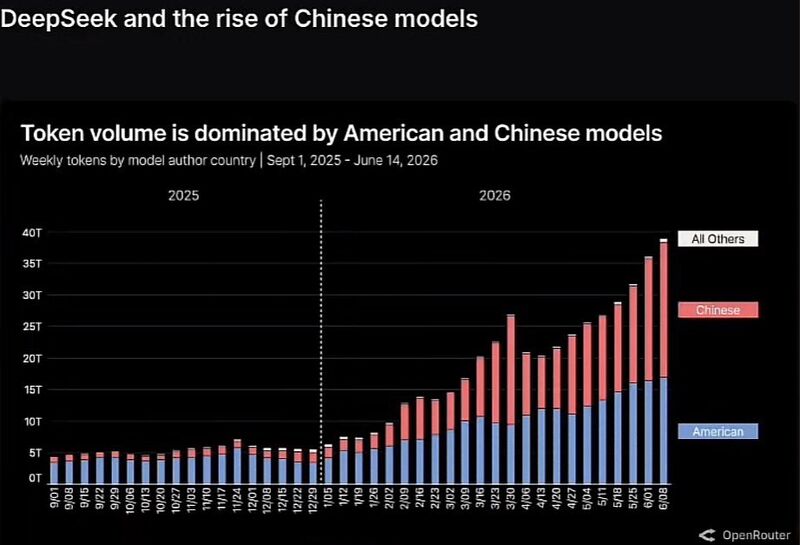
In 2025 American AI dominated with 90% market share.
Today Deep Seek and other AI open source Chinese AI has overtaken the US and now control about 52% of the market. Why? Because Chinese AI is much cheaper. Source: QE Infinity
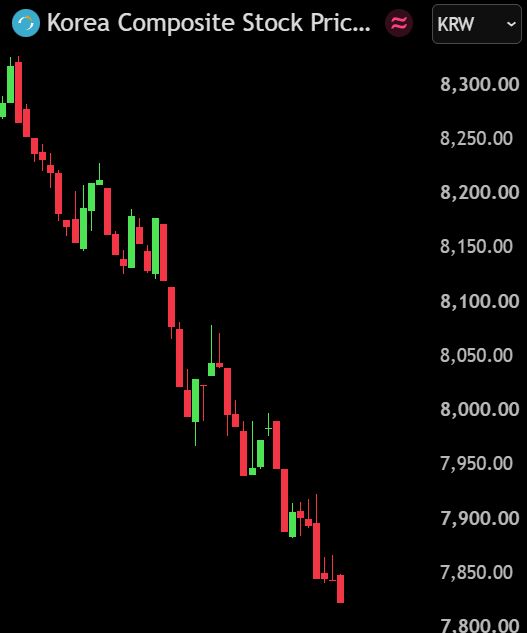
South Korea's KOSPI has crashed -6% from today's high as foreign investors continue to sell ahead of Samsung's earnings report.
Foreign investors sold ₩2,200,000,000,000 worth of Korean stocks today, marking their 11th consecutive day of net selling. Their cumulative net sales have now reached ₩157.3 trillion ($116 billion) since 2026. Samsung is set to release its Q2 earnings on July 7, with Q2 operating profit expected to surge 18x. Source: Bull Theory
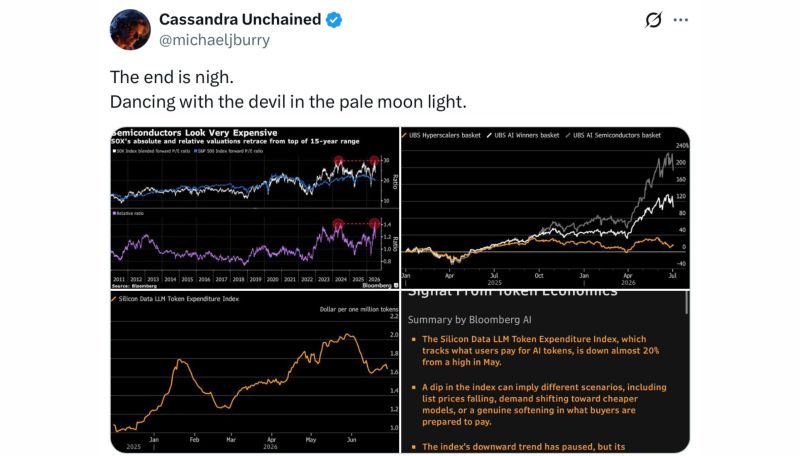
One chart may have just revealed a major shift in the global energy order.
For the first time in history, U.S. oil exports have surpassed China's crude oil imports. At first glance, it looks like just two lines crossing on a chart. In reality, it could mark a profound structural change. For two years, China's crude imports hovered around 12–14 million barrels per day. Then they suddenly plunged to roughly 8.5 million. At the same time, U.S. oil exports, long stuck around 9–10 million barrels per day, surged above 12 million. Why? China didn't stop buying oil because demand disappeared. It stopped because supply became constrained. • Nearly 38% of China's crude imports depended on the Strait of Hormuz. • Gulf producers faced major disruptions. • Russia was already exporting at full capacity. • U.S. light sweet crude isn't an ideal substitute for many Chinese refineries. With few alternatives, China began drawing down strategic inventories instead of importing. That collapse in imports isn't necessarily a sign of weaker demand. It may be evidence of a country relying on its emergency reserves to navigate one of the biggest supply shocks in years. Meanwhile, U.S. exporters stepped in to replace part of the missing Gulf supply. Sometimes, the most important geopolitical shifts don't make the front page. They simply appear when two lines cross on a chart. Source. Jack Prandelli on X, IEA