
JP Morgan Chase & Co. has begun publishing research reports on leading private companies.
Marking a strategic shift as these firms wield growing influence over global markets, a source told Reuters on Friday. The bank's first note focuses on OpenAI, the ChatGPT creator that ignited Wall Street's AI frenzy with a valuation surpassing $27?billion. As IPO timelines stretch and private market valuations rival those of S&P 500 companies, institutional investors are seeking earlier insights into disruptors like SpaceX and TikTok parent ByteDance. In an internal memo, JPMorgan's head of global research, Hussein Malik, said the reports will provide structured analysis and market tracking but will exclude ratings and price targets. "Private companies are increasingly shaping industries, particularly in the new economy space," Malik wrote. The timing reflects explosive growth in private markets. North America alone hosts over 1,000 unicorn startups valued above $1?billion worth nearly $4 trillion collectively, according to PitchBook. Private capital markets, spanning venture and private equity, reached $18.7 trillion last year and are projected to hit $24 trillion by 2029. RTTNews, Bloomberg

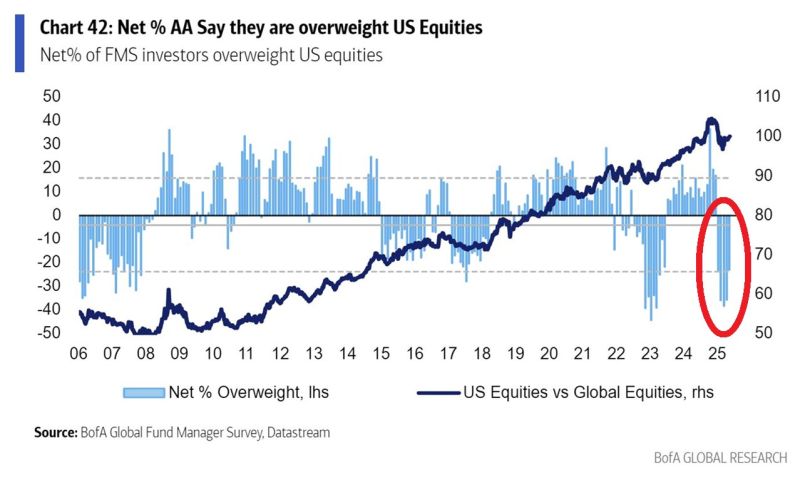
⚠️ Global fund managers are under invested in US stocks:
▶️ Professional investors have remained UNDERWEIGHT US equities versus global stocks for the 5th consecutive month. 👉 Meanwhile, the MSCI World Ex. USA index is up 17% year-to-date, beating the S&P 500 gain of 7%. Source: Global Markets Investor, BofA
Ether $ETH relative to bitcoin $BTC is breaking out after a multi-month consolidation.
Is this bearish for bitcoin? No. It just means that we might be at the beginning of the so-called "altcoin season" where other cryptos start to outperform bitcoin. But it does NOT mean that bitcoin is heading south. The new all-time highs in Coinbase, Robinhood and other crypto-related stocks and assets like Galaxy Digital are additional evidence that the crypto bull market might actually gathering speed. Source. J-C Parets NB: this is not an investment recommendation. Do your own research
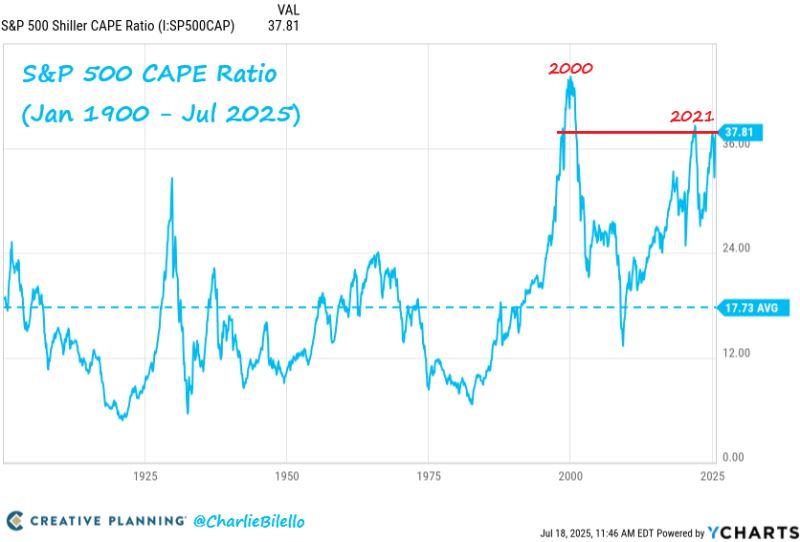
The SP500's CAPE Ratio is about to cross above 38 for the 3rd time in history, now higher than 98% of historical valuations. $SPX
Source: Charlie Bilello
Japan PM Ishiba Vows To 'Stay On' Despite Ruling Coalition Facing Major Loss; Exit Polls Show
The governing coalition of Prime Minister Shigeru Ishiba is likely to lose a majority in the smaller of Japan's two parliamentary houses in a key election Sunday, according to exit polls, worsening the country's political instability. Voters were deciding half of the 248 seats in the upper house, the less powerful of the two chambers in Japan's Diet. Ishiba has set the bar low, wanting a simple majority of 125 seats, which means his Liberal Democratic Party, or LDP, and its Buddhist-backed junior coalition partner Komeito need to win 50 to add to the 75 seats they already have. That would mean a big retreat from the 141 seats they had before the election. The LDP alone is projected to win from 32 to 35 seats, the fewest won by the party, which still is the No. 1 party in the parliament. Source: www.zerohedge.com

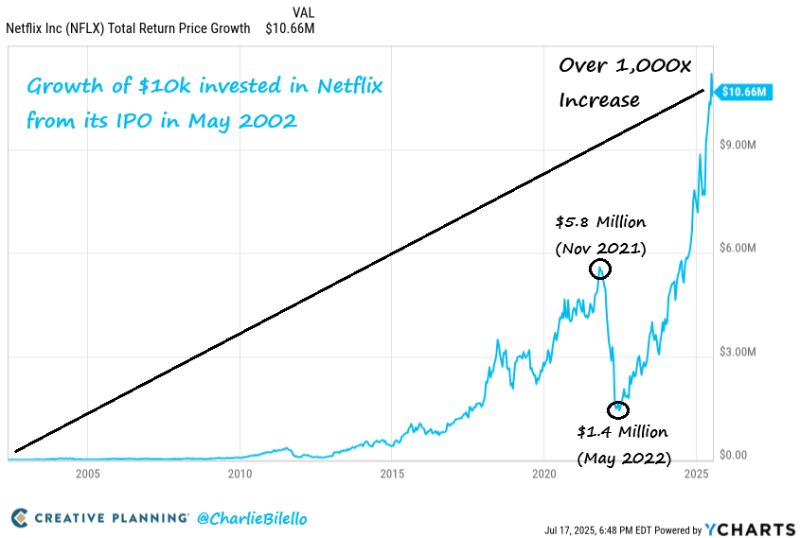
$10,000 invested in Netflix at its IPO in May 2002 is worth over $10 million today. $NFLX
Source: Charlie Bilello
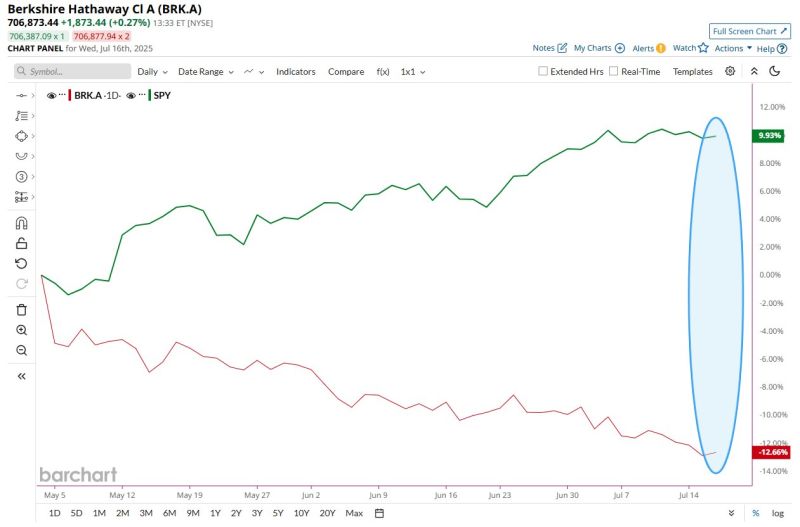
Berkshire Hathaway is now underperforming the S&P 500 by almost 23 percentage points since Warren Buffett announced his retirement 📉📉
Source: Barchart
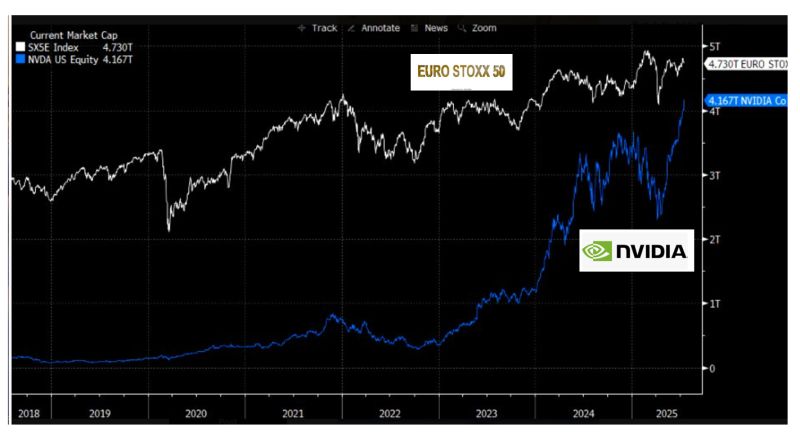
Nvidia $NVDA is now less than $600 Billion away from having a higher market cap than the entire Euro Stoxx 50 (largest 50 stocks in Europe) 🚨🚨🚨
Source: Bloomberg, Barchart