
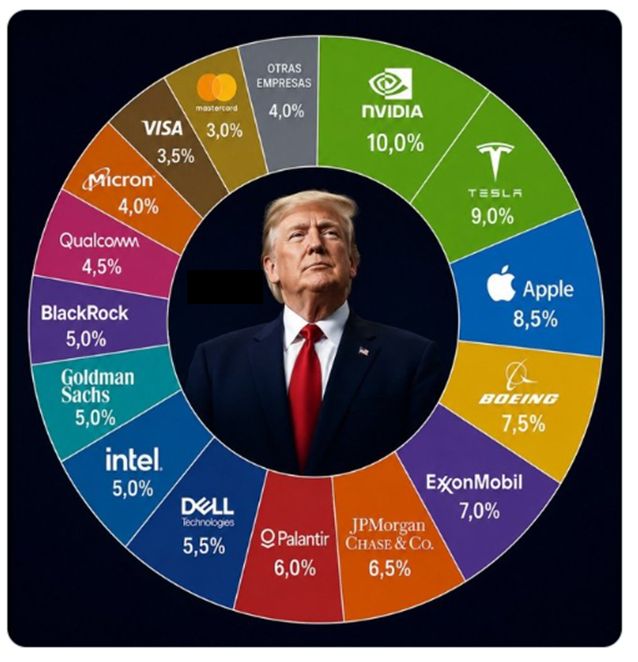
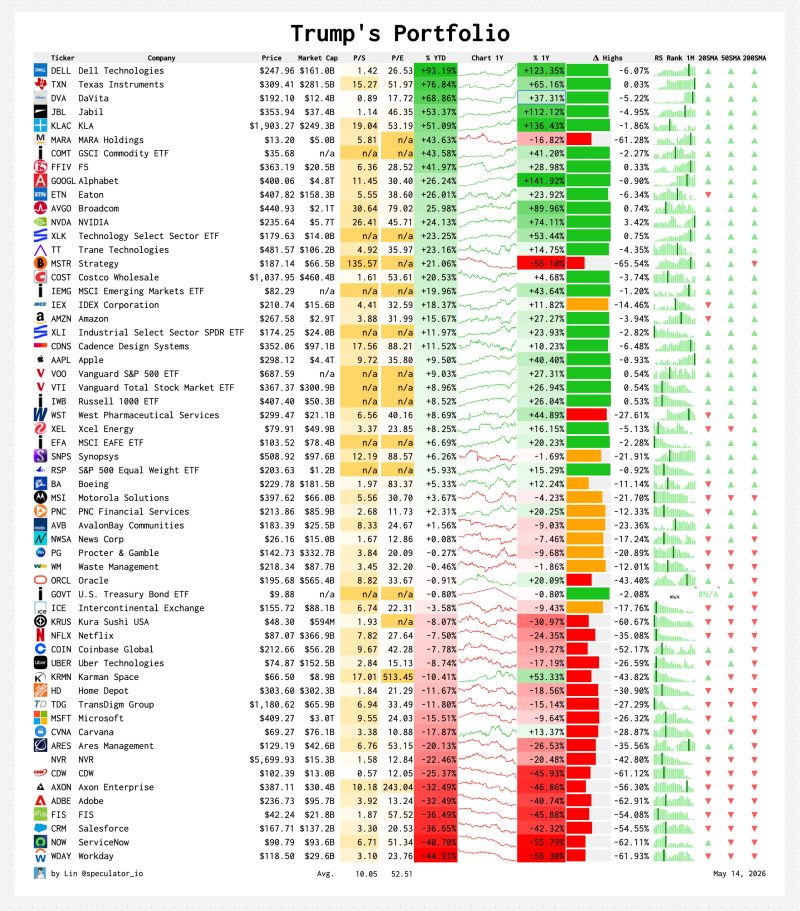
Trump's stock portfolio:
Source: Stocks World
PRESIDENT TRUMP'S Q1 STOCK DISCLOSURE COVERS 3,800+ TRANSACTIONS. THE LARGEST: $5M-$25M SALES EACH OF META, AMAZON, AND MICROSOFT ON 2/10.
The OGE 278-T was filed May 8 and certified by the Office of Government Ethics on May 13. This is Trump's personal portfolio: $AVGO Broadcom $DELL Dell $TXN Texas Instruments $DVA DaVita $JBL Jabil $KLAC KLA $COMT GSCI Commodity ETF $FFIV F5 $GOOGL Alphabet $ETN Eaton $NVDA NVIDIA $XLK Technology Select Sector ETF $TT Trane Technologies $COST Costco $IEMG MSCI Emerging Markets ETF $IEX IDEX $AMZN Amazon $XLI Industrial Select Sector SPDR ETF $CDNS Cadence Design Systems $AAPL Apple $VOO Vanguard S&P 500 ETF $VTI Vanguard Total Stock Market ETF $WST West Pharmaceutical $IWB Russell 1000 ETF $XEL Xcel Energy $EFA MSCI EAFE ETF $SNPS Synopsys $RSP S&P 500 Equal Weight ETF $BA Boeing $MSI Motorola $NWSA News Corp $MSTR Microstrategy $ORCL Oracle $WM Waste Management $GOVT U.S. Treasury Bond ETF $ICE Intercontinental Exchange $MARA MARA $NFLX Netflix $UBER Uber $KRMN Karman Space $HD Home Depot $TDG TransDigm $MSFT Microsoft $CVNA Carvana $COIN Coinbase $AXON Axon $ADBE Adobe $CRM Salesforce $NOW ServiceNow $WDAY Workday Source: Lin
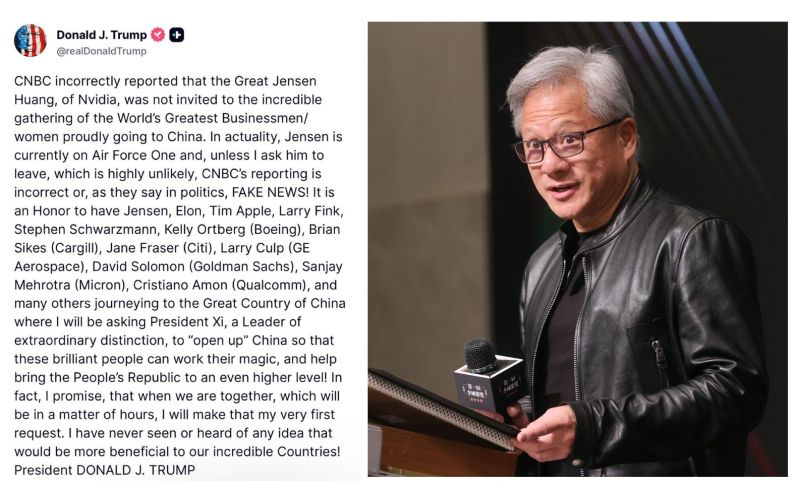
Trump just confirmed that Nvidia CEO Jensen Huang is traveling with him to China aboard Air Force One.
According to TruthSocial, a potential US–China semiconductor deal is being discussed around a high-level tech summit involving major industry figures, with Nvidia CEO Jensen Huang’s late inclusion seen as a signal that advanced chip sales (especially H200 chips) could be on the agenda. The Trump administration has already outlined a conditional framework for allowing some China-bound chip exports, and broader comments suggest market access is part of negotiations. However, political resistance from China hawks, pending legislation to review chip exports, and analyst skepticism make a full breakthrough unlikely. The most probable outcome is limited, conditional progress rather than a broad deal. Source: TruthSocial
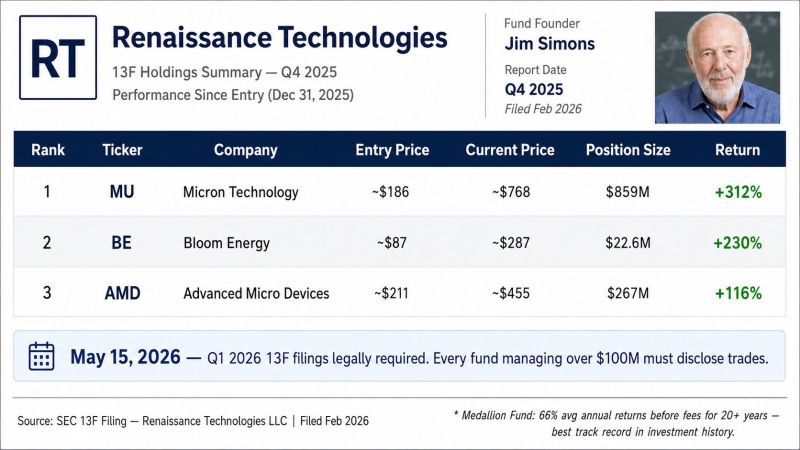
Renaissance Technologies filed their Q4 2025 holdings with the SEC in February.
This is the fund built by Jim Simons, a mathematician who beat Wall Street for 40 years using pure math and zero emotion. Their Medallion Fund averaged 66% annual returns before fees for over 20 years. The best track record in the history of investing. Here's what they were holding at December 31, 2025, and what those positions are worth today. MU – held $859M worth at ~$186/share. Now ~$768. Up 312%. BE – held $22.6M worth at ~$87/share. Now ~$287. Up 230%. AMD – held $267M worth at ~$211/share. Now ~$455. Up 116%. Source: The Assembly
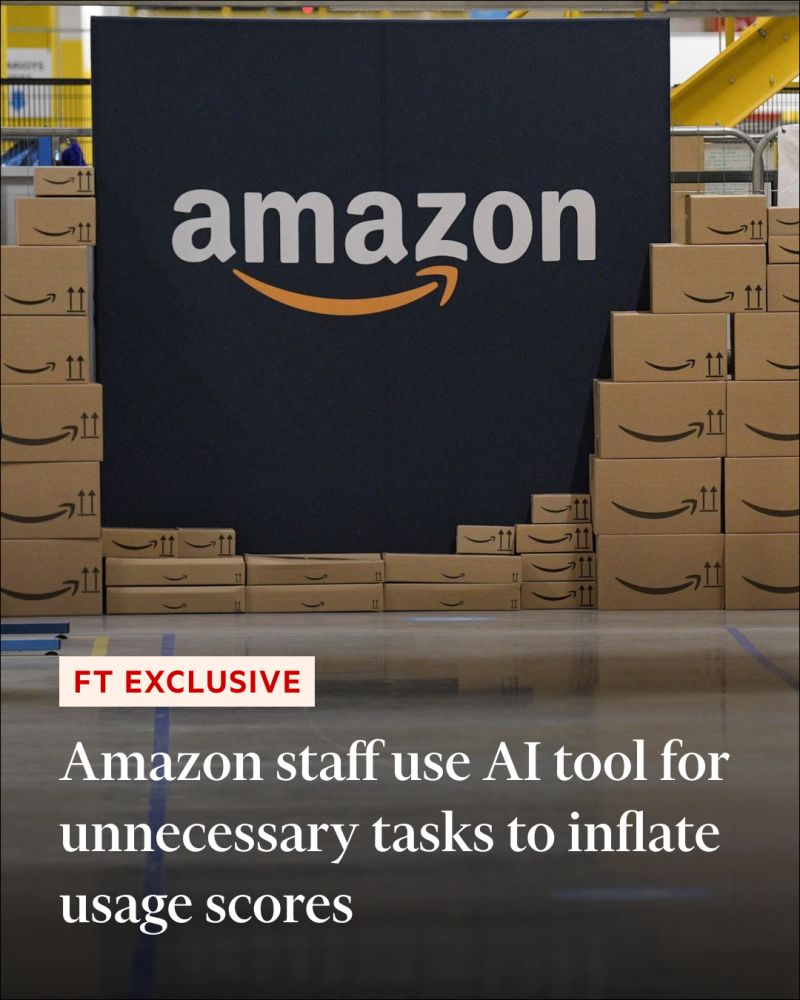
Everyone says they want AI adoption. Until metrics become the goal instead of the outcome.
Amazon employees are using AI agents to automate unnecessary work, by how AI usage is tracked through token consumption metrics, leaderboards, and adoption targets. This creates incentives to optimize for measured activity rather than real value, a classic case of people gaming whatever is being measured. As a result, employees focus on using AI—and being seen using it—rather than improving outcomes, leading to behaviors sometimes called “tokenmaxxing.” The situation mirrors past cases like vanity KPIs, meeting overload, and lines-of-code metrics. The key lesson is that AI adoption should be measured by business impact, not usage. Source: FT
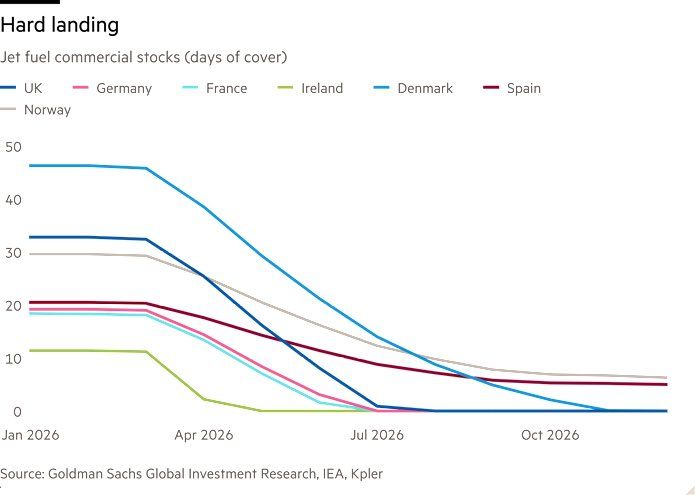
Europe is running out of jet fuel.
Source: Hedgeye
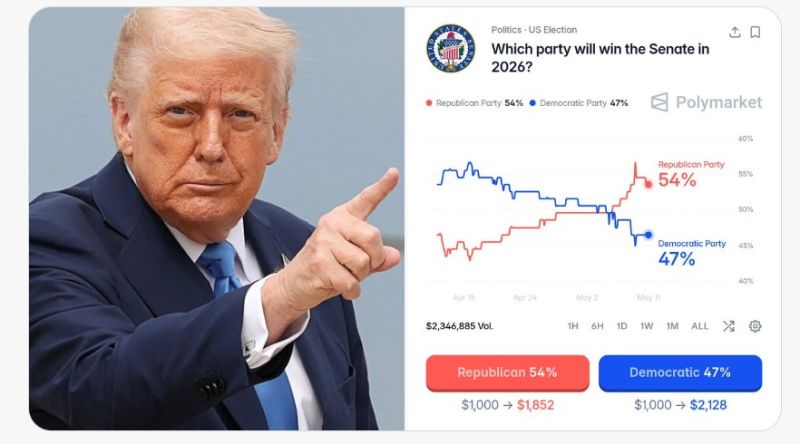
Republicans surge past Democrats in Senate midterm odds projected to remain in power.
Source: Polymarket
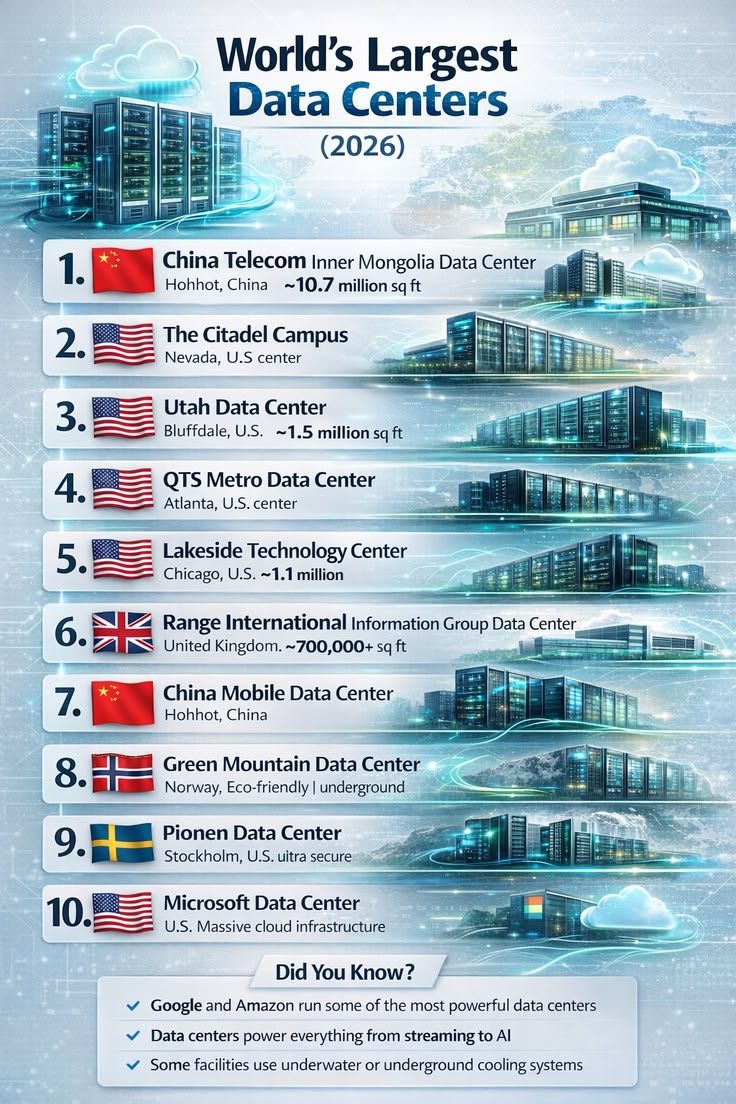
World's Largest Data Centers ▶️
Source: Mack