Straight from the Desk
Syz the moment
Live feeds, charts, breaking stories, all day long.
- All
- equities
- United States
- Macroeconomics
- Food for Thoughts
- markets
- bitcoin
- Central banks
- geopolitics
- Fixed Income
- AI
- Asia
- gold
- europe
- Commodities
- investing
- Technology
- Crypto
- technical analysis
- nvidia
- china
- oil
- ETF
- earnings
- Forex
- energy
- banking
- magnificent-7
- Volatility
- Real Estate
- Alternatives
- apple
- emerging-markets
- switzerland
- tesla
- Middle East
- amazon
- United Kingdom
- microsoft
- assetmanagement
- ethereum
- russia
- meta
- Industrial-production
- ESG
- Healthcare
- Global Markets Outlook
- bankruptcy
- Turkey
- brics
- Market Outlook
- performance
- africa
- inflation
- Global
- Market News
Geopolitics is now the biggest tail risk according to the latest BofA Fund Manager Survey
Source: BofA, TME
UBS says private credit defaults could hit 15%.
That's 3x the peak bank loan default rate in 2008. Source: Leadlag report, Michel Gayed
The Global Equity market is valued at $154 trillion as of 2025 and here's the detailed breakdown.
44% of the global share is owned by USA, while the rest of the world combined holds 56%. China and the European Union (EU) hold similar stakes at about 9.6% each. India is the third largest country, representing 6.9% of the global equity markets, followed by Japan at 4.9%. A 10-year comparison (2015 vs 2025): Interestingly, China, EU, Hong Kong, Japan and UK have each seen a decline from their share in 2015. On the other hand, India and USA have both witnessed an increase in their share. Source: Stocks World @anandchokshi19
Goldman Sachs on stocks
Goldman Sachs on stocks: "Overall, equities [aka stocks] face rising correction risk; valuations are stretched, macro conditions are deteriorating at the margin and cracks are appearing across growth, inflation, credit and labour markets. But strong fundamentals argue against a bear market, reinforcing the view that weakness should be temporary as the medium-term backdrop is more constructive: earnings remain resilient, balance sheets are solid and history suggests that geopolitical shocks often present opportunity rather than lasting damage." Source: Brian Sozzi
The US private credit exit wave is picking up speed
Cliffwater’s $33B flagship fund capped redemptions at 7% after investors requested 14%—a record, per Bloomberg. Morgan Stanley limited withdrawals to 5% from its North Haven Private Income Fund, and BlackRock recently imposed limits at 9.3%. Pressure spreads as JPMorgan marks down software-linked loans and tightens lending to private credit firms due to concerns over credit quality, loan valuations, and AI disruption. Public BDCs are also under stress: FS KKR Capital ($FSK) saw its NAV premium collapse over 40 points, and Hercules Capital ($HTGC) dropped roughly 30 points. Investors seek liquidity, but options are shrinking. The key question: when will the broader market take notice? Source: FT, Global Markets Investor
Financial stocks this year
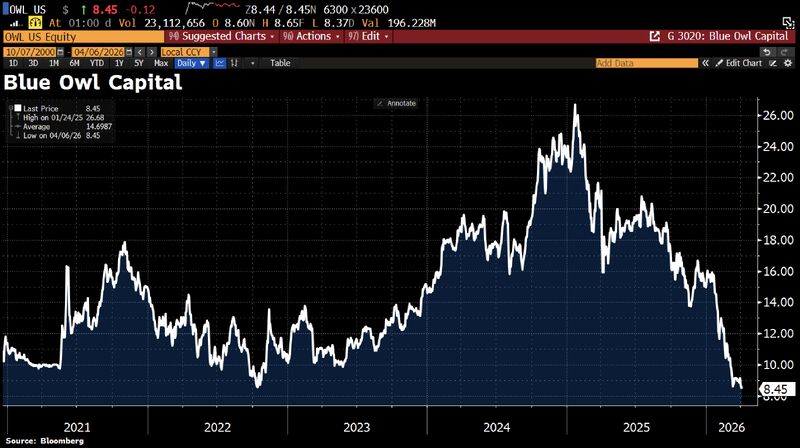
- Blue Owl: -44% - Blackstone: -35% - Wells Fargo: -21% - Morgan Stanley: -15% - BlackRock: -15% - Goldman Sachs: -14% - JPMorgan: -13% $OWL $BX $WFC $MS $BLK $GS $JPM Source: Phil Rosen @philrosenn
Speed Matters in Credit Market Downturns
When credit markets unwind, timing is crucial. JPMorgan Chase, with its conservative private credit practices, may be among the first to reduce exposure and trigger margin calls. Early movers often limit losses, as seen with Goldman Sachs versus Credit Suisse during the Archegos collapse, where slow reaction cost Credit Suisse $5.5 billion. Credit cycles punish slow responses, not analysis. As leverage rises and growth slows, the key question is: which banks will be last to adjust? JPMorgan may demand more collateral on private credit loans, signaling declining collateral values since origination. Source: Desiree Fixler @desireefixler
Another one!! $33 Billion Cliffwater Private Credit Fund limits redemptions to 7%, half of what came in Blue Owl, Blackstone, BlackRock, JP Morgan, Cliffwater... so what's going on?
Private credit funds limit withdrawals because their assets private loans are illiquid and rarely traded. When redemption requests rise, managers must either sell assets at discounted prices or cap withdrawals; most choose caps to protect remaining investors. Semi-liquid funds therefore offer higher yields but reduced liquidity, especially during market stress. Source: Barchart
Investing with intelligence
Our latest research, commentary and market outlooks