
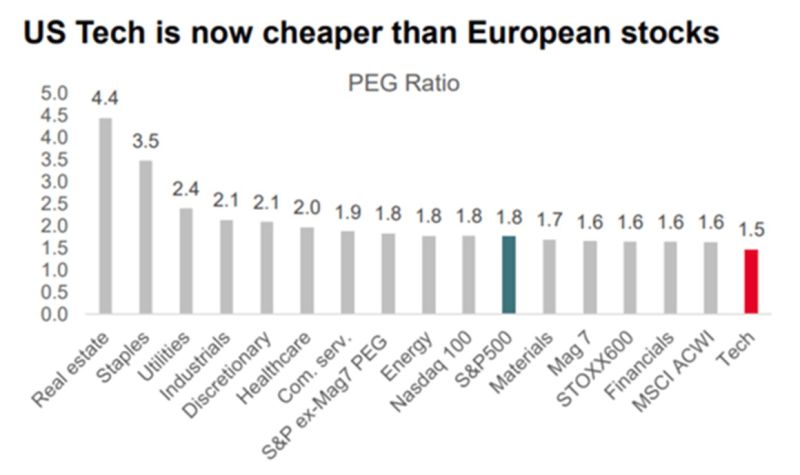
SocGen notes that Tech has one of the lowest PEGs..
Source. SocGen
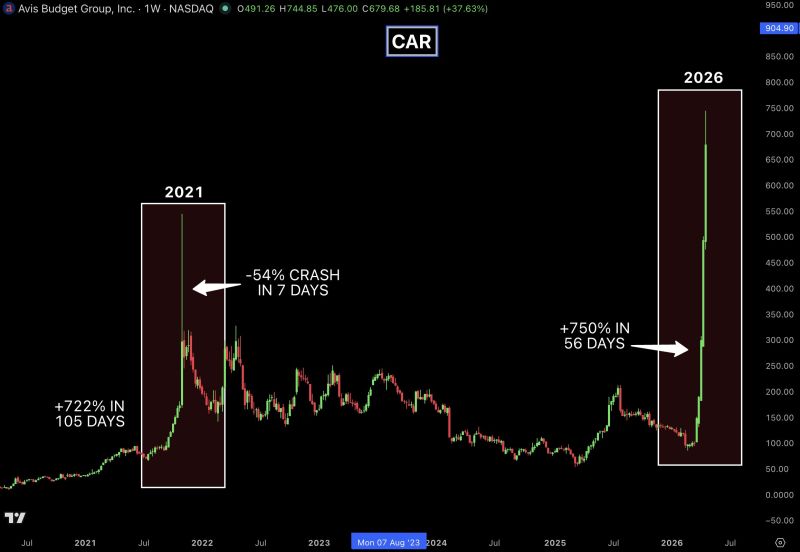
Avis Budget Group ($CAR) could experience another extreme short squeeze similar to 2021, when the stock surged 722% in 41 days before collapsing 54% in a week.
Fast forward to 2026 and $CAR - Avis Budget - is up 656% in a month!!! The US government shut down. Airport security workers stopped getting paid. Thousands quit. 4-hour queues. Passengers abandoned flights. Road trips surged. Add a massive short squeeze and you get a 600% move. So what's going on? ---------- In 2021, the surge was driven not by fundamentals but by market positioning. At the time, Avis was heavily shorted because many investors viewed it as weaker than Hertz—citing valuation concerns, exposure to used car price volatility, and a less attractive balance sheet. Meanwhile, a popular hedge fund strategy involved a pair trade: long Hertz (fresh out of bankruptcy with an EV narrative) and short Avis. This created a crowded short position. The situation reversed when Avis delivered a strong earnings surprise and broader industry news (including Hertz-related developments) disrupted expectations. As the stock price rose, short sellers faced mounting losses, margin pressure, and forced liquidations. Since closing a short requires buying the stock, this triggered a feedback loop: rising prices forced more short covering, which pushed prices even higher. This self-reinforcing cycle—not fundamentals—drove the explosive rally. Once most shorts had exited and buying pressure faded, the stock rapidly collapsed. Today’s conditions—crowded positioning, limited float, and market structure—mirror that setup. If similar dynamics unfold, prices could again detach from fundamentals and rise sharply due to forced buying rather than intrinsic value. Source: Bull Theory
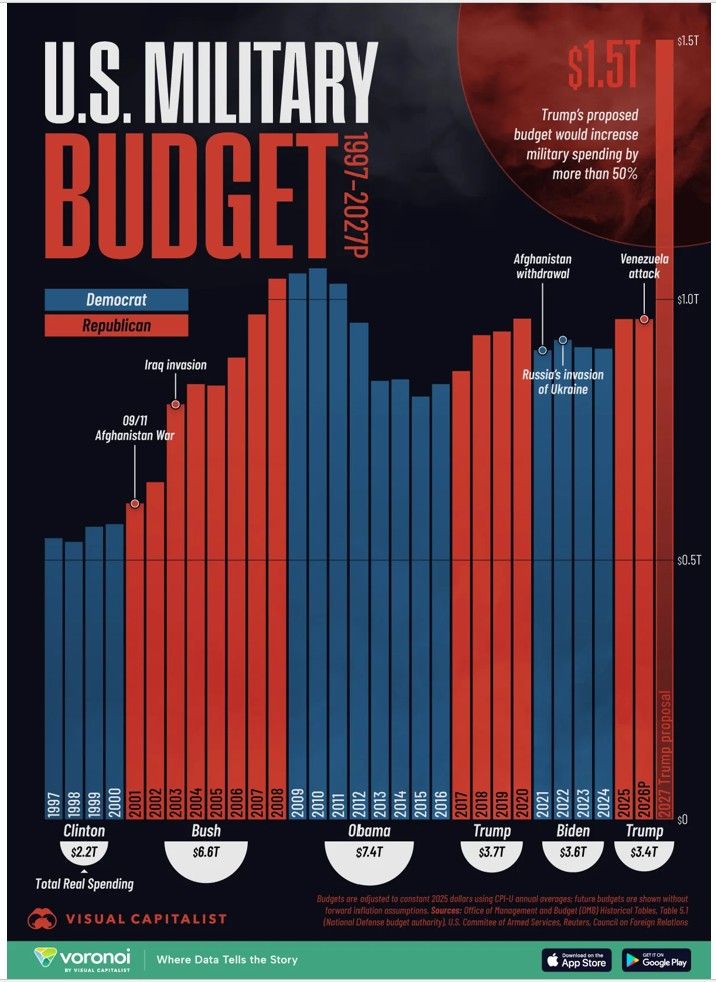
The Pentagon just proposed the largest defense budget in U.S. history at $1.5T or +42% in one year.
• $65.8T (warships & support ships) - Largest shipbuilding program since Kennedy. • $54.6T (autonomous warfare) • $6.1T (next-gen B-21 bomber) • 85 F-35 jets • 18 battle force ships • 16 non-battle force ships • Golden Dome missile defense • 12 critical munitions restocked • critical minerals supply chain investment Record drone investment. 44,000 new troops. The Iran war costs are not included. That’s a separate bill. America is no longer preparing for a war. It’s preparing for wars (with a "s")👁️ Source: Visual capitalist, Voronoi
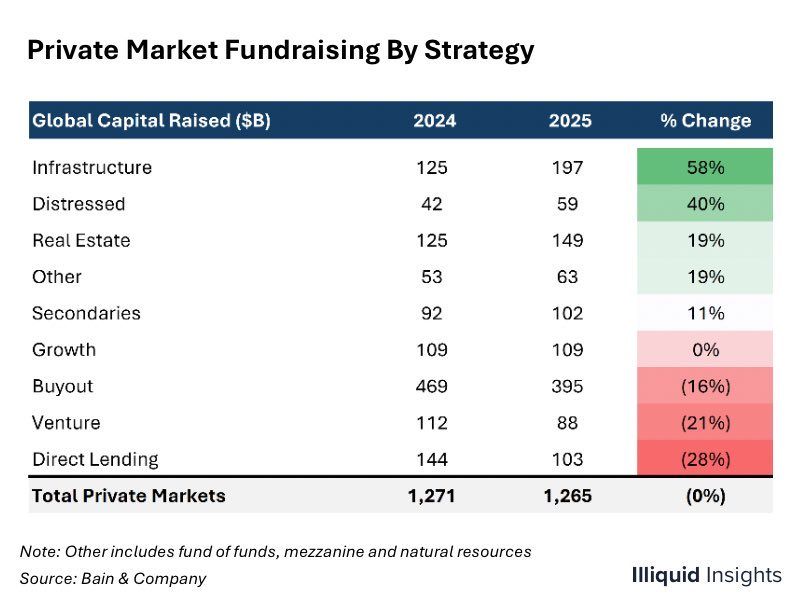
LPs are rotating.
Infrastructure and liquidity solutions (secondaries, opportunistic) are in. Software, buyouts and direct lending are out. Source: Illiquid Insights
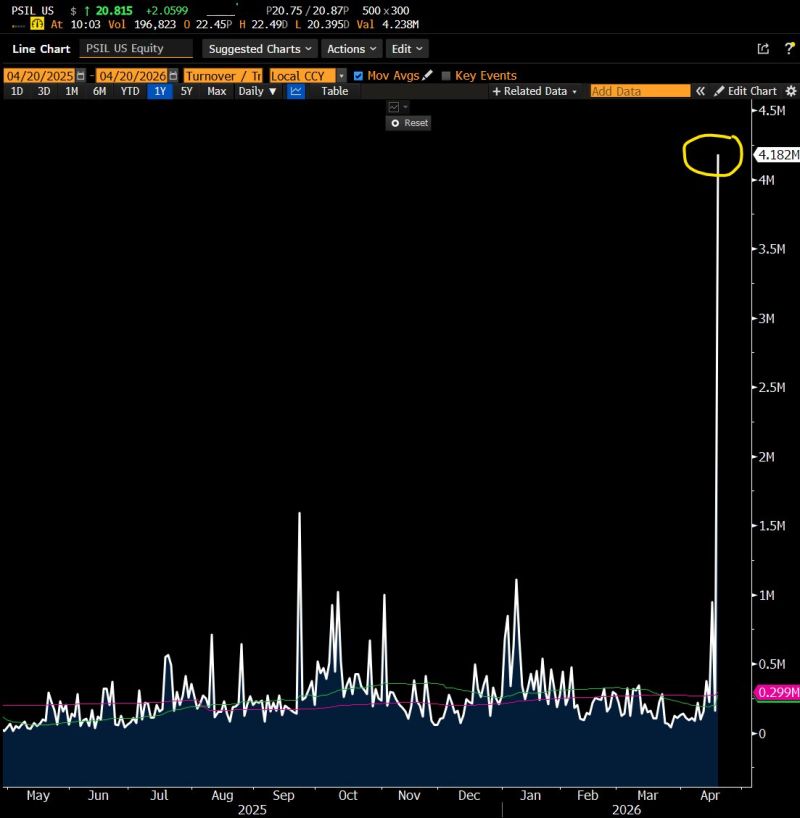
The Psychedelics ETF $PSIL has destroyed its daily volume record in first 30min of trading...
Why ??? Trump just signed ex order expediting research/access to psyche drugs to cure depression. The sector has been in dog house, waiting for catalyst, up 10% today. Watch this space. Source: Eric Balchunas
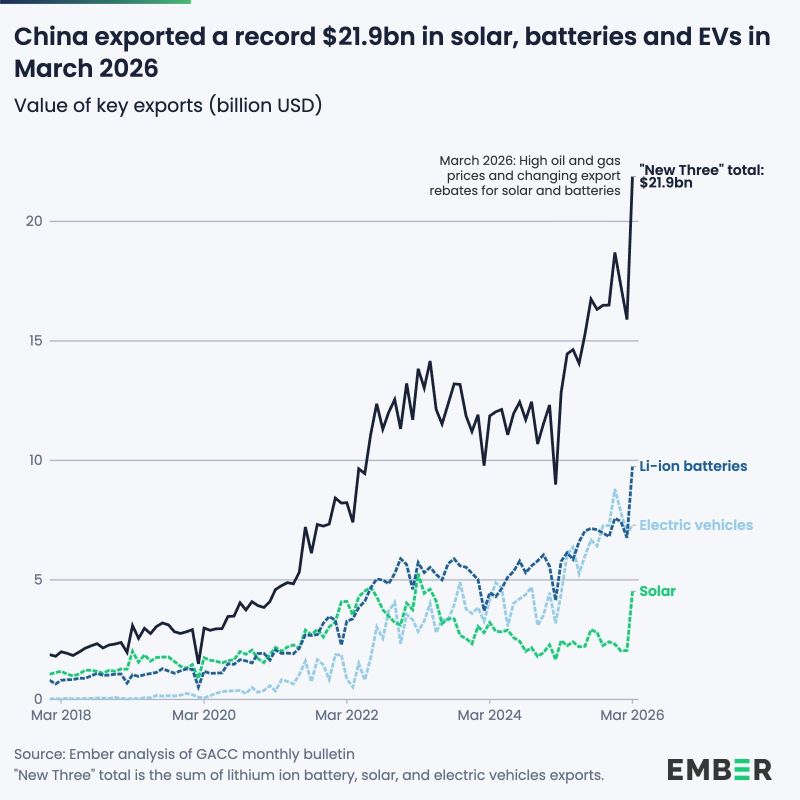
For anyone wondering whether the fossil fuel crisis in the Middle East is driving interest in clean energy technologies:
China's exports of batteries, EVs and solar products shot up in March to $21.9 billion! This is an all-time record and a 70% increase over March 2025. Source: Nicolas Fulghum
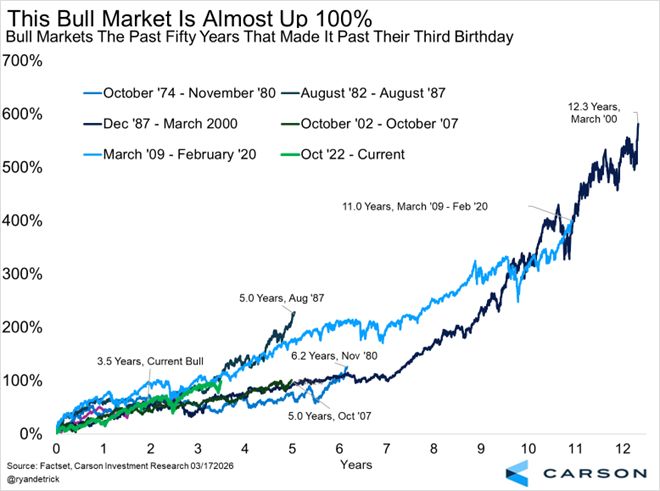
The current bull market is 3.5 years old and up 99.2%. As we've noted many times, once bull markets get past their third birthday they rarely end anytime soon.
Source: Over the past past 50 years, 5 made it past their 3rd birthday and those lasted eight years on average".
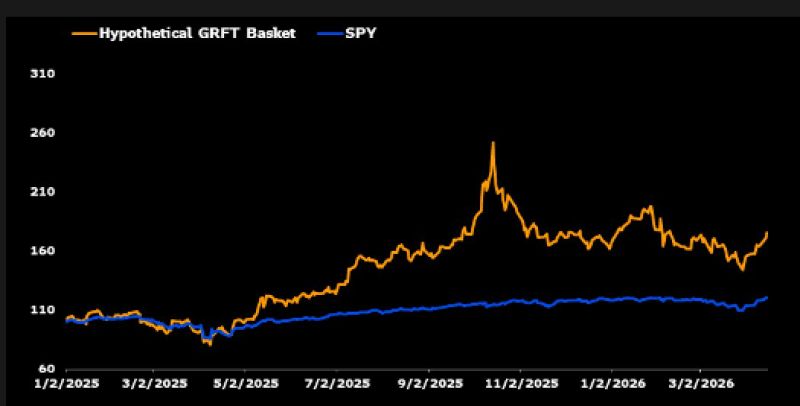
THE WHITE HOUSE BASKET (aka "Don't fight Trump") is massively outperforming the S&P 500
Don't fight the Fed, or the White House Investing alongside Trump's tweets and White House moves ("White House basket") has returned about 75% since the start of his term, versus roughly 20% for the S&P 500, led by Intel and USA Rare Earths, found @psarofagis. Note: Tuttle has been trying to ETF-ize this strategy in the Government Grift ETF but no exchange will list it because it too controversial (?) Source: Eric Balchunas on X