Straight from the Desk
Syz the moment
Live feeds, charts, breaking stories, all day long.
- All
- equities
- United States
- Macroeconomics
- Food for Thoughts
- markets
- bitcoin
- Central banks
- geopolitics
- Fixed Income
- gold
- europe
- Asia
- Commodities
- AI
- investing
- Technology
- technical analysis
- Crypto
- nvidia
- china
- ETF
- earnings
- oil
- Forex
- energy
- banking
- Real Estate
- Volatility
- magnificent-7
- Alternatives
- apple
- emerging-markets
- tesla
- switzerland
- Middle East
- amazon
- United Kingdom
- assetmanagement
- microsoft
- ethereum
- russia
- meta
- Industrial-production
- ESG
- Healthcare
- Global Markets Outlook
- bankruptcy
- Turkey
- brics
- Market Outlook
- africa
- performance
The US is willing to impose lower tariffs on the UK than the EU primarily due to strategic, economic, and political factors:
Bilateral Leverage and Trade Balance: The UK, as a single nation, has less negotiating power than the EU, a bloc of 27 countries with a larger collective market. The US can secure concessions more easily from the UK. Additionally, the US runs a trade surplus with the UK (e.g., $25.9 billion in goods in 2024), while it has a significant trade deficit with the EU (e.g., $209 billion in 2024). Lower UK tariffs align with maintaining favorable trade dynamics, while higher EU tariffs aim to address the deficit. Post-Brexit Alignment: Since Brexit, the UK has sought closer ties with the US to offset its reduced EU market access. The US leverages this to secure a favorable deal, offering exemptions (e.g., auto, aerospace) and lower tariffs (e.g., 10% baseline vs. EU’s potential 20-50%). The UK’s flexibility, unbound by EU regulations, allows quicker agreement on US priorities like digital trade and agriculture. Geopolitical Strategy: The US views the UK as a key ally in countering EU influence and promoting a US-led trade framework. Lower tariffs strengthen the US-UK “special relationship,” especially in defense and intelligence (e.g., AUKUS), while higher EU tariffs pressure the EU to concede on issues like steel and digital services taxes. Source: SuperGrok
The UAE is tokenizing almost all of its real estate.
Dubai Land Department has signed an agreement with Crypto.com to develop procedures that support digital real estate transactions, enabling investors to buy and sell property using digital currencies. The collaboration, which seeks to create a digital ecosystem that enables investor verification, custody, settlement and real estate tokenisation, supports the Dubai Real Estate Strategy 2033 and its Dh1 trillion ($272 billion) transaction target. Source: The National
BofA argues that CHF is now behaving more like gold:
A liquid, neutral hedge against long-term fiscal uncertainty in a world that doesn't have many G10 alternatives, not short-term market stress. Source: Patrick Saner
Fintech stock $SOFI sofi technlogies JUST HIT $20 AFTER ANNOUNCING RETAIL ACCESS TO PRIVATE MARKETS
New funds now offer exposure to OpenAI, SpaceX & Epic Games -- starting at just $10. SoFi Technologies SOFI +is expanding access to private markets, an asset class once reserved for institutional investors and high-net-worth individuals. Following this news, SOFI stock surged about 5% shortly after the market opened on Tuesday and hit a new 52-week high of $20.89. Through new partnerships with asset management firms such as Cashmere, Fundrise, and Liberty Street Advisors, SoFi is allowing its members to invest in high-growth private companies like OpenAI, SpaceX, and Epic Games with a minimum of $10. SOFI is Breaking Down Barriers Private markets have often delivered strong returns but were inaccessible to retail investors. By lowering the entry point and simplifying the process, SoFi is making it easier and more affordable for retail investors to enter this market. This move is part of SoFi’s efforts to expand its alternative investment offerings. It recently added new funds from big names such as ARK, KKR, Carlyle CG and Franklin Templeton BEN , giving users access to private credit, real estate, and pre-IPO companies. Source: Tipranks.com, Bloomberg AI
Global Statistics @Globalstats11
Top 10 Largest Car Producing Countries in 2024 1. China - 31,281,592 2. United States - 10,562,188 3. Japan - 8,234,681 4. India - 6,014,691 5. Mexico - 4,202,642 6. South Korea - 4,127,252 7. Germany - 4,069,222 8. Brazil - 2,549,595 9. Spain - 2,376,504 10. Thailand - 1,468,997 Source: International Organization of Motor Vehicle Manufacturer
Carvana has pulled off one of the greatest comebacks in stock market history.
Carvana Co., together with its subsidiaries, operates an e-commerce platform for buying and selling used cars in the United States. The company offers vehicle acquisition, inspection and reconditioning, online search and shopping experience, financing, complementary products, logistics network and distinctive fulfillment experience, and post-sale customer support. Comment by Next100 baggers on X: "The stock had to rally 9,900 % just to crawl out of a 99 % draw-down, so even at $345 it’s still below the 2021 peak. The turnaround is real, SG&A per unit has fallen from roughly $4.7 k to $2.2 k, gross profit per unit has doubled to about $6.4 k, and the $5.7 B debt deal pushed maturities out to 2030 but fundamentals now carry a premium price tag. At $345 the market cap is roughly $75 B and enterprise value about $50 B, versus Street FY25 EBITDA estimates near $2.1 B, which puts you in the mid 20s EV/EBITDA range while retail unit volume is still shrinking. Fantastic comeback trade, much tougher fresh entry". Source: Brew markets
Deflation remains the name of the game in china
China’s producer prices plunged 3.6% in June from a year earlier, marking its largest decline in nearly two years, as a deepening price war rippled through the economy that’s already grappling with tepid consumer demand. The drop in producer prices, however, came worse than the expected 3.2% in a Reuters poll and marked its biggest fall since July 2023, according to LSEG data. The PPI has been mired in a multi-year deflationary streak since September 2022. The consumer price index edged 0.1% higher in June from a year ago, according to data from the National Bureau of Statistics Wednesday, returning to growth after four consecutive months of declines. Economists had forecast a flat reading compared to the same period a year earlier, according to a Reuters poll. Core CPI, stripping out food and energy prices, rose 0.7% from a year ago, the biggest increase in 14 months, according to NBS. China June Annual CPI +0.1% [Est. 0.0% Prev. -0.1%] Monthly CPI -0.1% [Est. 0.0% Prev. -0.2%] Annual PPI -3.6% [Est. -3.2% Prev. -3.3%] Monthly PPI -0.4% [Prev. -0.4%] Source: CNBC
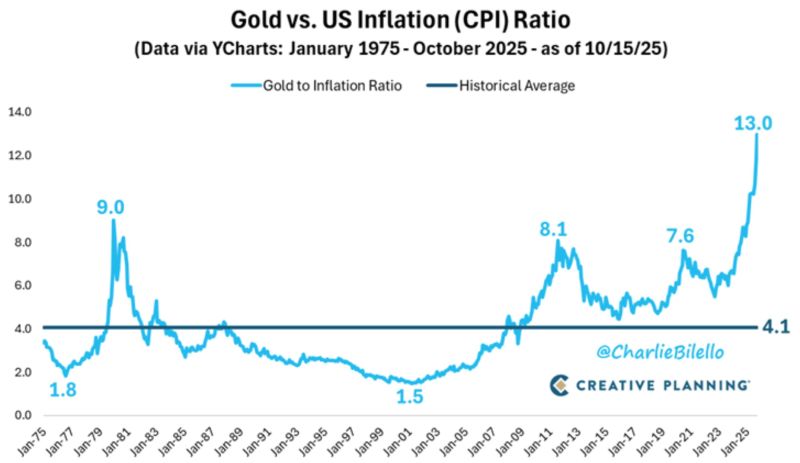
This is what happens to a currency when the focus is to increase debt to inject liquidity, rather than addressing the root causes of the problem.
Thank God we have gold (and bitcoin). Source: Guilherme Tavares i3 invest
Investing with intelligence
Our latest research, commentary and market outlooks