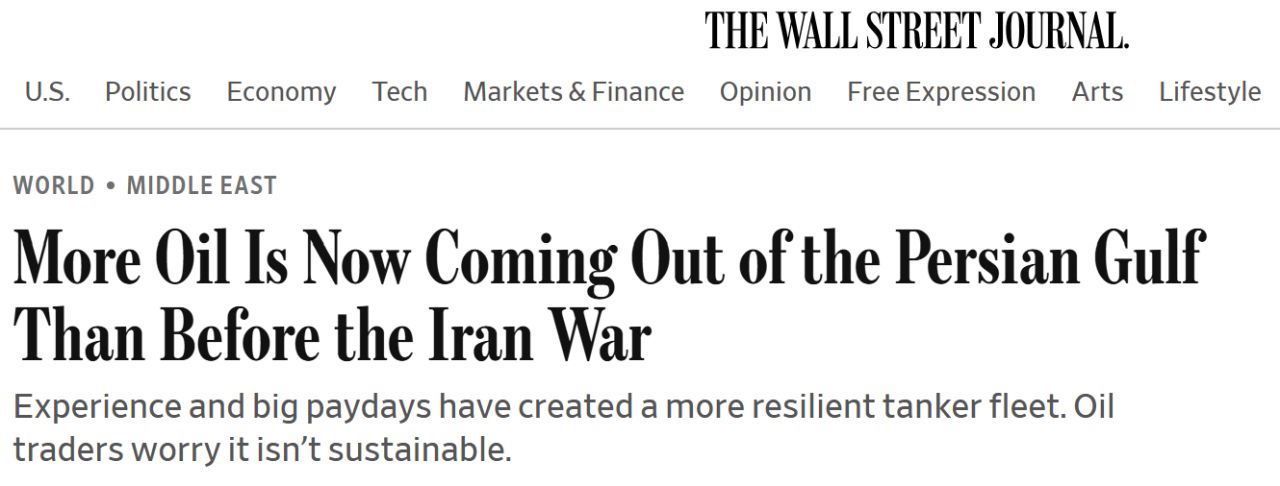
According to the WSJ, more oil is now coming out of the Gulf than before the Iran Wa
WSJ: "Persian Gulf oil exports have surpassed prewar levels, as an improvised shipping system under U.S. protection is helping tankers move oil through one of Iran’s fiercest waves of attacks in the Strait of Hormuz. Middle East oil flows, including shipments through Hormuz and alternative routes across the region, averaged more than 24 million barrels a day in the week through Oct. 18, surpassing prewar levels of 23.3 million, according to ship tracker Kpler".
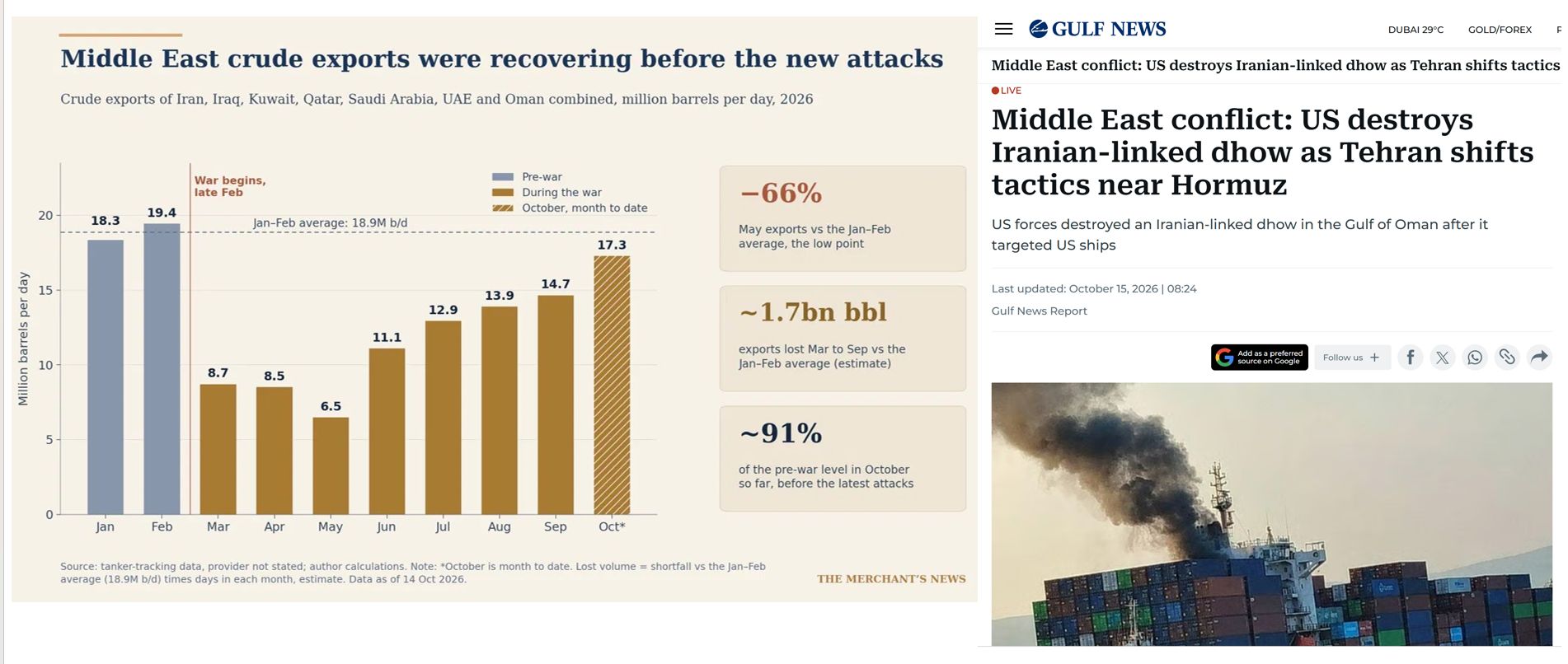
Middle East crude exports were approaching pre-war levels.
Then the attacks resumed. Combined exports from Saudi Arabia, Iraq, the UAE, Kuwait, Iran, Qatar and Oman tell the story: ▪️ Jan–Feb: 18.9 million barrels/day ▪️ May trough: 6.5 million — down 66% ▪️ September: 14.7 million ▪️ October so far: 17.3 million — 91% of pre-war levels The recovery relied on ingenuity: Saudi pipelines diverted crude to the Red Sea, while shuttle tankers carried barrels through Hormuz to supertankers waiting outside. But the cumulative damage remains enormous: 1.7 billion fewer barrels exported between March and September than at the pre-war pace. And October’s rebound is fragile. ⚠️ The figures cover only the first two weeks. Six ships were hit around Hormuz on 11 October. More than 10 empty supertankers have turned back near Fujairah. Export routes can adapt. A sustained recovery still requires security. Source: Jack Prandelli on X, Gulf News
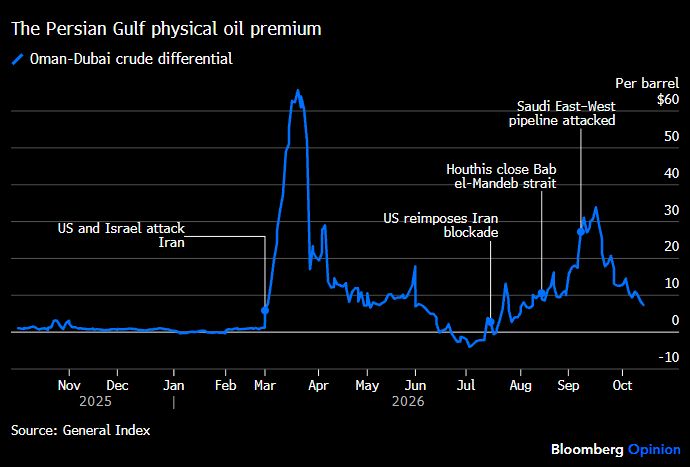
Middle East oil flows are bending. But they haven’t broken.
Despite renewed Iranian attacks, regional crude exports excluding Iran are holding at roughly 75% of pre-war levels, down from a late-September peak near 95%. Yet here’s the surprise: Average flows over October 1–10 remained above September’s average—and well above August’s. The disruption is making shipments more erratic: busy tanker crossings followed by quiet days. Kuwait is struggling most. Saudi Arabia, the UAE and Iraq are proving more resilient, with bypass routes providing crucial support. But the risks remain clear: continued attacks could disrupt both Hormuz and Red Sea traffic. The market signal to watch? Physical premiums for Middle Eastern crude have fallen to a near 2½-month low. For now, the physical market is signalling less scarcity—even as the security headlines worsen. Source: Javier Blas, Bloomberg
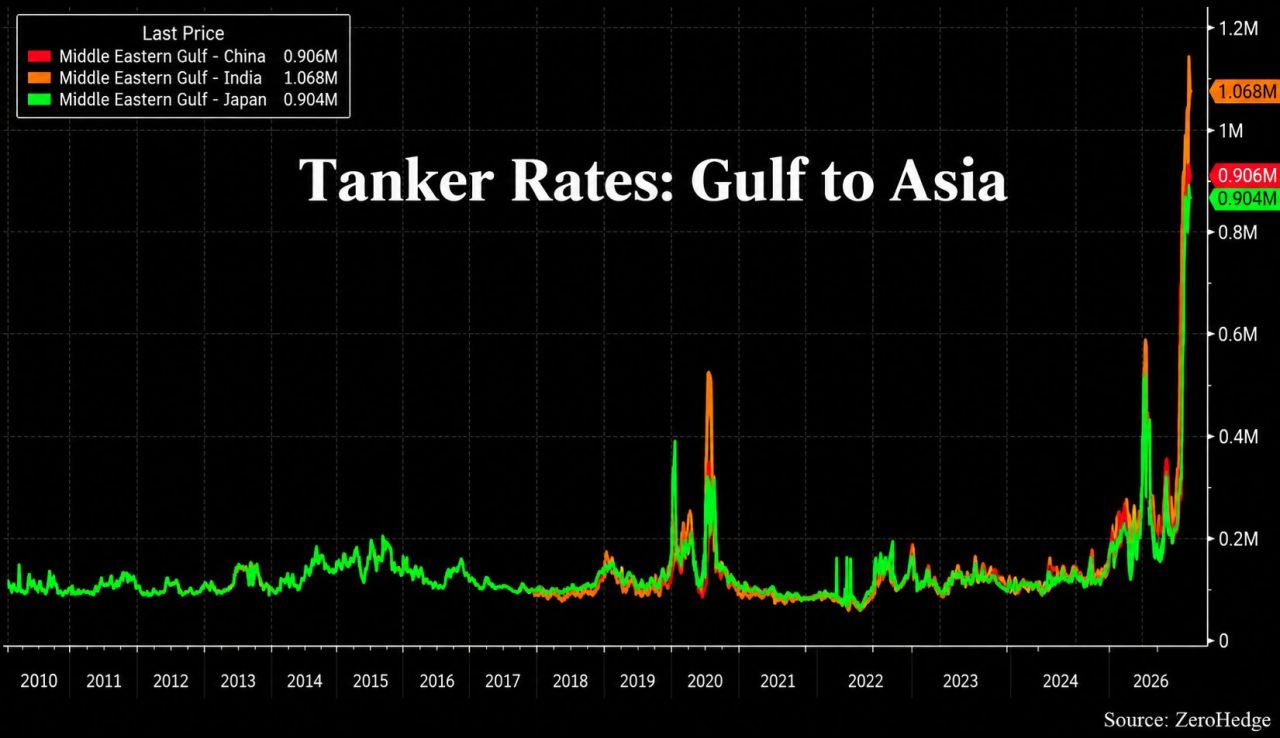
Oil tanker rates from the Middle East to Asia are EXPLODING:
Daily tanker rates have surged to $1.068 million for voyages to India, $906,000 to China and $904,000 to Japan. Meanwhile, at least 10 empty very large crude carriers, alongside several Suezmax tankers, have stopped or reversed course while approaching Fujairah in the UAE amid escalating Iranian attacks. This threatens a key workaround that has helped Persian Gulf oil exports recover toward prewar levels, as shuttle tankers carry crude through the Strait of Hormuz to larger vessels waiting outside the waterway. The system is becoming harder to sustain as tanker availability tightens, ship-to-ship transfers keep vessels occupied for longer, and rising security risks make routes through the region more costly. If empty supertankers continue retreating, fewer receiving vessels could be available, forcing shuttle tankers to remain occupied longer and slowing crude shipments. The disruption comes as tanker availability is already tight, pushing shipping costs to record levels. The risk for the global economy is no longer just higher oil prices, but whether enough tankers will be willing and available to move the oil. Source: Global Markets Investor
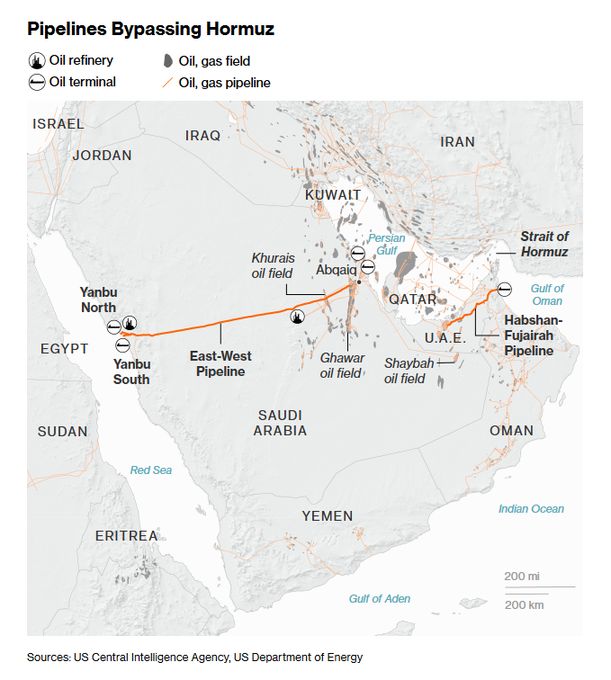
OIL PIPELINES & GEOPOLITICS.
Saudi Arabia has announced plans to expand its East–West pipeline, a critical route that bypasses the Strait of Hormuz. Its nominal capacity is 7 million barrels per day, although it is probably operating closer to 6 million after a September attack destroyed a pumping station. The immediate fix? Convert an existing natural gas pipeline to carry crude. Within 7–8 weeks, Saudi Aramco could add 1.2 million barrels per day of capacity. But the relief would be temporary: the line must return to gas service by May to supply power stations during the summer. Saudi officials have not identified the pipeline. One possibility is the old IPSA line: a 48-inch, roughly 1,500-kilometre pipeline built in the 1980s that runs largely parallel to the East–West route towards Yanbu. Saudi Arabia seized it after Iraq invaded Kuwait in 1990 and later incorporated it into its Master Gas System. That identification remains a hypothesis. The longer-term ambition is bigger: raise East–West capacity to around 10 million barrels per day within 2–3 years, mainly by upgrading pumping capacity. The strategic message is clear: Riyadh wants more of its oil exports to reach global markets without passing through Hormuz. Source: Javier Blas
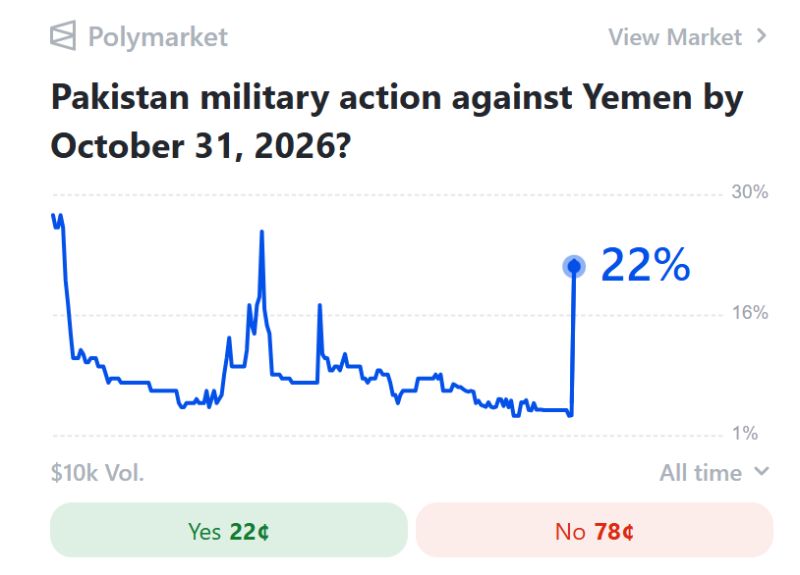
Houthis Unleash Large Missile, Drone Barrage On Saudi Arabia, Target Riyadh Airport & Aramco Facility
➡️ Saudi-backed forces launch major counteroffensive with roughly 100 Saudi fighter jets supporting attacks along the Red Sea coast. ➡️Mocha's status remains disputed: Government forces claim to have retaken the strategic port, while Houthis deny the loss. ➡️Houthis announce major missile & drone attack on Saudi territory, including against international airport in Riyadh. ➡️Houthi fighters reportedly seize homes of senior government figures, including Parliament Speaker Sultan al-Barakani's mansion. ➡️Bab el-Mandeb is increasingly at risk, raising concerns for Red Sea shipping and the wider Suez trade route. Source : Summary by zerohedge
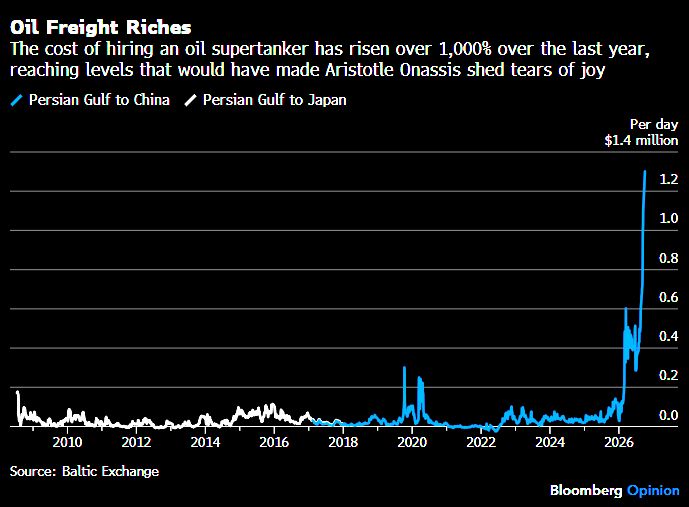
The cost of hiring a supertanker to ship oil from the Persian Gulf to the Far East has climbed further, reaching ~$1.3 million per day.
It was less than $50,000 a day before the war started; and ~$1.1 million when I first published the chart in September Source: Javier Blas, Bloomberf
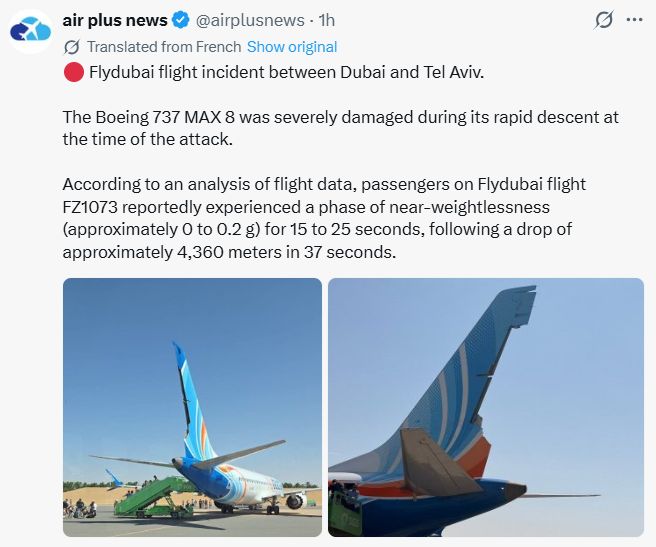
A routine Dubai–Tel Aviv flight turned into a midair emergency
FlyDubai Pilot Reportedly Stabbed, Israeli News Says Incident Treated As "Full-Fledged Terror Attack". Flydubai flight FZ1073 diverted to Tabuk, Saudi Arabia, today after a reported cockpit altercation and a rapid descent. The aircraft landed safely. All passengers were safe and accounted for. Israeli officials allege that the co-pilot stabbed the captain and are investigating a possible attempted terror attack. Flydubai has confirmed an onboard incident but has not specified its nature. ⚠️ BEWARE OF FAKE NEWS AND BREAKING NEWS MOVING FASTER THAN FACTS: NOTHING IS CONFIRMED AT THIS STAGE ‼️ Source: zerohedge