
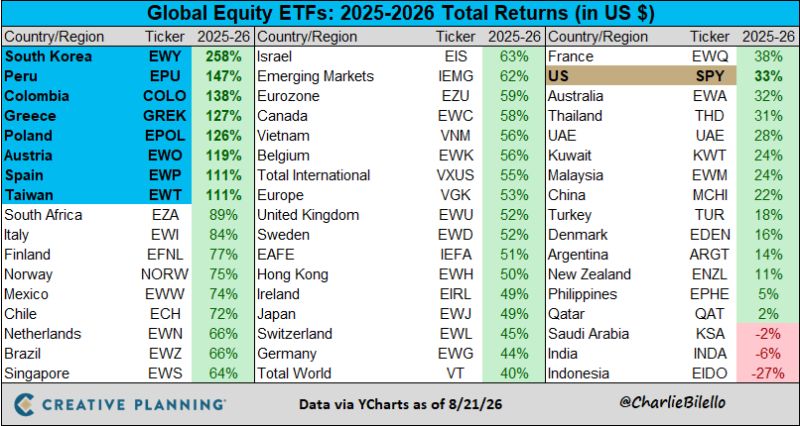
The S&P 500 is up 33% since the start of 2025.
South Korea: +258% Peru: +147% Colombia: +138% Greece: +127% You never know where the next big winner will be. That’s why you diversify. Source: Peter Mallouk Charlie Bilello
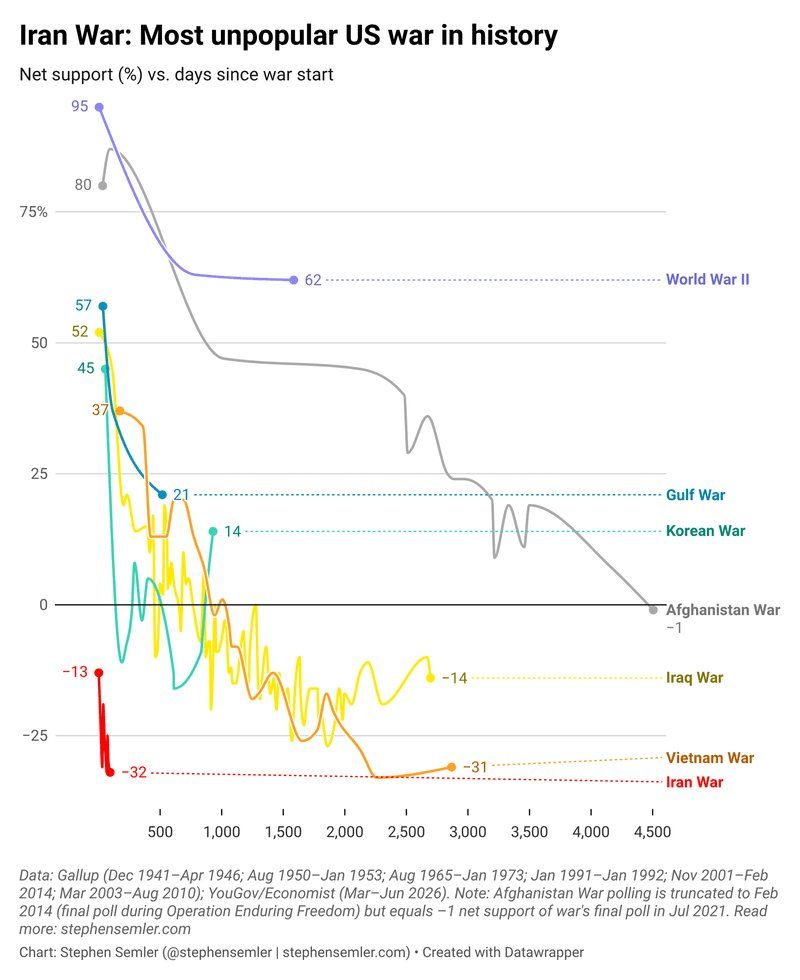
There has never been a less popular war, a result of the president's unserious approach to the war and his refusal to rally the people or congress.
Source: Mike Nelson
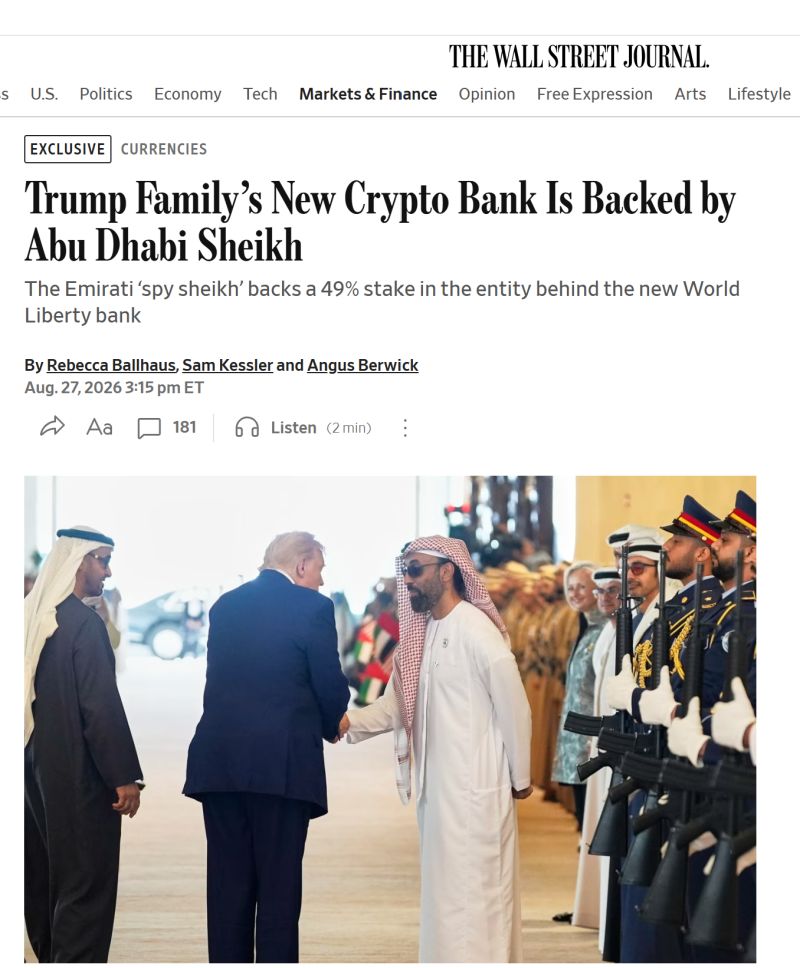
Abu Dhabi royal group acquires 49% stake in Trump-backed crypto bank
Sheikh Tahnoon bin Zayed al Nahyan and co-investors reportedly hold a 49% stake in the holding company behind World Liberty Financial’s proposed U.S. trust bank, per WSJ. The proposed bank received preliminary approval from the Trump administration this month, bringing the Trump-backed crypto venture closer to launching its own U.S. banking operation. World Liberty Financial will run its USD1 stablecoin. This follows his previously undisclosed $500M investment in World Liberty, $263M of which went to Trump family entities. Source: WSJ
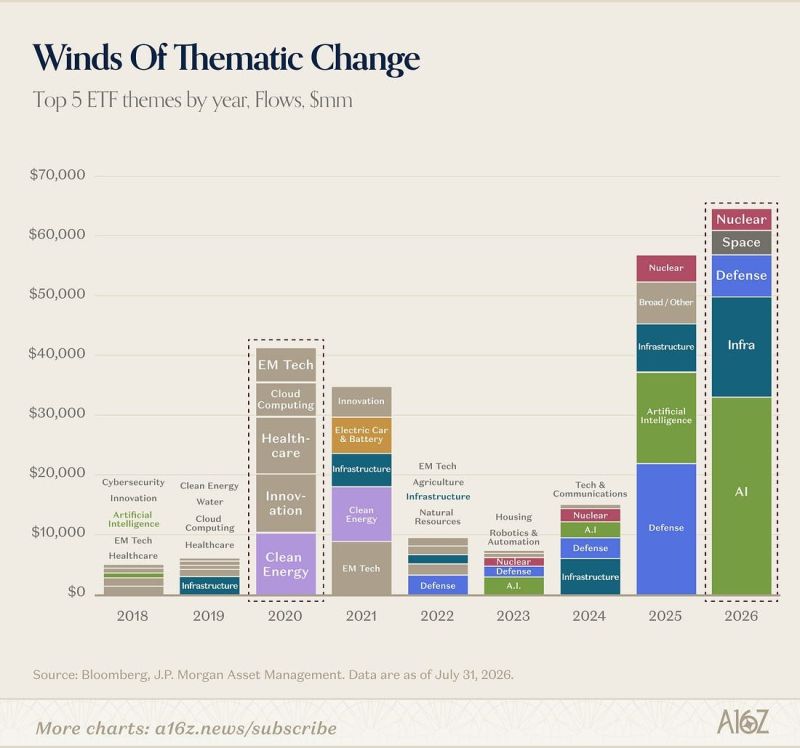
AI, Infrastructure, Defense, Space, and Nuclear are now the top 5 ETF themes of 2026
Source: Hedgeye A16Z
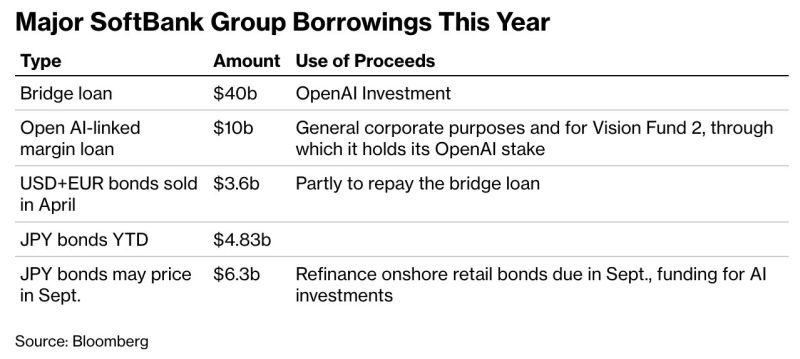
SoftBank is building one of the largest leveraged bets in AI history.
The group is discussing a $20 billion bond offering to refinance part of the $40 billion bridge loan used for its OpenAI investment. The strategy is simple: OpenAI and Arm valuations rise → SoftBank’s NAV increases → borrowing capacity expands → more capital flows into AI. For now, the machine looks manageable: SoftBank’s loan-to-value ratio remains around 13%. But the balance sheet is increasingly concentrated in Arm, Vision Fund 2 and, indirectly, OpenAI. An AI correction could quickly reverse the loop: Lower valuations → lower NAV → higher leverage → collateral calls → forced asset sales. And the funding is expensive: SoftBank’s 10-year dollar bonds issued in April carried an 8.5% coupon. As long as credit markets remain open, the AI boom can extend far beyond near-term cash flows. But the longer the chain between valuations, collateral and debt, the more fragile the system becomes. Source: Bloomberg
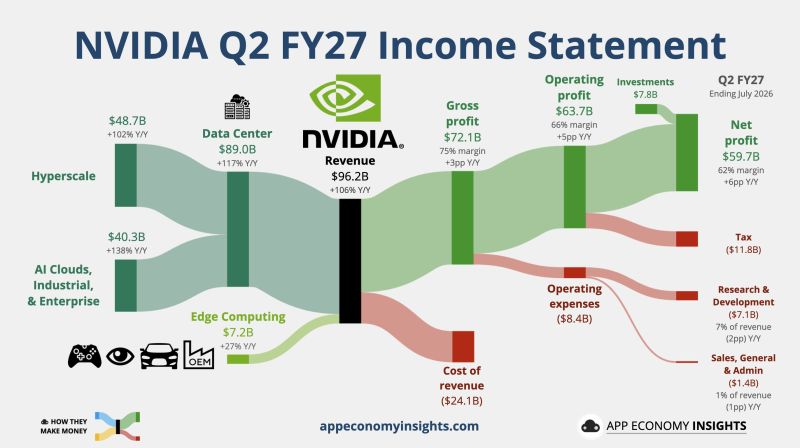
Nvidia Q2 earnings double beat & raise
Adj. EPS: $2.22 (vs $2.10 est) ✅ Revenue: $96.2B (Est. $92.2B) p; +106% YoY Adj. EPS: $2.22 (Est. $2.10) r; +120% YoY Data Center: $89.0B (Est. $85.8B) t; +117% YoY Adj Gross Margin: 75.0% (Est. 75%) n; +250 bps YoY Q3 Guide: Revenue: $108.0B +/- 2% (Est. $104.2B) Adj Gross Margin: 74.0% +/- 50 bps Adj OpEx: ~$9.0B Segment Revenue: Data Center: $89.0B; +117% YoY Edge Computing: $7.2B; +27% YoY Financials: Adj Operating Income: $64.0B; +124% YoY Adj OpEx: $8.2B; +54% YoY Adj Net Income: $54.0B; +118% YoY Free Cash Flow: $21.3B Cash & Cash Equivalents: $22.4B Short-Term Debt: $1.0B Long-Term Debt: $32.4B Capital Return: ( Shareholder Returns: ~$26.0B in Q2 + Remaining Authorization: ~$99.0B Key Updates: GAAP-to-non-GAAP adjustment includes $7.8B of net gains from equity securities Outlook assumes no Data Center compute revenue from China Vera Rubin is ramping into full production with racks running at partners 🟢 Comments: “AI has reached its inflection point. It’s doing useful work. Its tokens are productive and profitable. Now, compute is revenue.” “The AI infrastructure buildout is at full steam. Vera Rubin, now in full production, was built to power exactly this moment.” Source: App Economy Insights, Wall St Engine
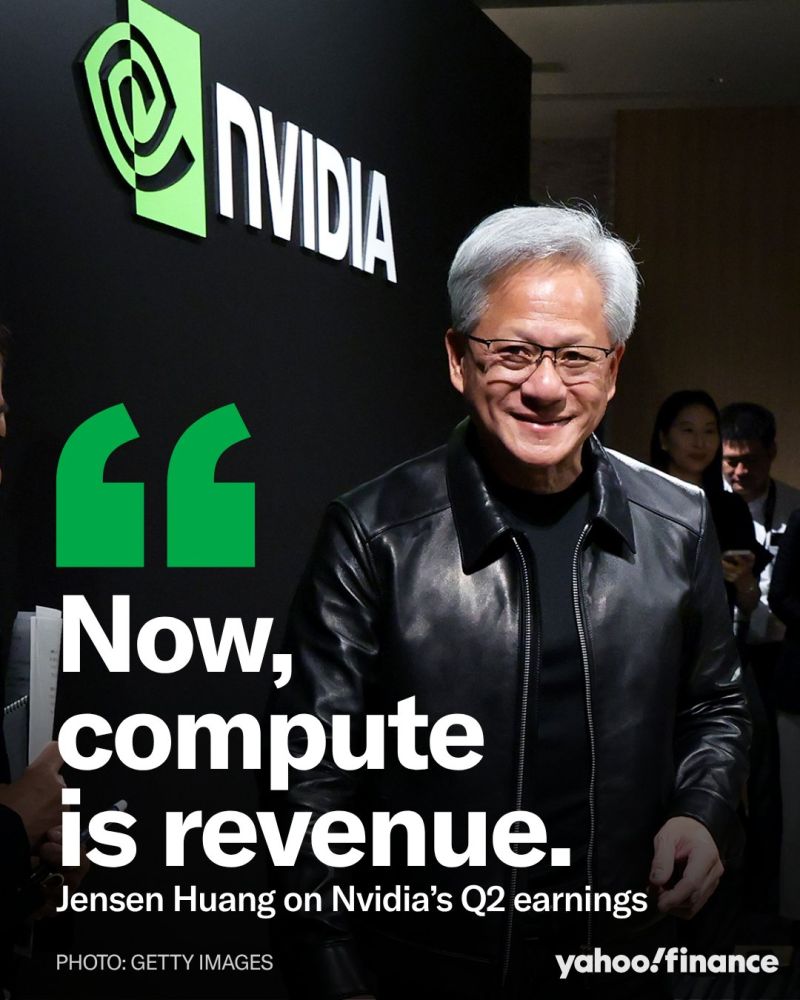
Nvidia CEO Jensen Huang says AI has officially reached its inflection point, shifting from experimental tech to productive, profitable work.
Huang added that more people using AI agents is driving the surging demand for compute: "The amount of compute necessary for an agent versus a human using is probably 15 to 100 times, depending on the type of problem you're trying to solve." Source: Yahoo Finance
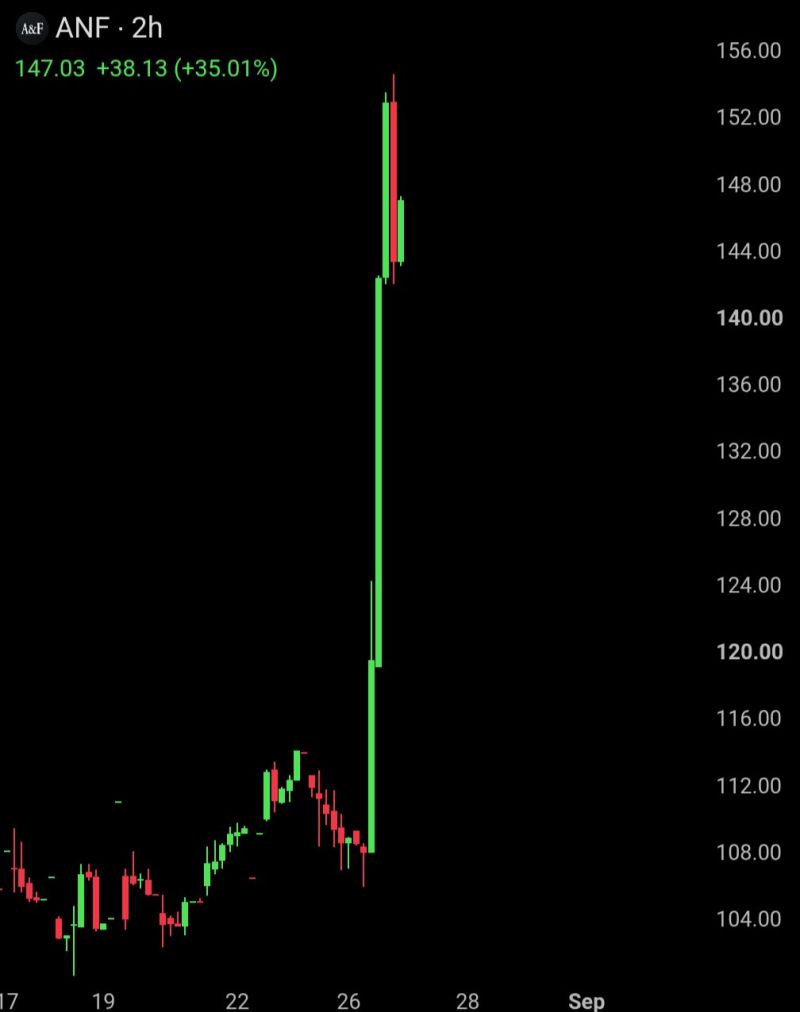
Abercrombie & Fitch just delivered a historic earnings surprise.
$ANF surged 35% yesterday, putting the stock on track for its biggest one-day gain in 30 years as a public company. Q2 EPS reached $4.17, more than double the $1.97 expected. A $100 million tariff refund added $1.75 per share, but even excluding that boost, EPS still came in at $2.42, comfortably above forecasts. The company also: Raised full-year EPS guidance by 27%, from $10.20 to $13.35 Increased planned share buybacks to at least $500 million Reported record Q2 revenue of $1.27 billion Extended its growth streak to 15 consecutive quarters Before today, the stock was down 26% year-to-date. One earnings report erased the entire decline and pushed $ANF to its highest level in 19 months. Sometimes, expectations matter more than headlines. Source: Trend Spider