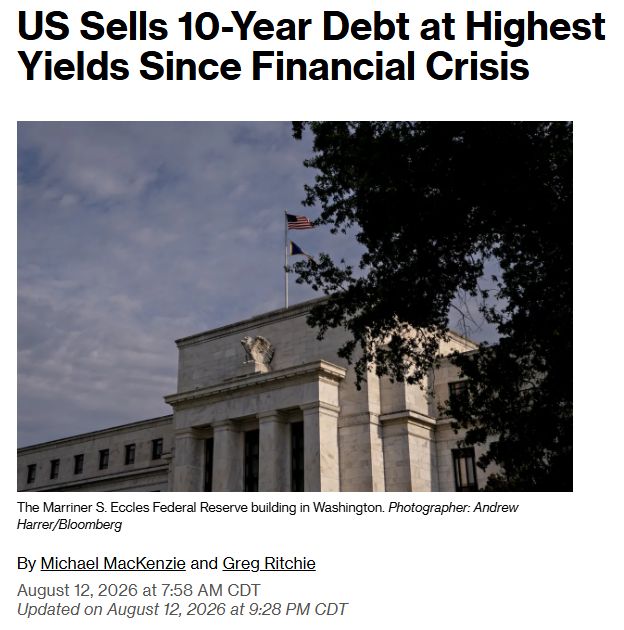
Yesterday, the 10-Year Treasury Note Auction drew an interest rate of 4.683%, the highest since the run-up to the Global Financial Crisis
Source: Barchart
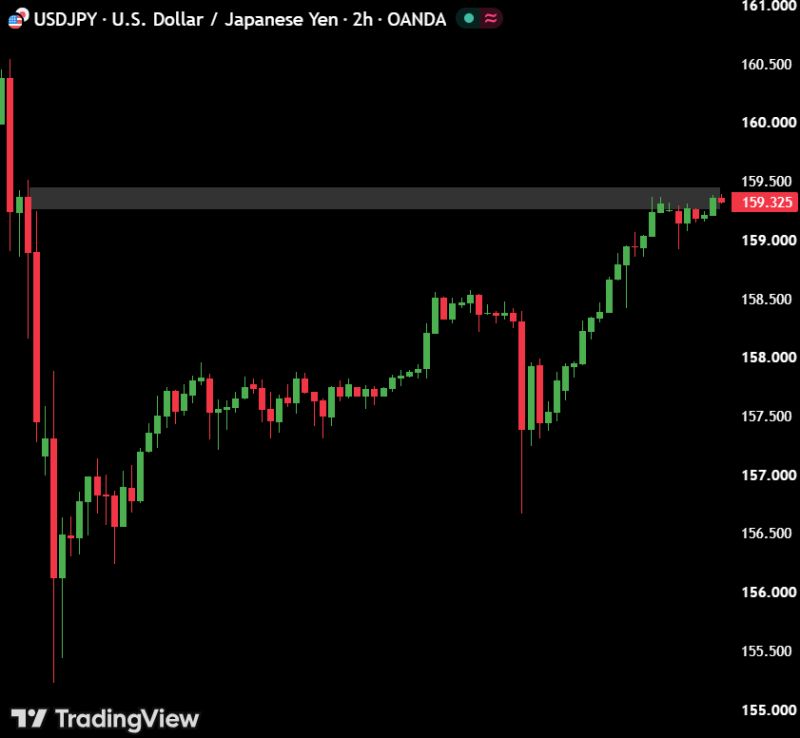
US intervention has failed this time
USD/JPY is now back to the same level where the US intervened to strengthen the yen. Also, USD/JPY rallied almost 0.9% yesterday, its biggest daily gain in 5 months. At this pace, we might see USD/JPY above 164 in a few weeks again. Source: The Macro Paper
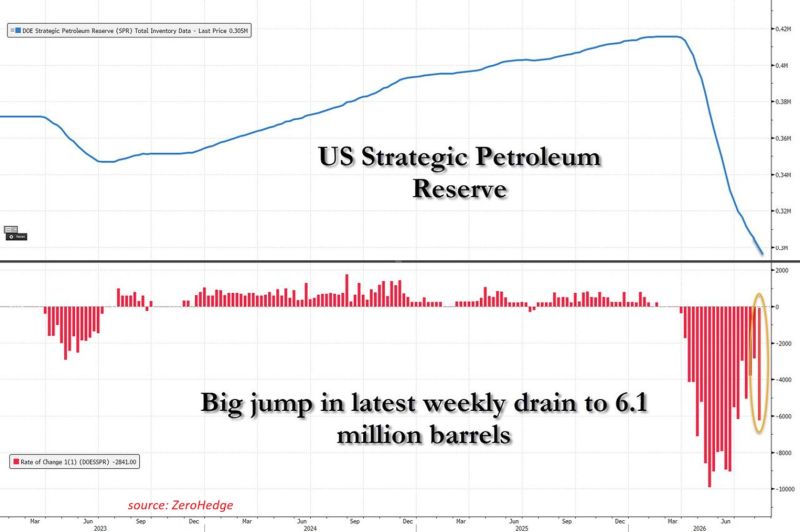
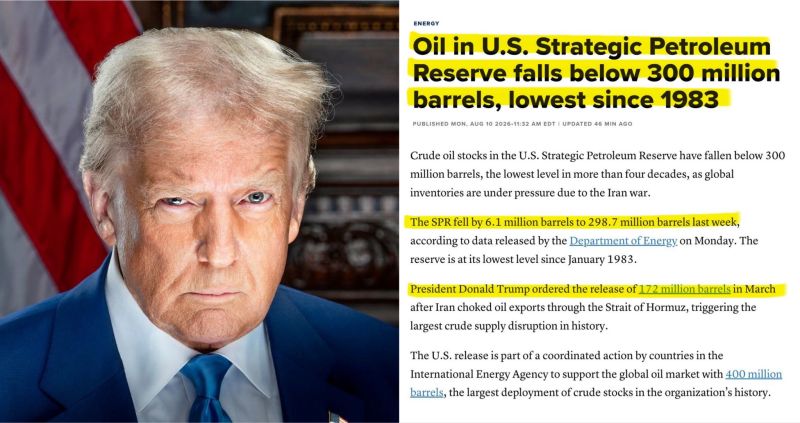
America’s strategic oil buffer is rapidly disappearing.
The U.S. Strategic Petroleum Reserve (SPR) fell by another 6.1 million barrels last week, dropping to 298.7 million barrels. That pushes the reserve below 300 million barrels for the first time since January 1983, and to its lowest level in more than 43 years. The pace of depletion is also accelerating: • Previous week: -2.8 million barrels • Latest week: -6.1 million barrels Since the Iran war began, Washington has relied heavily on the SPR to offset disruptions to global oil supplies and limit upward pressure on crude prices. But that strategy has a limit. The reserve is now entering the estimated 250–300 million barrel operational floor, where extracting additional oil can become increasingly difficult. At the current pace of withdrawals, the U.S. could move deeper into that critical range within weeks. The SPR was built as America’s emergency energy insurance policy. That insurance policy is getting dangerously thin. Source: Global Markets Investor, zerohedge
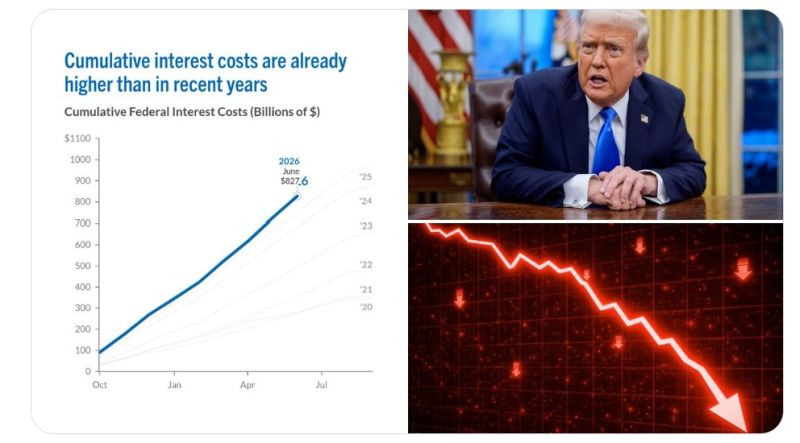
The US is now borrowing money to pay interest on money it already borrowed
US federal interest costs have reached roughly $2.85 billion per day, more than $1 trillion a year. That’s around 14% of federal spending and now rivals or exceeds some of Washington’s largest spending categories. Meanwhile, US national debt has crossed $40 trillion. The problem is not just the size of the debt. It’s the cost of refinancing it. The US continuously rolls over maturing debt by issuing new Treasuries. But much of that debt was originally issued when interest rates were significantly lower. Now it is being refinanced at much higher yields. The 30-year Treasury recently reached 5.27%, its highest level since 2007. That creates an increasingly uncomfortable cycle: Higher rates → higher interest costs → larger deficits → more borrowing → even higher interest costs. And this doesn’t stop in Washington. Treasury yields are the foundation of the US financial system. Higher government borrowing costs ultimately feed into mortgages, corporate debt, car loans and business investment. The debt problem is increasingly becoming an interest-rate problem. Source: Bull Theory
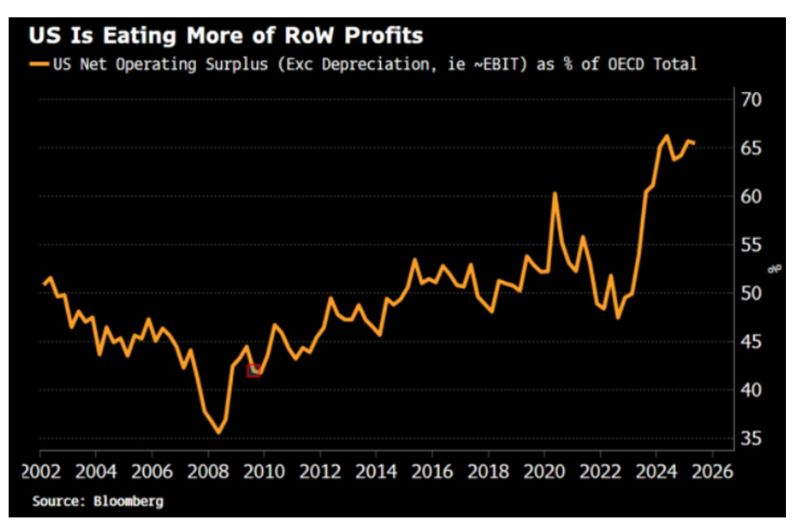
The US is generating almost 2/3 of OECD profits...
Warren Buffet: "Never bet against america" Source: Bloomberg
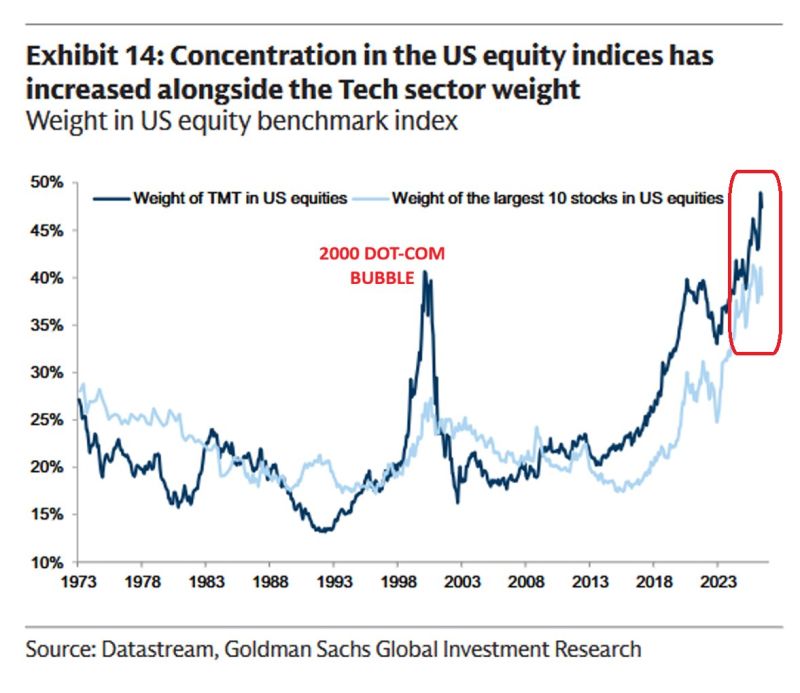
US stock market concentration is at unprecedented levels
US tech stocks now account for nearly 50% of US stock market capitalization, an all-time high. This is ~9 percentage points above the 2000 Dot-Com Bubble peak. The top 10 stocks alone represent a record 40% of the S&P 500's market cap, ~13 percentage points above the Dot-Com Bubble peak. Source: Global Markets Investor
The US Strategic Petroleum Reserve has fallen to 298.7 million barrels, its lowest level since 1983.
Since the Iran war began in February, Washington has repeatedly released emergency oil whenever oil prices surged to stop fuel costs from exploding. Source: Bull Theory
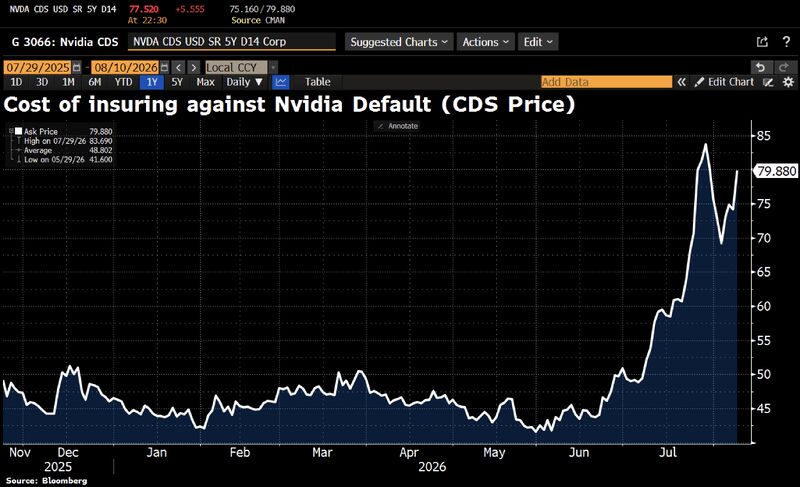
Wall Street is preparing to deploy $500 billion to help Nvidia’s customers buy Nvidia chips.
Jensen Huang calls compute “an investable asset.” But there’s another chart worth watching: Nvidia’s credit risk is rising. NVDA’s 5-year CDS has jumped nearly 6 basis points recently. More strikingly, the cost of insuring Nvidia’s debt has almost doubled since late May, rising from 41.6 bps to 77.5 bps—just below the July 29 record of 83.7 bps. At first glance, that seems counterintuitive. Nvidia could potentially unlock hundreds of billions of dollars of additional demand without putting that financing directly on its own balance sheet. That should be positive for Nvidia. But the CDS market may be highlighting the other side of the story: the AI boom is becoming increasingly dependent on leverage. More capital. More infrastructure. More financing. The demand is real—but so is the financial engineering supporting it. Source: Bloomberg, HolgerZ