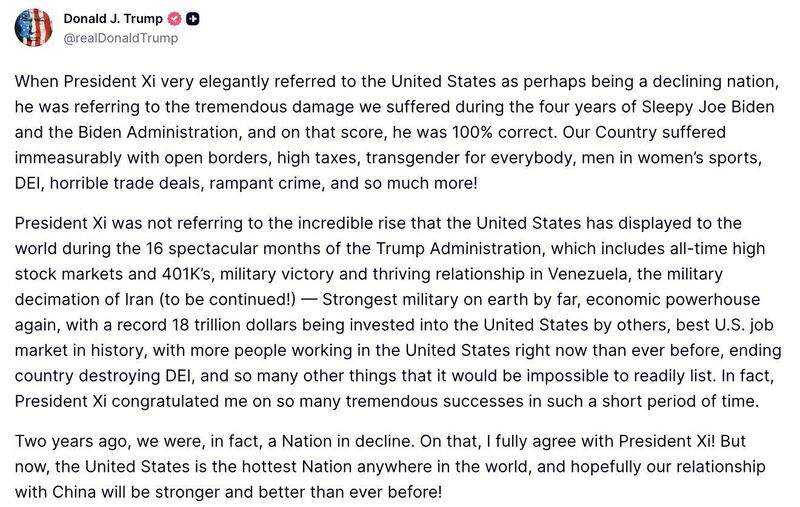

The dispersion of public market returns between sellers and buyers of AI.
Note however it feels weird to find Alphabet $GOOGL in the "loser" camp as the stock is up 130%+ over the last 12 months. Some buyers of product shortage are able to perform well as long as investors see clear evidence that its AI investments are turning into real revenue and profit growth — not just hype. Alphabet's cloud computing business has been delivering much better than expectations. Source: Tanay Jaipuria
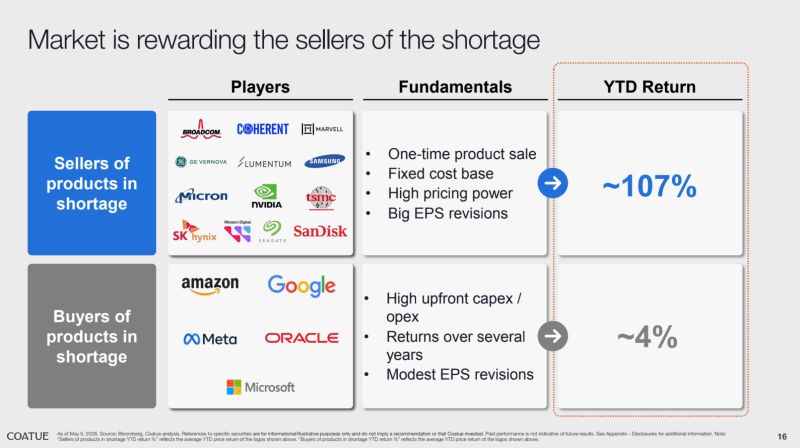
Two months after Trump announced that the US would provide insurance to ships seeking to transit the Strait of Hormuz, the programme has not provided a single dollar of cover.
The scheme never got off the ground, according to insurance brokers, as it did not fulfil all the requirements needed for ships transiting the strait and was tied to a US naval escort for vessels, which has not been established. Source: Alexander Stahel on X, FT
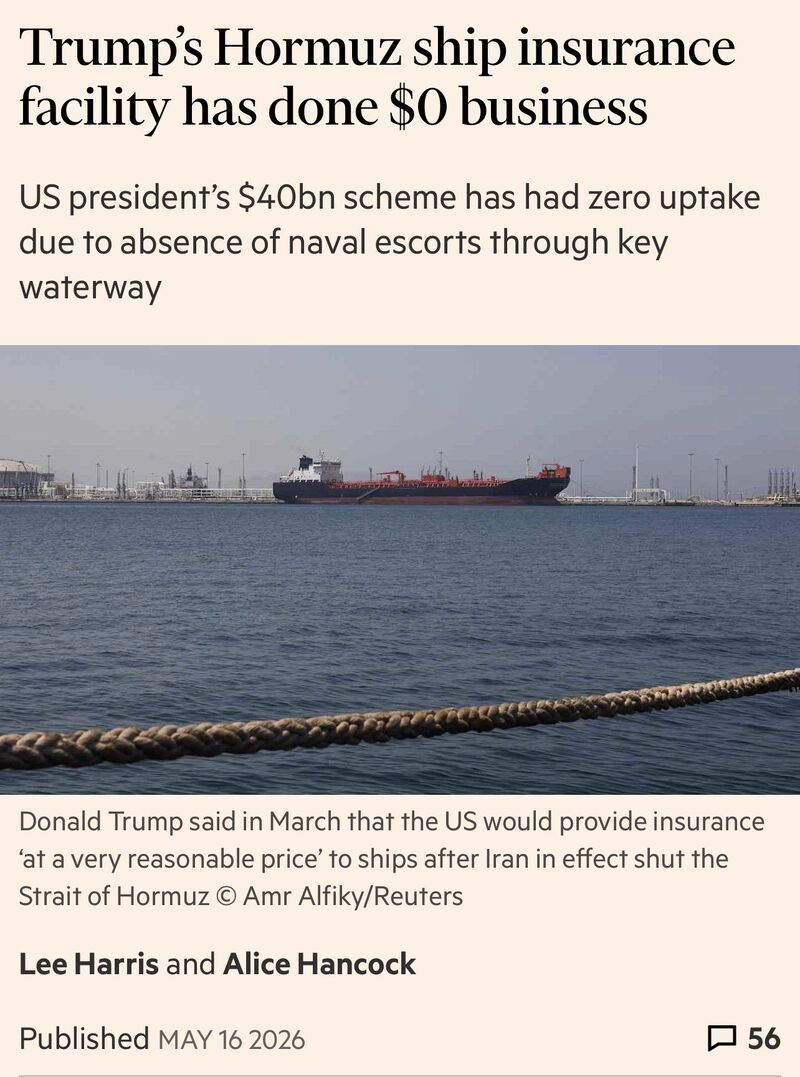
Goldman Sachs just updated its “Rule of 10” screen.
And the conclusion is clear: The strongest growth in the S&P 500 is still concentrated around AI infrastructure. Not consumer apps. Not speculative software. Infrastructure. ⚡ The screen focuses on companies expected to deliver >10% annual revenue growth from 2024–2028. The biggest projected winners for 2026? ➡️ Memory ➡️ Compute ➡️ Servers ➡️ Cooling ➡️ Storage ➡️ Networking Here’s where the growth is clustering: • Micron ($MU): +230% expected revenue growth AI demand is reshaping the memory cycle. High-bandwidth memory (HBM) and advanced packaging are becoming strategic bottlenecks. • Broadcom ($AVGO): +74% Custom AI chips, optical networking, VMware integration — one of the most diversified AI infrastructure plays. • Nvidia ($NVDA): +71% Still the dominant compute layer powering enterprise AI deployment at scale. But the AI stack goes far beyond semiconductors: • Super Micro ($SMCI): +68% AI server density demand remains explosive, despite profitability concerns. • Vertiv ($VRT): +33% Cooling and power are now mission-critical as GPU clusters scale. • Seagate ($STX): +29% AI creates massive storage demand through training data, inference logs, and cloud archives. • Arista Networks ($ANET): +27% Networking becomes essential as large-scale AI clusters increasingly rely on high-performance Ethernet fabrics. What stands out most: AI is no longer just a software story. The real bottlenecks — and the strongest projected growth — sit inside the physical infrastructure layer powering the AI economy. Goldman’s screen also highlights a second theme: Platform + healthcare compounders. • DoorDash ($DASH) → logistics scale • Axon ($AXON) → public safety software • Meta ($META) → AI-driven ad monetization • Eli Lilly ($LLY) & Insulet ($PODD) → durable healthcare demand The market narrative may evolve. But for now, capital expenditure still follows one core reality: No AI revolution without infrastructure. Source: Sergey
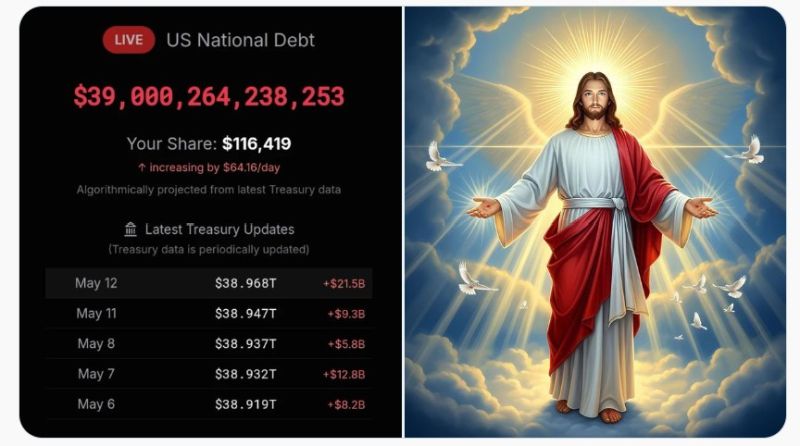
Interesting statistic: If you spent $10 million every day since Jesus was born, you would’ve spent $7.4 trillion. The US debt is $39 trillion.
Of course. it does not account for inflation. The $7.4 trillion figure is in nominal dollars, as if someone spent today’s $10 million every day for ~2,026 years. If you adjust for inflation, the comparison becomes messy because: - Dollars did not exist for most of that period. - Inflation data only exists meaningfully for recent centuries. “$10 million per day” could mean either: -> $10 million in today’s purchasing power each day, or -> $10 million nominal dollars each day, which is unrealistic historically. It still shows that today’s U.S. debt is over five times larger than that total. Source: Bull Theory
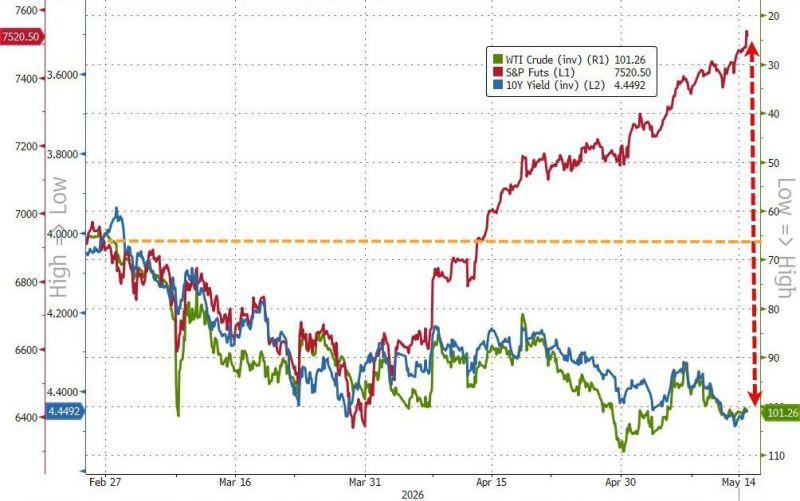
US stocks have completely decoupled from oil & bonds...
Source: www.zerohedge.com, Bloomberg
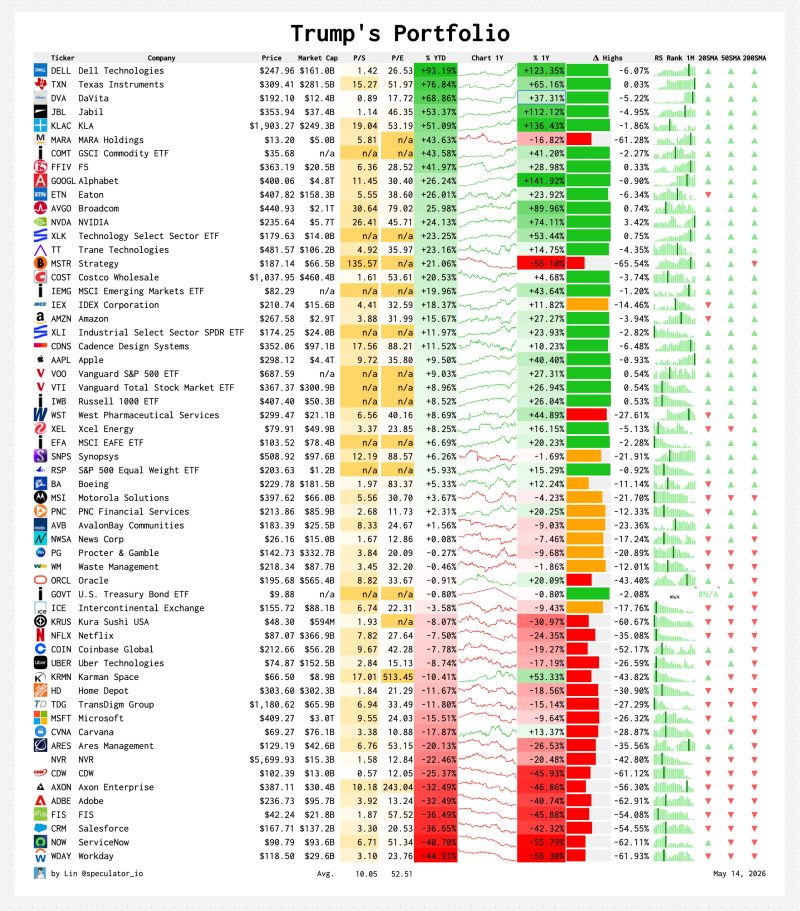
PRESIDENT TRUMP'S Q1 STOCK DISCLOSURE COVERS 3,800+ TRANSACTIONS. THE LARGEST: $5M-$25M SALES EACH OF META, AMAZON, AND MICROSOFT ON 2/10.
The OGE 278-T was filed May 8 and certified by the Office of Government Ethics on May 13. This is Trump's personal portfolio: $AVGO Broadcom $DELL Dell $TXN Texas Instruments $DVA DaVita $JBL Jabil $KLAC KLA $COMT GSCI Commodity ETF $FFIV F5 $GOOGL Alphabet $ETN Eaton $NVDA NVIDIA $XLK Technology Select Sector ETF $TT Trane Technologies $COST Costco $IEMG MSCI Emerging Markets ETF $IEX IDEX $AMZN Amazon $XLI Industrial Select Sector SPDR ETF $CDNS Cadence Design Systems $AAPL Apple $VOO Vanguard S&P 500 ETF $VTI Vanguard Total Stock Market ETF $WST West Pharmaceutical $IWB Russell 1000 ETF $XEL Xcel Energy $EFA MSCI EAFE ETF $SNPS Synopsys $RSP S&P 500 Equal Weight ETF $BA Boeing $MSI Motorola $NWSA News Corp $MSTR Microstrategy $ORCL Oracle $WM Waste Management $GOVT U.S. Treasury Bond ETF $ICE Intercontinental Exchange $MARA MARA $NFLX Netflix $UBER Uber $KRMN Karman Space $HD Home Depot $TDG TransDigm $MSFT Microsoft $CVNA Carvana $COIN Coinbase $AXON Axon $ADBE Adobe $CRM Salesforce $NOW ServiceNow $WDAY Workday Source: Lin
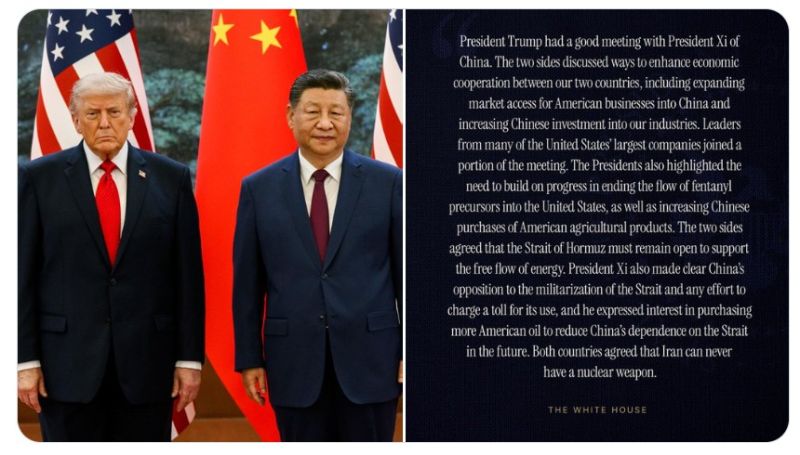
TRUMP-XI JUST PUBLISHED THE EXACT LIST OF WHAT THEY AGREED ON ABOUT IRAN AND HORMUZ
Not vague summaries. Not "productive talks." NAMED COMMITMENTS. SPECIFIC POINTS. Item by item. 🇺🇸 US companies get expanded access to Chinese markets — signed off in Beijing, May 14 🇨🇳 China increases investment into the United States 🇺🇸 China cracks down harder on fentanyl flowing into America 🌾 China buys more American agricultural products 🛢 Hormuz Strait must stay open — both sides committed in writing ⚓ China explicitly opposes militarization of the Strait of Hormuz ⛽ China opposes anyone charging tolls to pass through Hormuz 🛳 China will buy MORE American oil specifically to reduce its own dependence on the Hormuz route ☢️ Both sides agree: Iran cannot have nuclear weapons 💀 9 named commitments 💀 ZERO quantitative targets in the readout 💀 ZERO new enforcement board created 💀 100% of the Hormuz points exist because Iran nearly shut the world's oil supply in February 2026 Source: Ronald Carter on X
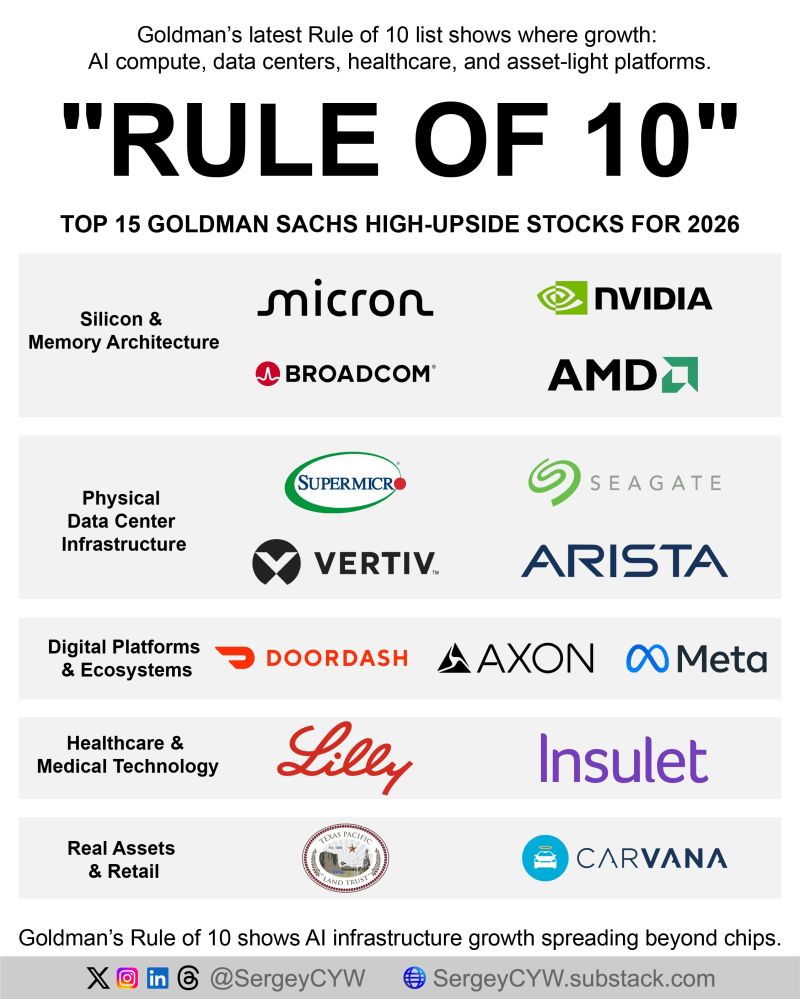
Trump publicly described Xi Jinping calling the U.S. “perhaps a declining nation,” agreeing that Biden-era policies weakened America while portraying his own presidency as restoring strength.
He highlighted military pressure on Iran, adding “(to be continued!),” which analysts interpret as signaling the Iran conflict remains unresolved. Trump also said Xi privately pledged not to send military equipment to Iran and offered help securing stability in the Strait of Hormuz. Source: Shanaka Anslem Perera ⚡