Straight from the Desk
Syz the moment
Live feeds, charts, breaking stories, all day long.
- All
- equities
- United States
- Macroeconomics
- Food for Thoughts
- markets
- bitcoin
- Central banks
- geopolitics
- Fixed Income
- europe
- gold
- Asia
- Commodities
- investing
- AI
- Technology
- technical analysis
- Crypto
- nvidia
- china
- ETF
- earnings
- oil
- Forex
- energy
- banking
- Volatility
- Real Estate
- magnificent-7
- Alternatives
- apple
- emerging-markets
- tesla
- switzerland
- Middle East
- amazon
- United Kingdom
- assetmanagement
- microsoft
- ethereum
- russia
- meta
- Industrial-production
- ESG
- Healthcare
- Global Markets Outlook
- bankruptcy
- Turkey
- brics
- Market Outlook
- africa
- performance
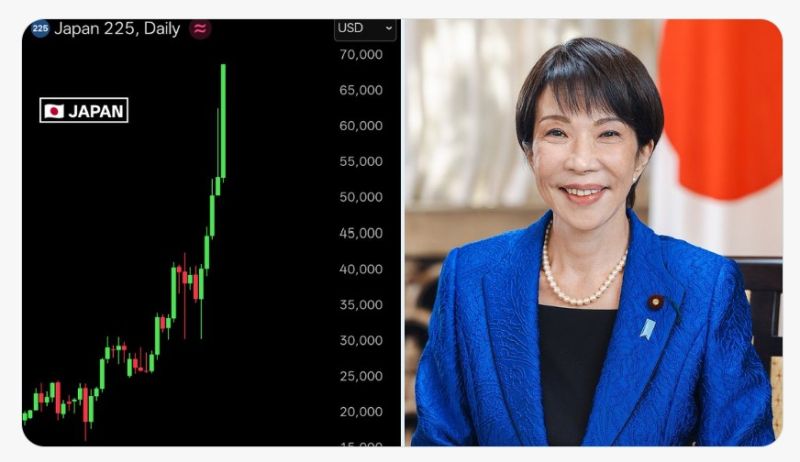
🚀 Japan just dropped a $110 BILLION economic stimulus — its boldest move in years.
And it’s coming with a major shift in strategy. New Prime Minister Sanae Takaichi isn’t tiptoeing around slow growth or budget pressure. She’s going all-in with: ✅ Tax cuts ✅ Help with rising utility bills ✅ Direct support to local communities — even food aid But here’s the real story 👇 Japan isn’t just trying to ease short-term pain. It’s placing massive strategic bets on the industries that will define the next decade: 💡 Artificial Intelligence 🔧 Semiconductors 🚢 Shipbuilding 🛡️ Defence & advanced manufacturing This is about future-proofing Japan’s global competitiveness — especially in Asia’s fast-moving tech ecosystem. 💼 What does this mean for investors? This stimulus could be a major tailwind for: 📈 Japanese equities 🛍️ Consumer-focused sectors 💻 Tech, AI, and semiconductor plays But there’s a twist: expect some yen volatility. With the government coordinating closely with the Bank of Japan to keep interest rates low, markets will be watching every move. 🔍 The big question Will this $110B push spark sustained long-term growth — or just a short-lived burst of momentum? The world is watching closely. Because how Japan executes this plan could reshape Asia’s tech supply chains and become a blueprint for how far government spending can go in revitalizing an economy. Source: StockMarket.news
Hong Kong’s IPO Comeback
Chinese IPOs in America have collapsed 93% since 2021, raising just $875 million this year vs. $13 billion at the peak. Meanwhile, Hong Kong is reaping the rewards — Chinese listings there surged 164% to $18.4 billion across 56 deals. The turning point came after Beijing’s regulatory crackdown on Didi’s 2021 New York debut — a short-lived listing that ended with a forced delisting. Since then, companies in “strategic industries” face a regulatory maze for U.S. approval. The Nasdaq has raised the bar with a $25 million minimum for Chinese IPOs, while Hong Kong introduced its “Technology Enterprises Channel” to fast-track tech listings. source : cnbc
Sanae Takaichi on Tuesday created history, winning Japan’s parliamentary vote to become the country’s first woman prime minister, with domestic stock markets cheering her ascendancy.
Takaichi garnered 237 votes in the first round of voting, negating the need for a runoff vote in the 465-seat Lower House, according to public broadcaster NHK. Her victory comes after the ruling Liberal Democratic Party allied with the Japan Innovation Party and reportedly signed an agreement over the weekend to form a coalition government. Takaichi agreed to back JIP policies such as a reduction in parliamentary seats, free high school education and a two-year pause on food consumption tax, according to Reuters. Source: CNBC
Japan 30-Year Bond Yield jumps to 3.29%, the highest level in history.
Source: Carl ₿ MENGER @CarlBMenger
Big drop in U.S. student visas to Asia - India down 43.5%
New data shows a major decline in U.S. F-1 student visas issued in H1 2025, with total visas falling 14.7% year-over-year. India saw the steepest drop: down 43.5%. China fell 24.1%, Nepal 17.1%, and South Korea 18.4%. Vietnam was the only major country to increase, up 19.6%. Source: Statista, U.S. Department of State, ApplyBoard thru Mario Nawfal on X
BREAKING: The Bank of Japan announced that it will leave its benchmark interest rate on hold
The decision was widely expected amid political uncertainty stemming from the resignation of PM Shigeru Ishiba. BUT HERE'S THE BIG NEWS: The Bank of Japan has decided to begin SELLING its ETF holdings. The BOJ is the largest shareholder of ~70% of large listed stocks in Japan; if it really does this, it will put downside pressure on Japanese stocks. The planned pace of sales is based on an annual book value of ¥330 billion. As of June 2025, the BOJ’s ETF balance stood at a book value of ¥37.1861 trillion. The stock market is already asking the BOJ: “are you sure bro?” - see chart below. Best of luck to the BOJ plan to sell stocks when the BOJ IS THE MARKET.
Investing with intelligence
Our latest research, commentary and market outlooks