
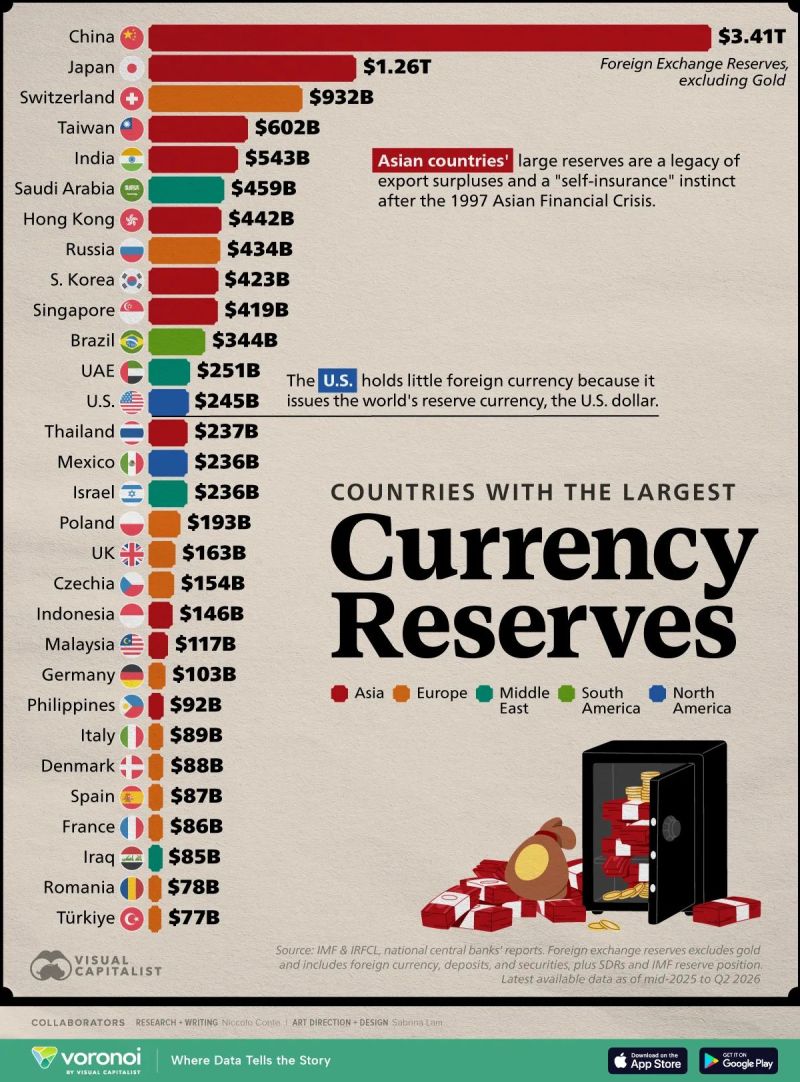
Ranked: Countries with the Largest Currency Reserves
China holds over $3.4 trillion in foreign exchange reserves, nearly 3x more than Japan. Seven of the world’s 10 largest reserve holders are in Asia, reflecting decades of export-led growth. Despite being the world’s largest economy, the U.S. ranks only 13th because the dollar is the world’s primary reserve currency. Source: James Wong, Visual Capitalist
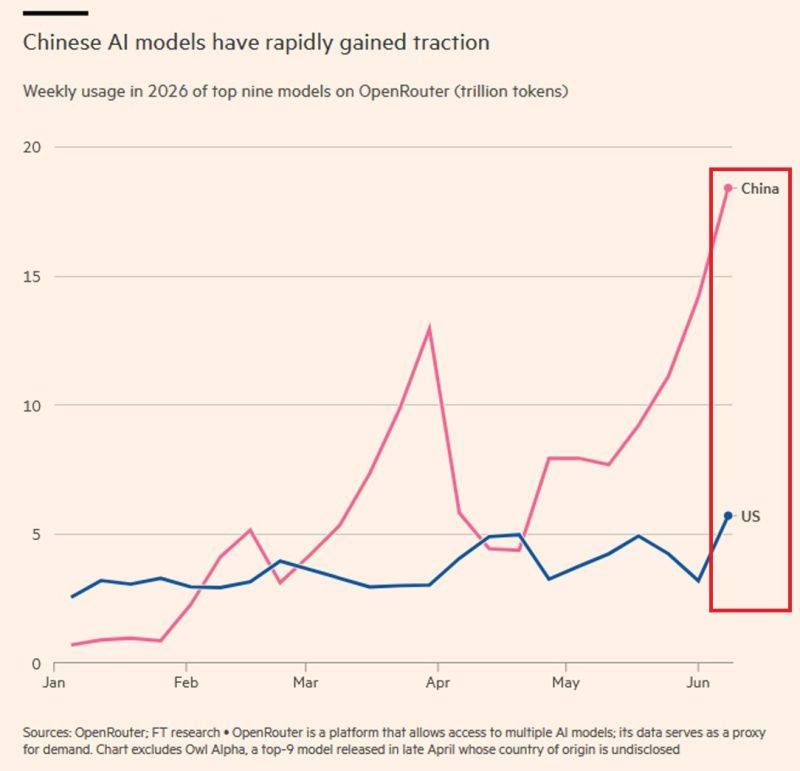
🚨 The AI race is entering a new phase.
Not because demand is slowing. Because costs are becoming impossible to ignore. Here are the numbers: 📈 Chinese AI models now process ~18.5 trillion tokens per week on OpenRouter. 🇺🇸 US models? Around 6 trillion. That's a 3x gap. Why? • Lower energy costs. • More efficient models. • Aggressive pricing that's reshaping the competitive landscape. Meanwhile, something interesting is happening inside large enterprises. Companies including Amazon, Walmart, Cisco, Uber, and Meta are reportedly introducing internal limits on AI usage as spending exceeds expectations. One striking example: A software company saw its AI bill jump 7x overnight after moving from a flat-rate subscription to usage-based pricing. Suddenly, the true cost of AI became visible. And this is only the beginning. 📊 Goldman Sachs estimates AI agents could increase token consumption by 24x by 2030. That creates a fundamental challenge: AI demand may keep exploding... while AI budgets become increasingly constrained. The next competitive advantage won't just be building the smartest models. It will be building the most cost-efficient ones. The AI story is evolving: ➡️ From "Who has the biggest model?" ➡️ To "Who delivers the lowest cost per useful output?" The winners of the next AI wave may not be those with the most compute... ...but those who make intelligence affordable at scale. Do you think AI spending is finally reaching a reality check, or is this just a temporary pause before the next investment wave? Source: FT, Global Markets Investors
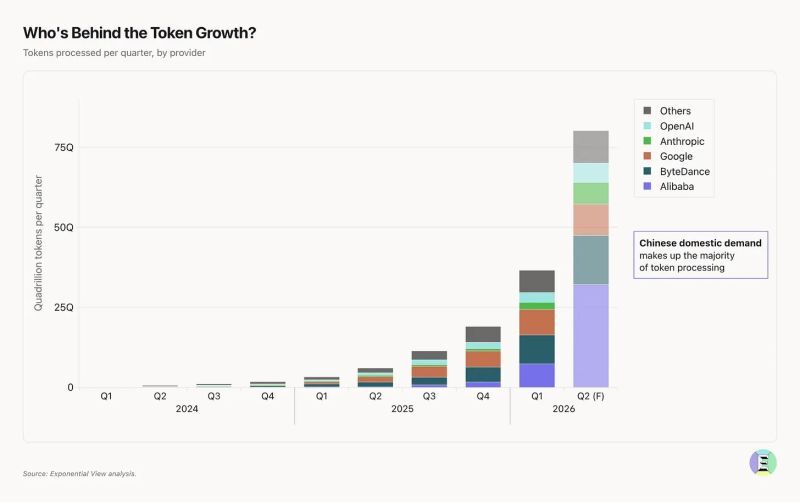
The number of tokens processed per quarter has grown by about 17,000x over four years.
Chinese domestic demand accounts for most of that growth. Source: Azeem Azhar
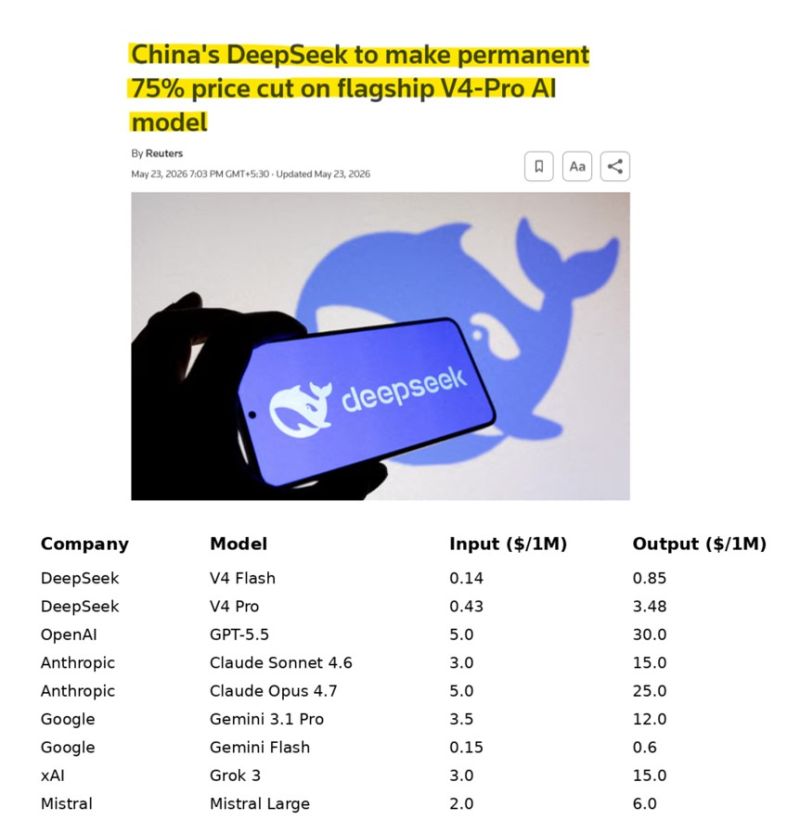
DeepSeek is now up to 50x CHEAPER than OpenAI and Anthropic for AI tokens.
DeepSeek’s massive price cuts have made its AI token costs up to 50x cheaper than OpenAI and Anthropic, reshaping enterprise AI economics. Since hashtag#AI costs scale with token usage, companies running coding agents or reasoning-heavy models can spend millions—or even billions—annually. More advanced models consume huge hidden “reasoning” tokens, dramatically increasing compute costs. This is pushing firms toward cheaper, optimized models and tools, with companies like Microsoft and Uber already feeling budget pressure. The key competitive advantage in AI may shift from having the smartest model to delivering “good enough” AI at the lowest scalable cost. Source: Bull Theory
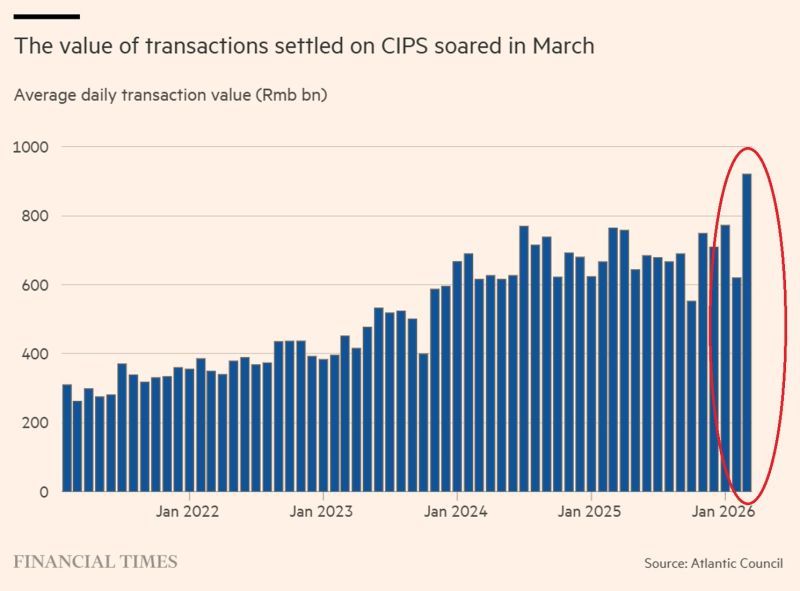
The Iran war is accelerating the rise of the Chinese yuan in global trade:
China’s Cross-Border Interbank Payment System (CIPS) has grown rapidly, with daily transactions rising from about 300 billion yuan in 2021 to a record 920 billion yuan in March 2026, briefly peaking at 1.22 trillion yuan in April. Created in 2015 as an alternative to Western payment networks, CIPS is increasingly used by sanctioned countries like Russia and Iran for energy trade. Saudi Arabia is also expanding renminbi-based oil transactions with China, boosting “petroyuan” speculation, though the US dollar still dominates global oil trade.
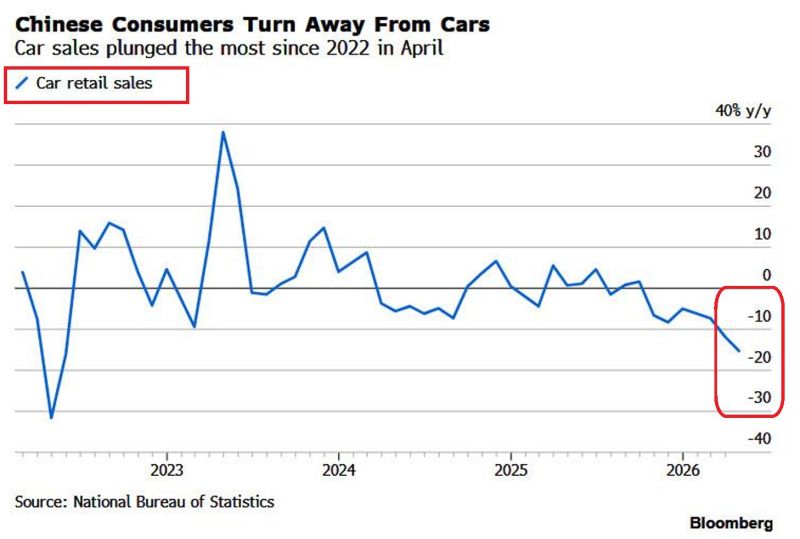
What is happening in China?
Car retail sales plunged -15% YoY in April, the steepest decline since mid-2022, according to China's National Bureau of Statistics. Home appliance and furniture purchases fell at a double-digit pace, while gold, silver, and jewelry sales collapsed -21% YoY. Overall retail sales rose just +0.2% YoY in April, the weakest reading since December 2022, while fixed-asset investment fell -1.6% in the first 4 months of 2026, returning to contraction. The April data suggest GDP could expand as little as +4.1% YoY in Q2 2026, which would represent a significant miss of Beijing's official growth target of 4.5% to 5% China's economy is struggling. Source: Global Markets Investor
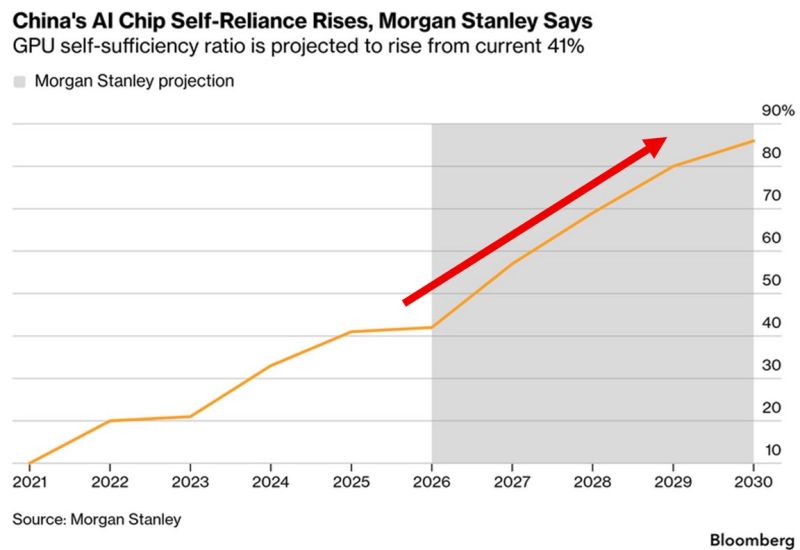
China is moving fast to replace foreign AI chips with domestic ones:
China's AI chip self-sufficiency ratio has risen from ~10% in 2021 to 41% in 2026, a more than 4 times increase in just 5 years, per Morgan Stanley. This ratio shows how much of China’s AI chip demand is filled by local production instead of imports. Morgan Stanley projects this ratio will rise further to ~86% by 2030, meaning China could meet nearly all of its AI chip demand domestically within 4 years. US export restrictions have accelerated China's push to develop domestic alternatives, and the results are advancing faster than most of the world expected. Source: Global Markets Investor
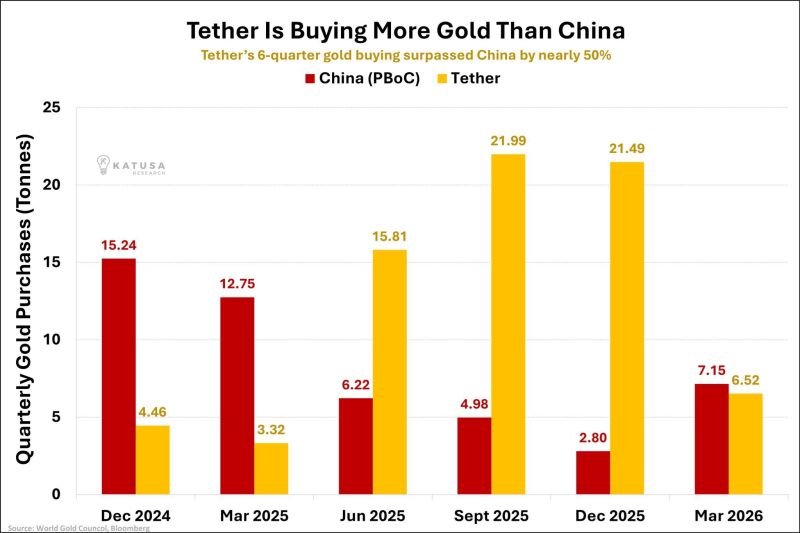
Tether is accumulating gold at a pace that rivals central banks
Tether purchased 6.5 tonnes of gold in Q1 2026, bringing total holdings to a record 132 tonnes. Over the last 6 quarters, Tether has purchased ~73 tonnes of gold in total, surpassing China's central bank purchases of ~49 tonnes over the same period by nearly +50%. Tether's gold holdings have more than DOUBLED over the last 12 months. In 2025, Tether acquired more gold than every central bank except Poland. Tether is now competing directly with central banks for gold. Source: Global Markets Investor