Straight from the Desk
Syz the moment
Live feeds, charts, breaking stories, all day long.
- All
- equities
- United States
- Macroeconomics
- Food for Thoughts
- markets
- bitcoin
- Central banks
- geopolitics
- Fixed Income
- gold
- europe
- Asia
- Commodities
- AI
- investing
- Technology
- technical analysis
- Crypto
- nvidia
- china
- ETF
- earnings
- oil
- Forex
- energy
- banking
- Real Estate
- Volatility
- magnificent-7
- Alternatives
- apple
- emerging-markets
- tesla
- switzerland
- Middle East
- amazon
- United Kingdom
- assetmanagement
- microsoft
- ethereum
- russia
- meta
- Industrial-production
- ESG
- Healthcare
- Global Markets Outlook
- bankruptcy
- Turkey
- brics
- Market Outlook
- africa
- performance
OPENAI AND MICROSOFT $MSFT JUST ANNOUNCED AN AMENDED PARTNERSHIP AGREEMENT
Here's what changes: ➡️ Microsoft will no longer pay a revenue share to OpenAI ➡️OpenAI can now serve its products to customers across any cloud provider ➡️Microsoft continues to participate in OpenAI's growth as a major shareholder and retains a license to OpenAI IP through 2032 ➡️Revenue share payments to Microsoft continue through 2030 Source Reuters / Evan on X
Meet the first clear casualty of AI disruption: Chegg.
Once a go-to platform for homework help and textbook rentals, it’s now in steep decline—its stock has collapsed nearly 99%, trading under $1 with a market cap around $100 million. Revenue has fallen dramatically from its 2022 peak, signaling a rapid unraveling of its core business. The shift is simple: tools like ChatGPT didn’t just compete with Chegg—they made it obsolete. When students can get instant, high-quality answers for free (or far less), the old model struggles to survive. This isn’t just one company’s story—it’s a turning point where AI disruption became real, fast, and unforgiving. So the real question is: who’s next?
TRILLION DOLLAR BABY...
OpenAI's pre-IPO valuation has officially hit a record $1 trillion. Pre-IPO instruments trading onchain, backed 1:1 by SPV exposure on Jupiter, are providing a real-time proxy for the company’s implied IPO valuation. OpenAI’s implied valuation is now up +163% since October 2025. This comes as Anthropic is also nearing a potential $1+ trillion IPO and SpaceX is reportedly targeting $1.7+ trillion. The world has never had this many trillion-dollar private companies... Source: The Kobeissi Letter
Jensen Huang shared a simple framework for understanding the entire Al economy the "Five-Layer Al Cake."
His message is clear: Al is no longer just software. It's becoming foundational infrastructure, similar to electricity or the internet. The 5 Layers of the Al Economy 1) Energy - The Power Behind Al Al requires massive electricity to run data centers and train models. This is why nuclear, renewable energy, and power infrastructure are becoming critical to the Al race. 2) Chips - Turning Power Into Compute Al chips convert electricity into computing power. Leaders like NVIDIA, TSMC, and Broadcom. dominate this layer with GPUs, advanced semiconductors, and high-bandwidth memory. 3) Infrastructure - The Al Factories Massive GPU clusters and cloud data centers coordinate tens of thousands of chips to "produce intelligence." Neo-Cloud leaders like Oracle, Nebius, Coreweave and Iren are building the backbone of Al compute. 4) Models - The Al Brain Large models process data and generate intelligence across language, science, robotics, and simulations. Competition is intensifying between companies like Meta, Microsoft, Amazon and Alphabet. 5) Applications - Where Value Is Created The top layer is where Al transforms industries: autonomous driving, Al agents, robotics, enterprise software, and more.
The US data center buildout is falling behind schedule:
Nearly 40% of US data center projects due to complete in 2026 are AT RISK of missing their deadlines by more than 3 months, according to SynMax satellite analysis and IIR Energy data. More than 60% of projects scheduled for 2027 have yet to begin construction as of April 2026. The 2027 pipeline alone represents ~50 gigawatts of planned capacity, equivalent to the output of ~50 nuclear reactors, with the majority still showing no construction activity, according to SynMax Vulcan Platform and IIR Energy. The primary constraints are chronic shortages of specialist labor, gas turbines, and transformers, along with permitting hurdles that are pushing labor costs up as much as +30% in remote locations. Is the US data center 'boom' hitting the wall? Source: Global Markets Investor, FT
The power of the AI trade...
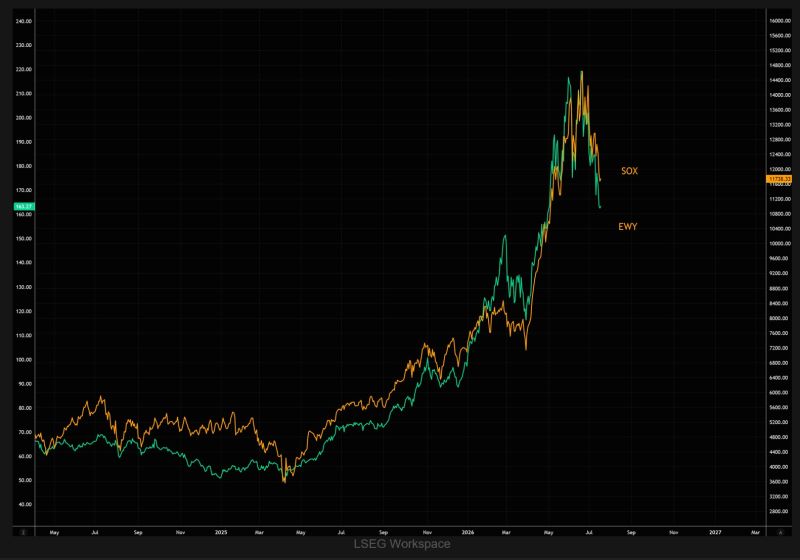
While Taiwan’s $977 billion economy is less than a quarter of the UK’s $4.3 trillion, last week Taiwan overtook the UK in stock market capitalization at $4.14 trillion, making it the world’s seventh largest, according to data compiled by Bloomberg showing the combined value of companies with a primary listing on the island. The UK’s market was valued at around $4.09 trillion. Source: Bloomberg, Neil Sethi
Looking for a "Anthropic proxy"?
It seems that SK Telecom ($SKM) offers stronger exposure to Anthropic than Zoom ($ZM) due to a larger and more valuable stake. SKM owns ~1.07% versus ZM’s ~0.6%, making its holding worth about $8.6B vs. $4.8B at an $800B valuation. As a result, Anthropic represents a much bigger portion of SKM’s valuation. Investors effectively get more Anthropic exposure per share with SKM, while its core business appears undervalued. Despite recent gains, SKM is still seen as a better proxy for Anthropic ahead of a potential IPO. Source: Negligible Capital
ChatGPT vs Gemini vs Claude vs Grok vs DeepSeek.
Everyone’s asking, “Which one’s the best?” Truth is: there’s no single winner. Each AI has its own lane. Source: AI Evolution
Investing with intelligence
Our latest research, commentary and market outlooks